Welcome to Cherry Times




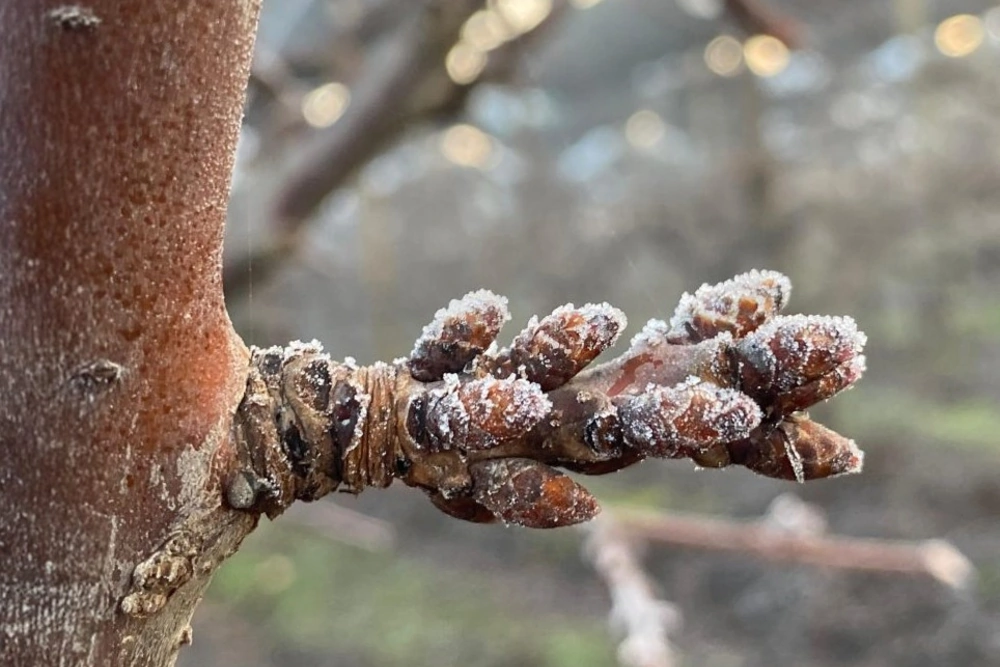 Source: Redagricola
The onset of dormancy and the quality of winter rest have become strategic parameters for anticipating an orchard’s production potential. According to the Abud & Cía. team, understanding these processes makes it possible to estimate fruit load before bud break and guide the agronomic decisions that determine the balance between yield, fruit size and profitability.
In cherry production, attention tends to focus on spring, when flowering, fruit set and fruit development guide agronomic decisions. For good reason: this is the stage when much of the season’s production potential is determined.
For Abud & Cía., however, the process begins several months earlier, in autumn, when the tree starts the physiological processes that will shape its response to the demands of spring.
Critical variables are established during this period, including bud quality, the state of reserves and the ability to accumulate winter chill. The yield equation brings these elements together to estimate the orchard’s potential and guide agronomic decisions before bud break.
From this perspective, systematic data collection stops being an administrative task and becomes a management tool.
Without a technical history of the orchard, it is impossible to interpret physiological indicators correctly and accurately predict how each season will unfold.
The sweet cherry has one of the shortest production cycles among deciduous fruit species of commercial importance.
For most varieties, fewer than 80 days pass between flowering and harvest: in this short period, the tree must turn its physiological potential into high-quality fruit.
The short cycle leaves very little room to correct mistakes once spring begins.
Bud-break problems, poor fruit set and excessive crop load rarely originate at that point; in most cases, they result from physiological processes that began during the post-harvest period and the transition into dormancy.
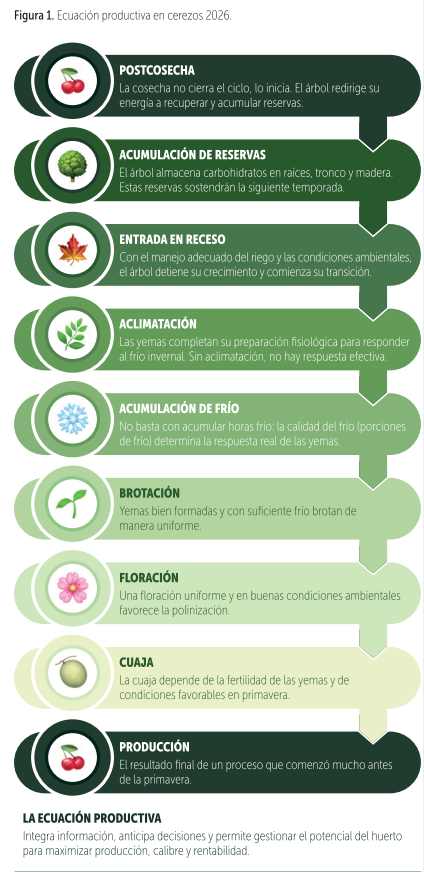
Before leaf fall, between summer and autumn, buds begin floral differentiation and form the primordia that will develop into flowers. Their quality depends directly on the tree’s physiological condition during this period.
If the tree is exposed to water stress, continues vegetative growth or delays its adaptation to winter, buds enter dormancy in suboptimal condition, compromising their reproductive potential.
These changes do not appear immediately. They emerge the following season as uneven bud break, lower fertility, poor fruit set, misshapen fruit and a reduction in production potential that is difficult to correct later.
From this perspective, harvest does not mark the end of the growing cycle, but the start of the next one. Winter does not create production potential; it only allows that potential to be expressed in spring.
Abud & Cía. regards the post-harvest period as a phase with a major agronomic impact, not a time when the orchard rests. Although visible activity declines after harvest, the tree remains physiologically active.
During the post-harvest period, the tree focuses its metabolism on building reserves of carbohydrates in its roots, trunk and permanent wood. These reserves provide the energy needed for bud break, flowering and early growth in the following season.
The scale of this process determines the orchard’s production behavior in the following campaign. A tree that builds adequate reserves enters winter in better physiological condition, promoting uniform bud break and more consistent flowering.
By contrast, a shortage of reserves negatively affects the next cycle from the outset.
The transition into dormancy is gradual and can be monitored through physiological indicators, such as changes in foliage color, which are associated with chlorophyll breakdown and the movement of nutrients into storage organs.
In this context, irrigation management is a decisive tool for regulating the process. Gradually shifting from irrigation intervals of two or three days to cycles of seven or eight days guides the tree from active growth toward the accumulation of reserves, without causing severe stress.
When environmental conditions extend the vegetative phase—as in warm autumns with persistent foliage—this adjustment becomes even more important. It helps promote leaf senescence and ensure a timely transition into dormancy, followed by the accumulation of winter chill.
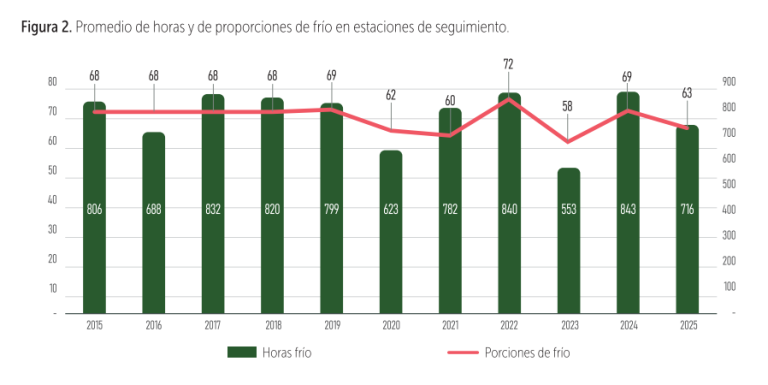
The accumulation of winter chill alone cannot explain an orchard’s production pattern.
Chill hours measure the time spent below a given temperature threshold. Chill portions, by contrast, account for both chill accumulation and the loss of chill during warm spells, making them a better representation of the tree’s physiological response.
Buds respond effectively to chill only after completing acclimation. If maximum temperatures remain high in April and May, the transition into dormancy slows, reducing the tree’s ability to respond to the chill available during winter.
Spring conditions also play a key role in final fruit set. In 2020, for example, winter chill accumulation was low in both quantity and quality.
Conditions during flowering, however, were highly favorable for bee flight and fruit set, resulting in a high-production season.
By contrast, in the previous season (25-26), winter chill requirements were generally met for most varieties.
Spring conditions were unfavorable, however: rain during flowering, low temperatures and insufficient solar radiation for bee flight led to a low-production season.
The yield equation combines the number of fruiting sites per hectare with the production coefficient to estimate the orchard’s potential yield.
When data on bud fertility are available, the estimate can be refined by adding the number of flowers, the fruit-set percentage and the projected fruit weight.
Counting fruiting sites provides the structural basis of the system. Spurs and shoots are the sweet cherry tree’s productive units and should be quantified using representative sampling, excluding structures with excessive vigor.
NDVI mapping (Normalized Difference Vegetation Index) makes it possible to divide the orchard according to vigor, select representative trees in each condition and reflect the actual variability of the block.
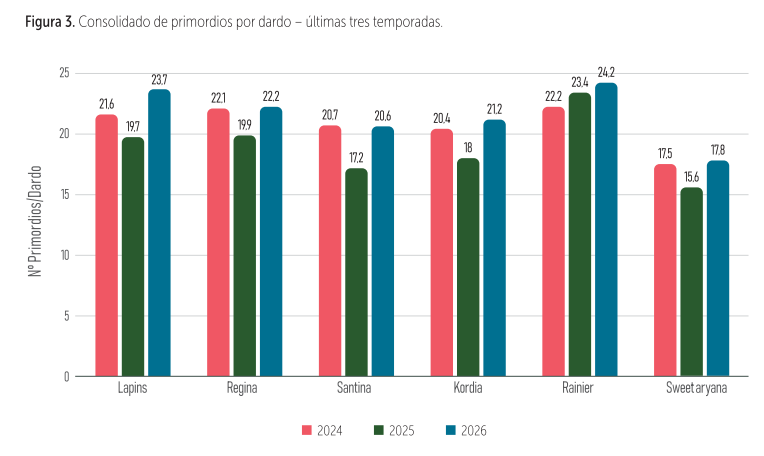
Bud fertility analysis adds the reproductive dimension to the system. Cross-sections can be used to count the floral primordia in each structure and refine the estimate of crop load potential.
Abud & Cía. has observed seasons in which, despite an equal number of fruiting sites, the number of primordia doubled. This substantially changed the yield forecast and crop-load adjustment decisions.
The production coefficient summarizes how the system performs. Expressed in grams per fruiting site, it incorporates the effects of variety, rootstock, area and the conditions of each season.
To interpret it, consistent historical data for each block are needed, since the coefficient depends heavily on the production and climate context.
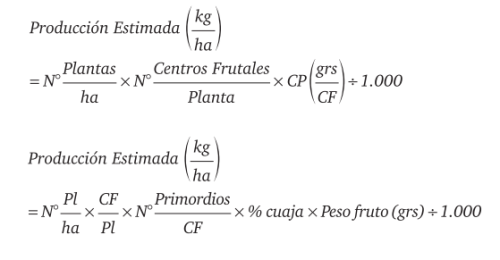
The value of the yield equation lies not in the estimate itself, but in the ability to make decisions at the right time.
If the projected crop load exceeds the orchard’s capacity and threatens fruit size, it should be regulated through fine pruning or by reducing fruiting sites in winter, while resource distribution can still be influenced.
If expected yields are low, the strategy can focus on preserving the crop load and optimizing operational efficiency.
For the 2026 season, the data analyzed by Abud & Cía. point to a favorable outlook. Chill accumulation through the end of June and adequate bud acclimation during autumn indicate, so far, normal conditions for fruit set.
In this context, precision in counting fruiting sites, analyzing bud fertility and assigning the production coefficient become decisive.
In sweet cherry, critical decisions are made not during flowering, but months earlier, during the post-harvest period and the transition into dormancy.
These are the stages when bud quality, the level of reserves and the ability to respond to winter chill are established, shaping how the tree’s production potential is expressed.
As fruit growing becomes increasingly guided by data, the challenge is to understand the processes that precede spring, as well as to respond to what happens then.
Winter rest is not a pause in the production cycle: it is a phase when much of the next season’s potential is built. In this context, the yield equation becomes a management model that can anticipate decisions and reduce uncertainty.