Welcome to Cherry Times




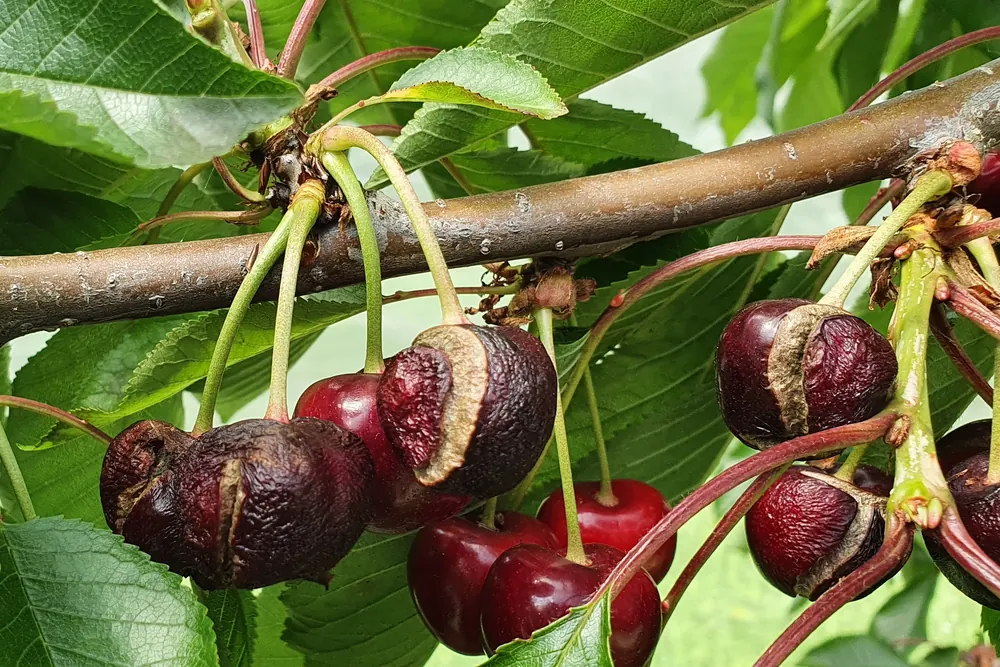
Cherry cracking management starts before the rain: it begins with the choice of plant material and continues with the regulation of fruit growth and crop load. As discussed in the first instalment, susceptibility develops as the fruit grows, and wetting can trigger a localised loss of integrity. Surface expansion, microcracking and the mechanical properties of the skin help explain why two cherries exposed to water may respond differently (Brüggenwirth and Knoche, 2016; Winkler et al., 2020; Knoche et al., 2025).
The agronomic implications are clear: the orchard needs to reach maturity with a less vulnerable variety combination and a crop load and water supply that support commercially sized fruit. Trials show that rootstock can reduce damage in some varieties, that heavy thinning can increase it, and that irrigation affects both cracking and fruit size. The preferred choice is therefore the one that improves the balance between yield, fruit integrity and size—not the one that maximises just one of these factors (Measham et al., 2012; Tersoglio and Setien, 2022; Blanco et al., 2022).
The first decision is to favour less susceptible varieties where rain regularly threatens the crop. Their advantage may come from greater fruit resistance under comparable exposure, or from a ripening period that avoids rainy events. Both reduce damage, but only the first describes intrinsic tolerance. Distinguishing between the two helps guide selection: field performance shows the local outcome, while trials using consistent wetting conditions help determine how much depends on the fruit itself (Measham et al., 2009; Winkler et al., 2020). Differences in the mechanical properties of the skin documented between ‘Regina’ and ‘Burlat’ provide a physiological basis for interpreting part of this varietal variation (Brüggenwirth and Knoche, 2016).
Comparative trials help quantify these differences in commercially relevant varieties. ‘Lapins’ had a lower cracking index than ‘Bing’ in both Apulia — 6.9 versus 30.3 — and Serbia — 19.5 versus 61.6. In Sarajevo, ‘Kordia’ and ‘Regina’ also showed lower indices than ‘Burlat’: 18.4 and 22.8, respectively, compared with 41.2. These results indicate relative tolerance under the immersion protocols used. The index weights how quickly cracks appear and should be read as a measure of experimental susceptibility, not as the percentage of the crop lost to rain (Greco et al., 2008; Milatović and Đurović, 2010; Stojanović et al., 2013).
To apply this information to an orchard, the next step is to compare it with damage observed in the region. Oregon State University classifies varieties using natural rainfall data from The Dalles between 2008 and 2018. There, ‘Bing’, ‘Brooks’, ‘Santina’ and ‘Skeena’ fall into the high-susceptibility group, while ‘Regina’, ‘Attika’ and ‘Lapins’ are classed as moderately susceptible. Table 1 therefore offers a selection of varieties that may carry lower risk, without treating their regional classification as an unchanging trait (Kaiser et al., 2019).
| Susceptibility | Varieties |
|---|---|
| High | Bing, Brooks, Rainier, Royal Edie, Royal Helen, Santina, Skeena, Utah Giant and Van. |
| High to moderate | Radiance Pearl, Sandra Rose, Sweetheart and Tieton. |
| Moderate | Attika (Kordia), Benton, Chelan, Coral Champagne, Cristalina, Ebony Pearl, Lapins, Regina, Royal Hazel, Samba and Tamara. |
| Low | Big Star, Black Pearl, Black Star, Blaze Star, Burgundy Pearl and Suite Note. |
Source: Kaiser, Long and Brewer (2019), Table 1, EM 9227, Oregon State University Extension Service. Adapted and translated with permission from Oregon State University. Natural rainfall in The Dalles, Oregon (2008–2018). The original categories for 30 varieties are retained; Early Robin and Selah, which appear in two categories, are omitted. Attika is the commercial name for Kordia. Regional classification: low susceptibility does not mean immunity. Original publication.
This perspective is particularly relevant in Chile, where ‘Santina’, ‘Lapins’ and ‘Regina’ account for more than three-quarters of the planted area in the latest census cycle analysed by ODEPA (Ovalle Reyes, 2026). Their commercial importance does not imply equivalent tolerance. INIA’s technical guide for southern Chile lists ‘Bing’ and ‘Van’ among the most susceptible varieties, and ‘Lapins’, ‘Sweetheart’, ‘Kordia’ and ‘Regina’ among the most tolerant, with particular emphasis on ‘Regina’. For that environment, the guidance favours these varieties over the more sensitive ones, although the guide does not quantify comparable losses for all of them (Ellena, 2012).
Spain also has references that can help guide variety selection. Table 2 lists 32 varieties included in Extremadura’s technical guidance, updated in March 2026. This regional assessment can be compared with immersion trials, which evaluate fruit response under consistent water exposure.
| Sensitivity | Varieties |
|---|---|
| Very sensitive | Royal Tioga, Nimba, Early Bigi, Early Lory, Sweet Aryana, Brooks, Celeste, Sweet Lorenz, Frisco and New Star. |
| Sensitive to very sensitive | Van. |
| Sensitive | Navalinda, Red Pacific, Royal Hazel, Royal Helen, Sweet Gabriel, Sweet Valina, Sonata, Lapins, Skeena, Sweet Stephany, Sweetheart, Staccato and Ambrunés. |
| Slightly sensitive | Burlat, Samba, Santina, 13S 3-13, Vera, Canada Giant, Sylvia and Somerset. |
Source: Junta de Extremadura (2026), Table 2, “Cracking or physiological disorders caused by rain” column. Selection of current varieties; obsolete varieties marked in blue are excluded. Sylvia is listed as “Silvia”. Regional technical guidance, not a percentage of loss.
Picota cherries provide an example of experimentally supported tolerance. At Aula Dei, Tabuenca and Cambra (1982) compared 28 varieties grafted onto SL 64 by immersing fruit close to maturity. The mean indices for 1981 and 1982 were 3.2, 4.9 and 6.1 for ‘Ambrunés’, ‘Pico Colorado’ and ‘Pico Negro’, respectively, compared with 49.1 for ‘Bing’ and 58.7 for ‘Burlat’; ‘Van’ recorded an intermediate value of 27.0. Calculated using the Verner method, the index weights when damage appears and is not equivalent to the percentage of the crop lost to rain. The response of the three picota varieties under the same wetting conditions provides an additional selection criterion alongside their late season, although its relevance to field conditions depends on local exposure (Tabuenca and Cambra, 1982).
Comparisons must preserve varietal identity. Germplasm bank records from La Orden-Valdesequera describe ‘Pico Colorado’ and ‘Pico Negro’ as highly resistant, but ‘Pico Limón Negro’ as poorly resistant. If cracking is a major consideration, this reference favours the first two over the latter, alongside assessments of productivity, quality and harvest timing (López Corrales, 2012).
Comparing the sources reveals discrepancies with practical implications. Extremadura’s guide classifies ‘Ambrunés’ as sensitive despite its favourable result in immersion tests, and ‘Burlat’ and ‘Santina’ as slightly sensitive, contrary to less favourable assessments in other regions or trials. For these varieties, local damage history should also inform planting decisions: transferring a classification directly from another environment can lead to the wrong choice (Tabuenca and Cambra, 1982; Kaiser et al., 2019; Junta de Extremadura, 2026).
IRTA’s results in Lleida show why local exposure matters. In Actel’s orchard, among the varieties assessed in 2024, ‘Sweet Aryana’ had more than 30% field cracking; ‘Sweet Lorenz’ exceeded 20%; ‘Sweet Gabriel’ exceeded 10%; and ‘Sonata’ remained below 5%. The last two varieties largely escaped rain close to harvest, yet still showed susceptibility when damage was induced in the laboratory. The comparison suggests planning protection for the most affected early varieties and assessing late varieties in light of local rainfall patterns (Lordan et al., 2025).
How the fruit is wetted also matters: immersion and continuous wetting can change a variety’s classification, as occurred with ‘Lapins’ (Michailidis et al., 2020). Wetting duration and surface area affect the response (Winkler et al., 2020). Variety selection is more robust when lower experimental susceptibility coincides with good local performance. Once the variety has been selected, the other part of the plant material remains to be chosen: the rootstock on which it will be grown.
Rootstock can affect damage, but its effect should be assessed in combination with the variety. Differences in cuticular microcracking have been observed among rootstocks, as have differences in cracking at harvest depending on the grafted variety (Hovland and Sekse, 2003; Tersoglio and Setien, 2022). Rootstock can therefore be included in prevention strategies: some combinations have demonstrated an advantage, but selection should be based on the specific response of each combination.
As a first guide, Oregon State University summarises variety × rootstock trials started in 2008 at The Dalles with this general order, from least to most susceptible: Krymsk 6, Krymsk 5, MaxMa 14, Gisela 6, Gisela 5, Mazzard and Mahaleb. Under comparable conditions, the guide lists Krymsk 6, Krymsk 5 and MaxMa 14 among the options to prioritise when assessing cracking. This is a regional extension summary that notes the dependence on variety and should be considered alongside soil adaptation and productivity (Kaiser et al., 2019).
Trials of specific combinations help refine this guidance. In ‘Celeste’, a specific selection of P. mahaleb, SL 64, was among the rootstocks with the least damage in the Argentine trial. The result shows why selection should be based on the combination and growing environment, rather than automatically applying a general rootstock classification.
In Mendoza, Tersoglio and Setien (2022) compared eight rootstocks over three harvests. With ‘Celeste’, SL 64, MxM 60 and Weiroot 13 had fewer split fruit than the other rootstocks; CAB6P had the highest value, while Gisela 5 and Gisela 6 were intermediate. With ‘Bing’, by contrast, the mean values for the eight rootstocks did not differ significantly (Table 3). The same experiment therefore shows where a rootstock preference can be based on cracking and where this criterion does not distinguish between them.
| Rootstock | Celeste | Bing |
|---|---|---|
| MxM 60 | 15.2 b | 9.42 a |
| SL 64 | 15.5 b | 7.22 a |
| Weiroot 13 | 17.1 b | 9.13 a |
| Gisela 6 | 19.6 c | 10.2 a |
| Adara–Mariana 2624 | 20.4 c | 12.8 a |
| Gisela 5 | 21.1 c | 7.04 a |
| MxM 14 | 21.9 c | 7.65 a |
| CAB6P | 28.4 d | 8.03 a |
Single source: Tersoglio and Setien (2022), Table 1. Split fruit: g per 100 g harvested. Mendoza, three harvests, first pick, drip irrigation and hail netting. Different letters indicate distinct groups according to the Scott–Knott test (p < 0.05). The columns do not compare varieties under identical rainfall exposure. Data selected and reordered from Table 1. © 2022 Tersoglio and Setien. Table adapted under CC BY-SA 4.0 (licence).
For growing ‘Celeste’ under comparable conditions, these data suggest considering SL 64, MxM 60 and Weiroot 13 over CAB6P. Adaptation and productivity will then determine which option is viable for the orchard. For ‘Bing’, the trial does not demonstrate an advantage against cracking. Selection should therefore be based on the performance of the combination, without attributing protection to a general vigour class (Tersoglio and Setien, 2022).
The same dependence appears in the comparison of Gisela 5 and Gisela 6 for varieties in the Bologna programme. In an immersion assessment of the 2025 crop in Trebinje, Radović et al. (2026) found opposite responses depending on the variety: the comparison favoured Gisela 5 for ‘Marysa’ and Gisela 6 for ‘Sweet Stephany’ (Table 4).
| Variety | Gisela 5 | Gisela 6 |
|---|---|---|
| Marysa | 23.2 b | 32.8 a |
| Sweet Gabriel | 14.0 c | 13.6 cd |
| Sweet Valina | 12.8 ef | 12.4 f |
| Sweet Stephany | 13.2 de | 11.2 g |
Source: Radović et al. (2026), Figure 2. Cracking index under immersion; Trebinje, 2025 harvest, orchard planted in 2024; three replicates of 50 fruit per combination. Shared letters indicate no significant difference according to Duncan’s test (p ≤ 0.05). Values do not represent field losses. New tabular presentation of the values in Figure 2. © 2026 Radović et al.; source under CC BY 4.0 (licence).
‘Sweet Gabriel’ and ‘Sweet Valina’ showed no significant differences between the two rootstocks. The preference observed for ‘Marysa’ and ‘Sweet Stephany’ identifies combinations worth testing locally, while taking into account the limitations of an assessment carried out in 2025 on trees planted in 2024 and conducted in the laboratory. It does not yet demonstrate a stable reduction in field losses (Radović et al., 2026).
Other studies explain why this level of precision is needed. Averaged across ‘Van’ and ‘Germersdorfi FL 45’, Colt had less cracking than MxM 97 after four hours of immersion, while the result was reversed after 24 hours; moreover, the averages for the two time points came from different assessment periods (Simon et al., 2004). In Plovdiv, the ranking of rootstocks for ‘Burlat’ and ‘Stella’ also changed between seasons (Lichev et al., 2009). Selection should therefore be based on an advantage repeated with the variety and under the conditions of interest. Microcracking provides a plausible physiological link, but a comparative cracking trial alone cannot establish whether the response depends on crop load, growth or water status (Hovland and Sekse, 2003).
Once the plant material has been chosen, annual management affects fruit growth. This is where rootstock, canopy, crop load and water come together: the aim is to reach commercial fruit size without unnecessarily increasing skin vulnerability. As fruit expands, the cuticle must cover a growing surface area and may accumulate strain and microcracks. Fruit size and integrity should therefore be considered together within the same variety combination (Knoche et al., 2025).
Knoche et al. (2025) demonstrated this relationship in progeny from the ‘Regina’ × ‘Garnet’ cross. Within each genotype, fruit that cracked first during immersion had a greater mass than the genotype’s average, while fruit that cracked last were smaller. Individual fruit mass was also associated with microcracking. However, when mean values from different genotypes were compared, size did not explain susceptibility. The result suggests monitoring growth within a variety, but not choosing small-fruited varieties on the assumption that they will be more resistant.
In the field, fruit size alone does not summarise the risk. Measham et al. (2012) linked it to visible cracks in the stem and apical regions, without finding that it consistently explained overall cracking; in ‘Prime Giant’, lower irrigation reduced both fruit size and damage (Blanco et al., 2022). The useful question is how fruit size is achieved: through balanced crop load and an appropriate water supply, or through interventions whose cost in yield or cracking outweighs the gain in size.
The canopy shapes the relationship between growth and production. Oregon State University recommends maintaining leaf cover that helps protect fruit from direct wetting and identifies UFO and KGB as favourable training systems. In practice, avoid excessive canopy opening that removes this protection unnecessarily, while maintaining light penetration and productive canopy distribution. This extension guidance supports a pruning principle; it is not an experimental comparison of the effectiveness of different systems (Kaiser et al., 2019).
The production balance of training systems has been examined in a field comparison. Robinson et al. (2023) compared Tall Spindle, UFO and Spanish Bush with ‘Rainier’ and ‘Skeena’ on Gisela 6 in New York. The trial included five variants and a higher planting density in the UFO system. In 2019 and 2021, Tall Spindle had the highest percentage of cracking, but also the highest estimated cumulative yield of uncracked fruit per hectare for both cultivars. It also had a lower mean soluble solids content than the Spanish Bush variants. The result helps guide selection based on marketable yield and quality under each system’s spacing and management, without implying that Tall Spindle systematically reduces the percentage of cracking.
Fruit number is regulated within this production structure. Thinning can improve size when crop load is limiting it, but excessive thinning reduces the crop and can increase cracking. Its intensity should therefore be adjusted to actual fruit set and to the size already supported by the existing crop load. After frost or poor fruit set, the priority may be to retain fruit rather than automatically completing a thinning programme planned earlier (Measham et al., 2012; Bound et al., 2013).
Cracking evidence gives a concrete reason for this caution. In ‘Sweetheart’, thinning four weeks after full bloom resulted in 27.40% cracking under a low crop load, compared with 16.62% and 15.22% under medium and high crop loads. At the same site, thinning during dormancy and at full bloom did not show the same separation. If the crop has already reached the target size, the result supports avoiding heavy, late thinning aimed at gaining additional fruit size (Measham et al., 2012).
Earlier intervention may improve the effectiveness of crop-load adjustment, but the response depends on the variety and season. In ‘Van’ in 2010/11, Bound et al. (2013) observed a general decrease in fruit size as thinning was delayed after full bloom. In ‘Sweetheart’, the reduction was concentrated in high crop loads thinned at six and eight weeks; in the following season’s ‘Van’ trial, timing did not affect diameter. The results support planning crop-load adjustment early, matching it to fruit set and avoiding disproportionate late corrections. This quality evidence complements the cracking results and provides a sounder basis for decisions than simply pursuing the largest fruit with the fewest possible cherries.
The Chilean comparison of ‘Lapins’/Colt in KGB shows that fruit-size gains and cracking resistance should be assessed separately. Matteo et al. (2022) halved the crop load 31 days after full bloom, producing larger and heavier fruit. In the control without calcium, however, the immersion cracking index rose from 10.8 in unthinned trees to 25.0 in thinned trees. No field cracking occurred during that season because there was no rain. The result reinforces a management principle: when thinning improves fruit size, also check how susceptibility changes, rather than assuming both responses will be favourable.
The ‘Prime Giant’/SL 64 comparison puts figures on this relationship. With irrigation at 110% of crop evapotranspiration (ETc), reducing the crop load from 66% to 33% of the natural load changed mean diameter from 31.48 to 31.73 mm: just 0.25 mm, with no statistically significant difference. Yield fell from 18.19 to 8.13 kg per tree, and cracking did not decrease significantly. In this case, maintaining the intermediate crop load was preferable to more intensive thinning (Blanco et al., 2022). Table 5 brings together the treatments and allows us to examine the next part of the same balance: the water supporting crop growth.
Once crop load has been set, irrigation should support crop growth while avoiding unnecessary water applications. The question for cracking management is whether a planned reduction improves fruit integrity without taking fruit below a useful size. Experiments with ‘Prime Giant’ show that it can do so under certain programmes, and explain why the timing of the restriction matters as much as the amount of water (Blanco et al., 2019, 2022).
Over four seasons, Blanco et al. (2019) compared a control at 110% of ETc, a sustained deficit at 85% — with 100% during flower differentiation — and a regulated deficit at 100% before harvest and during flower differentiation, with 55% for the rest of the post-harvest period. In 2018, the sustained deficit significantly reduced cracking in both harvest picks; the regulated deficit did so in the second pick. This latter result shows that the programme retained an advantage without falling below 100% of estimated ETc during the pre-harvest period. The response applies to the programme as a whole: the study design does not separate the effect of post-harvest restriction from the other differences from the control, which received 110%. For management, this supports considering programmes that maintain pre-harvest water supply when fruit size limits fruit value.
In 2019, another experiment on the same farm compared 110% and 70% of ETc, with treatments beginning before flowering and three crop-load levels. When the crop-load levels were pooled, the lower water supply reduced cracking from 27.11% to 8.33% (p = 0.001). Mean diameter fell from 31.23 to 29.84 mm and mass from 13.17 to 12.21 g (p = 0.004 for both), with no significant difference in total yield. The cracking benefit was clear, but came at the cost of smaller fruit: the strategy is more relevant where there is room to reduce fruit size than where a small reduction would change the commercial size class (Figure 1; Blanco et al., 2022).
Lower irrigation also changed the water status of the fruit: at harvest, water and osmotic potentials were more negative, and turgor estimated from the difference between the potentials was lower. These changes accompanied the reductions in growth and damage; they are not a direct measurement of cell pressure and do not, by themselves, identify the mechanism that initiates cracking. For management, the decisive evidence is the combined effect on cracking, fruit size and yield (Blanco et al., 2022).
| Irrigation (% ETc) | Crop load retained | Cracking (%) | Diameter (mm) | kg/tree |
|---|---|---|---|---|
| 110 | 33% | 31.50 | 31.73 | 8.13 |
| 110 | 66% | 28.50 | 31.48 | 18.19 |
| 110 | 100% | 21.33 | 30.48 | 25.31 |
| 70 | 33% | 10.33 | 31.05 | 8.91 |
| 70 | 66% | 4.83 | 29.32 | 20.06 |
| 70 | 100% | 9.83 | 29.15 | 27.52 |
Single source: Blanco et al. (2022), data from original Tables 1 and 2. Prime Giant/SL 64, Jumilla, 2019; three trees per combination. Crop load adjusted at flowering relative to the natural load. In the analysis of variance among nominal crop-load levels, cracking differences were not significant within either irrigation regime (p = 0.412 and 0.354); the text discusses the association with actual crop load per tree. No significance is attributed to individual comparisons between rows. ETc: crop evapotranspiration. Data selected and combined from Tables 1 and 2. © 2022 Blanco et al.; source under CC BY 4.0 (licence).
The table and tree-level analysis help clarify the role of crop load. Cracking differences among the three nominal levels were not significant within either irrigation regime; however, the authors identified a significant negative association between actual crop load and field cracking at 110% of ETc: trees with lower crop loads tended to have more damage. At 70%, the association was not significant. Both analyses support assessing crop load alongside the irrigation regime, but do not establish an optimal thinning intensity. The 4.83% recorded with the intermediate crop load and 70% irrigation should be interpreted as an observed result. Irrigation reduction showed the clearest difference in damage and was accompanied by smaller fruit, while crop-load adjustment affected yield and fruit size (Blanco et al., 2022).
Applying the results to another combination requires keeping the response-based approach, rather than copying a percentage. In ‘Sylvia’/F12/1, reducing the commercial programme to 50% increased lateral cracks compared with the standard programme or 150%; the immersion cracking index was 31, compared with 14 and 15. In that case, maintaining the standard programme was preferable to halving it to prevent cracking. The reference was an irrigation programme triggered by soil moisture, not a fraction of ETc, so the percentages in the two studies do not represent equivalent levels of water stress (Measham et al., 2013).
These comparisons point to a management priority: first adjust water supply to crop demand and the water available in the soil; then assess a planned restriction where a favourable response is possible, checking its effects on fruit size and damage. The ‘Prime Giant’ results justify assessing the programme as a whole. In both trials, the control received 110% of ETc: the results do not establish the optimal replacement rate for cracking and fruit size in another orchard. In addition, a programme maintained during crop development does not demonstrate that stopping irrigation a few days before a storm will have the same effect (Blanco et al., 2019, 2022; Measham et al., 2013).
When rain is forecast, immediate adjustments should take into account how much water will actually reach the roots. If soil reserves and effective rainfall meet demand, maintaining the same irrigation rate would add unnecessary water. Under cover, however, rainfall may miss the irrigated strip or collect where the plastic sheds water. Oregon State University’s practical guidance is to check water distribution and drainage, as well as recorded rainfall (Kaiser et al., 2019).
The guide recommends two measures: avoid severe drying followed by heavy irrigation, and remove water that accumulates or runs off the covers. These recommendations can help maintain a more regular water supply and prevent water from concentrating in the root zone. Irrigation and drainage therefore complete crop-load management: they regulate the water environment in which the crop finishes growing, even when the fruit surface is protected by a cover (Kaiser et al., 2019).
Agronomic prevention follows a sequence: select a less susceptible variety for the growing environment, choose the rootstock based on its response with that variety, and manage canopy and crop load to achieve the required fruit size. Water supply is then adjusted for that crop. This sequence provides a common decision-making goal: preserve quality production, avoiding a situation where a marginal gain in fruit size costs more fruit or leads to more cracking.
The evidence supports specific choices: consider SL 64, MxM 60 and Weiroot 13 over CAB6P for ‘Celeste’ under comparable conditions; retain crop load when heavier thinning offers little improvement in fruit size; avoid heavy, late thinning when it is not needed for production; and assess lower-irrigation programmes in combinations that respond favourably, while monitoring the cost in fruit size. Trials support these decisions, but do not define a profit-maximising programme for every farm (Measham et al., 2012; Tersoglio and Setien, 2022; Blanco et al., 2022).
Management determines the condition in which cherries encounter rain. The exposure of the fruit surface to water remains critical (Winkler et al., 2020). For this reason, when risk warrants it, agronomic prevention should be complemented by direct protection. The next instalment will examine covers and treatments: where they act and how much they contribute to preserving the crop.
Source: elmundodelacereza.com
Image source: Stefano Lugli