Welcome to Cherry Times




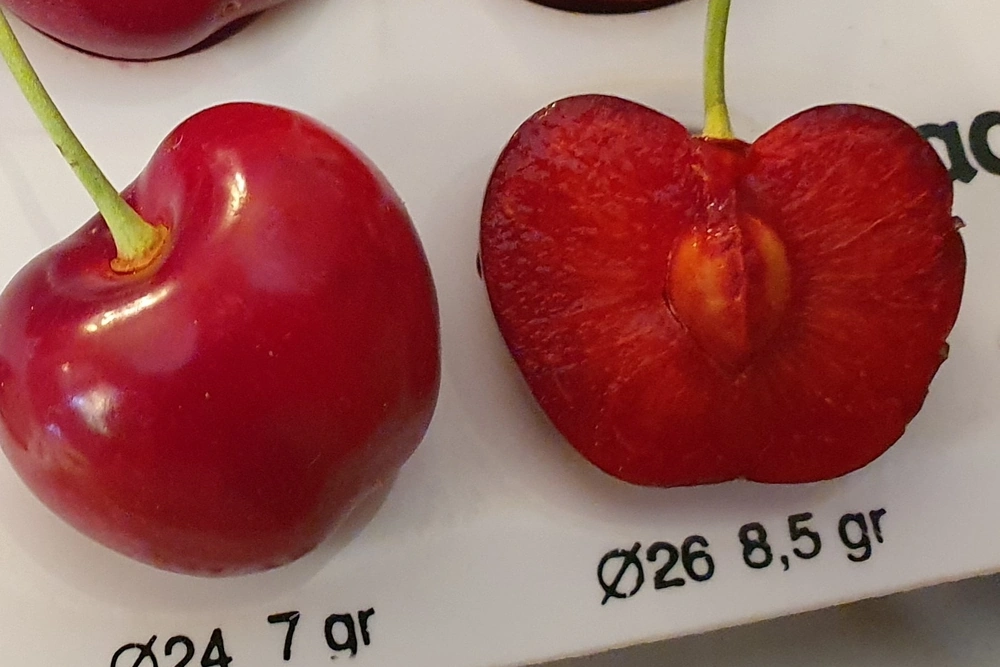 Source: Stefano Lugli
The quality of a cherry at harvest is the result of a sequence of processes that begins long before the fruit develops the color, size, and composition associated with ripening. During development, the fruit’s size and structure, vascular architecture, cuticle, firmness, water status, concentration and distribution of sugars and organic acids, pigmentation, and, in the final stages, a significant part of its phenolic and aromatic profile all change.
These processes are coordinated, but they are not synchronous. The point at which a trait becomes visible or easily measurable does not necessarily coincide with the stage at which its main biological determinants were established. This is one of the keys to correctly interpreting cherry quality and avoiding the identification of “ripening” with a single index, whether color, firmness, or soluble solids (Serrano et al., 2005; Ponce et al., 2021).
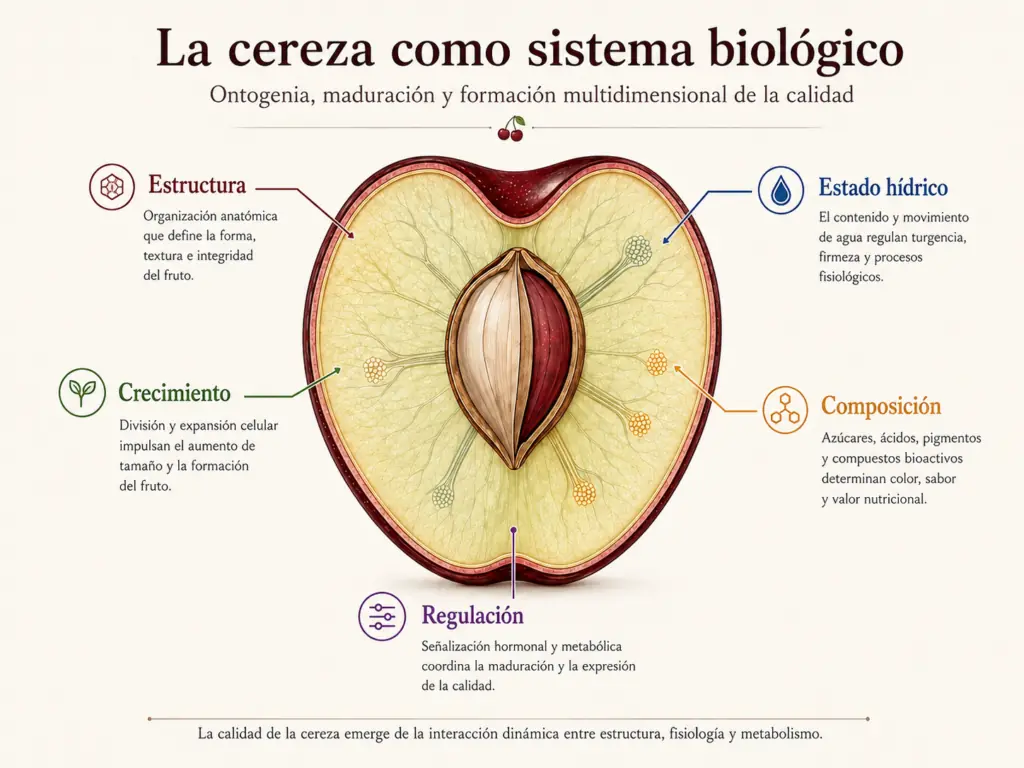
Figure 1. The cherry as an integrated biological system. Conceptual representation of five dimensions that contribute to the development of fruit quality during growth and ripening: structure, water status, growth, composition, and regulation. These components interact dynamically, and their relative contribution depends on genotype, developmental stage, and environmental conditions. The figure does not represent quantitative values or a causal hierarchy among the processes.
Cherry growth follows the characteristic double-sigmoid pattern typical of stone fruits. Stage I includes an initial period of rapid growth associated with cell division and expansion. During stage II, the rate of external growth decreases while endocarp lignification and seed development continue. Finally, stage III corresponds to a new period of rapid mesocarp expansion that progressively overlaps with ripening (Azarenko et al., 2008; Zhang and Whiting, 2013; Gibeaut et al., 2017).
The duration of these stages cannot be expressed as a fixed number of days after full bloom that applies to every cultivar. Azarenko et al. (2008), working with seven cultivars over several years, demonstrated that growth curves could be characterized using degree-hours accumulated from full bloom, while also showing that timing depended on genotype and experimental conditions.
Gibeaut et al. (2017), studying the ‘Chelan’, ‘Bing’, and ‘Sweetheart’ cultivars, also found that some events associated with pit growth were relatively consistent after adjusting for the date of anthesis, whereas the greatest differences among genotypes emerged during the subsequent expansion stage.
This behavior has an important consequence: the final growth stage does not build the fruit from scratch, but acts upon a structure that was partially established during the preceding stages.
The early determination of fruit size is one of the best-documented examples of this ontogenetic dependence.
Olmstead et al. (2007) compared cherry genotypes producing fruit of different sizes and concluded that differences in fruit size were primarily associated with the number of mesocarp cells, rather than cell length. Yamaguchi et al. (2004), analyzing a collection of 56 cultivars, selections, and related plant materials, found correlations between fruit weight and cell number ranging from 0.611 to 0.706, higher than those observed between fruit weight and cell length, which ranged from 0.488 to 0.599.
Cell number also showed greater stability across years.
These results do not imply that final fruit size is completely determined during stage I. Cell expansion during stage III remains essential and can significantly modify the expression of the initial potential. The most accurate interpretation is that a substantial part of the structural potential for fruit size is established early and is subsequently expressed, to varying degrees, during mesocarp expansion.
This distinction is important because it avoids attributing the entire fruit size observed at harvest to the fruit’s “final swelling stage.”
A similar phenomenon affects the epidermis and cuticle.
In the ‘Sam’ cultivar, deposition of the cuticular membrane was particularly intense during the early stages of development. Subsequently, the total mass of the cuticle tended to stabilize while the fruit surface area continued to increase. As a result, the amount of cuticular material per unit of surface area progressively decreased during expansion (Knoche et al., 2004; Peschel et al., 2007).
The mature cuticle must therefore adapt to a considerable increase in surface area without the deposition of new material increasing to the same extent. Knoche et al. (2004) also demonstrated that cuticle deformation changes during development and includes plastic and elastic components that depend on the growth stage.
Later, during stage III, the frequency of microscopic microcracks on the fruit surface also increases, although these discontinuities should not be directly equated with macroscopic fruit cracking (Peschel and Knoche, 2005).
Therefore, the surface integrity observed close to harvest is also the result of processes that began much earlier.
The transition to stage III introduces an important change. Endocarp growth approaches its limit, while the mesocarp enters a new stage of rapid expansion. During this period, fruit volume and mass increase rapidly, and many of the processes generally associated with ripening begin to intensify.
However, there is no precise physiological boundary between “growth” and “ripening.” The two processes overlap.
Developmental series show that color change, the increase in soluble solids, and changes in firmness occur while the fruit continues to increase in size (Serrano et al., 2005; Yang et al., 2021). At the same time, hormonal profiles are reorganized, and changes involving sugars, anthocyanins, and other metabolites intensify (Teribia et al., 2016; Ponce et al., 2021).
This simultaneity does not mean that all traits develop with the same kinetics. Color development may precede or follow softening, soluble solids accumulation, or changes in acidity. The scientific literature highlights considerable differences among cultivars and even demonstrates that certain experimental treatments can partially uncouple some of these processes.
For this reason, two cherries with a similar external color do not necessarily have the same physiological condition.
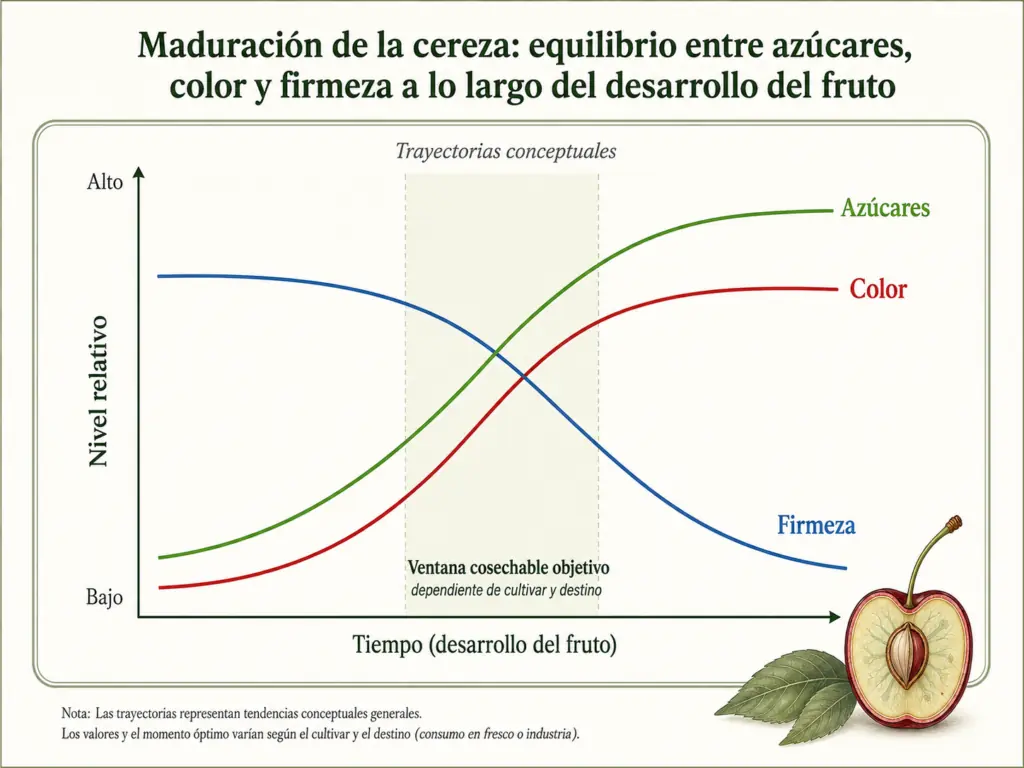
Figure 2. Conceptual diagram of the development of different traits during the final stage of fruit development. The curves do not represent experimental values or a universal timeline; the cultivar, environment, and growing conditions affect both the magnitude and timing of the responses.
The issue can be illustrated using three variables commonly employed to characterize ripening: color, firmness, and soluble solids.
Color provides relevant information about the progression of pigmentation, but its significance depends on the characteristics of the cultivar. Soluble solids generally increase during the final stages, although they represent the overall concentration of refractometrically active substances and are not equivalent to total sugar content. Firmness, meanwhile, integrates the properties of the cell wall, water status, and the mechanical contribution of the surface tissues, and does not necessarily follow a linear trend throughout development.
Muskovics et al. (2006), working with the ‘Alex’, ‘Carmen’, and ‘Krupnoplodnaja’ cultivars, described an evolution in firmness characterized by an initial increase followed by a marked decrease during ripening, while fruit mass and volume continued to increase. Serrano et al. (2005), through a series of 14 developmental and ripening stages, also demonstrated that growth, softening, glucose and fructose accumulation, pigmentation, and phenolic composition followed different timelines.
Cherry quality must therefore be interpreted as a multidimensional and dynamic configuration, rather than as a single value.
From a physiological perspective, harvest does not mark the end of fruit development. It represents the moment when the fruit’s functional connection with the tree is interrupted.
The choice of harvest date selects a specific combination of fruit size, firmness, water status, pigmentation, soluble solids, acidity, aromatic composition, and surface integrity. Because these traits do not develop in perfect synchrony, the selected stage will necessarily depend on the cultivar and the fruit’s intended destination.
A relatively early harvest may better preserve certain mechanical properties, while allowing the fruit to remain on the tree for longer may enable the continued accumulation of soluble solids, pigments, or specific aromatic compounds. The extent of this trade-off depends on the production system and does not justify establishing a universal threshold for color, firmness, or Brix degrees for cherries as a species.
Harvest should therefore be regarded as the selection of a physiological state generated during development, rather than as the process that creates quality.
After the fruit is detached from the tree, the external supply of water and carbon ceases, but the fruit maintains its metabolic activity by using the internal substrates available. The structural, compositional, and water status achieved on the tree therefore represents the starting point for its postharvest behavior.
Jesus Alonso
EL MUNDO DE LAS CEREZA