Welcome to Cherry Times




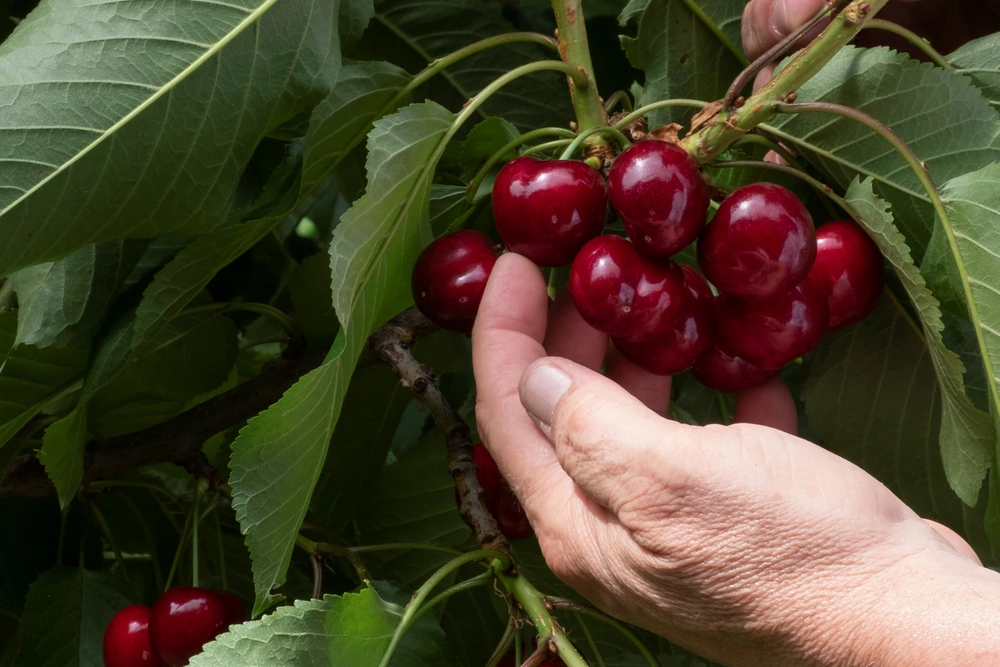 Source: Stefano Lugli
Obtaining fruit of good size remains one of the main challenges in cherry production. Key practices include regulating and thinning the crop load early during winter pruning, applying the right fertiliser and ensuring adequate irrigation. Fruit size can also be improved through the appropriate use of plant hormones and growth regulators.
In addition to applying cytokinins to promote stage I of fruit growth and improve size, another important stage in determining fruit size is stage III of growth and development. The hormone responsible for this process is gibberellic acid, which mainly promotes cell elongation.
Application should begin at the straw-coloured stage: treatments applied too early during growth may delay, in particular, the synthesis of the pigments that determine fruit colour. Factors that limit fruit quality include dry matter accumulation and soluble solids content, both of which are affected by conditions such as cold springs, nutrition, irrigation and the management of growth regulators.
To promote dry matter accumulation and obtain fruit in which commercial and physiological maturity coincide, helping to determine the ideal harvest date, the use of colour-uniforming products is recommended. These help achieve an even colour and concentrate the harvest.

Gibberellic acid application and rate depend on the variety and crop load.

Determining application timing is essential: treatments during the early stages of fruit growth and development inhibit chlorophyll breakdown and interfere with the synthesis of the pigments that determine fruit colour. The first application is therefore recommended at the beginning of the colour break, followed by a second application 5 days later. Because fruit growth and development are uneven, the total dose should be split into two applications.

Determining application timing is essential: treatments during the early stages of fruit growth and development inhibit chlorophyll breakdown and interfere with the synthesis of the pigments that determine fruit colour. The first application is therefore recommended at the beginning of the colour break, followed by a second application 5 days later. Because fruit growth and development are uneven, the total dose should be split into two applications.

Excess gibberellic acid can affect flowering in the following season, cause fruit drop, so-called “alligator skin”, internal browning and delayed harvest. It is therefore important to calculate rates correctly and determine the right application timing.
Both gibberellic acid applications should be complemented with foliar applications of phosphorus and potassium. These elements play an important role in building the tissues that give fruit firmness and contribute to pigment formation. Potassium, together with boron as a cofactor, is also the main element involved in transporting carbohydrates to the fruit.
It is important to make two applications: the first at the straw-coloured stage and the second 7 days later, to even out colour and concentrate the harvest. This helps achieve an appropriate level of commercial and physiological maturity at harvest.

