Welcome to Cherry Times




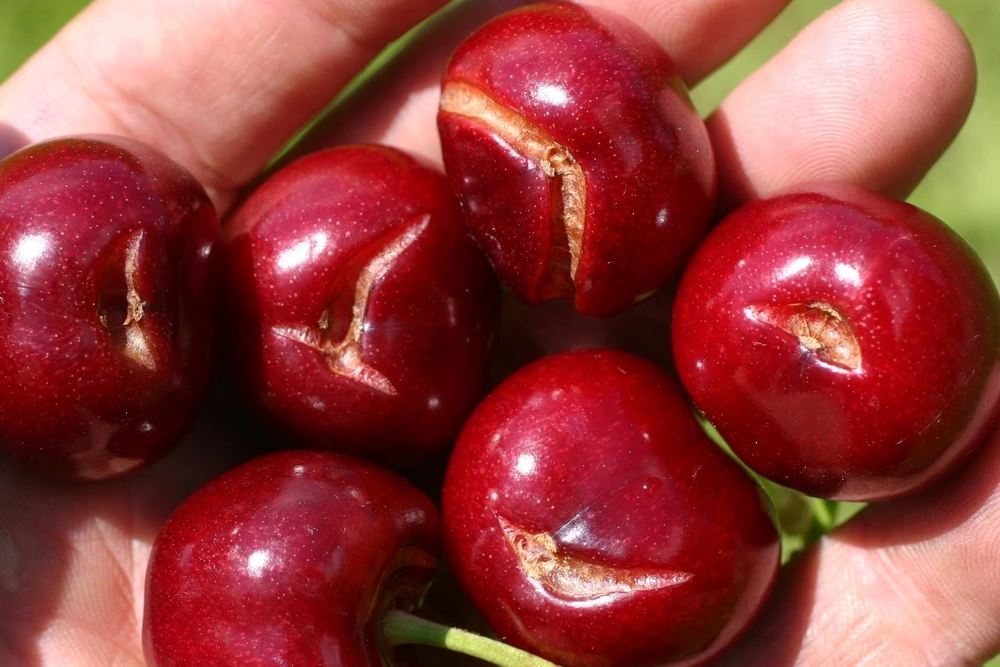 Source: Stefano Lugli
In recent years, cherry production has faced greater variability in weather conditions, with more unsettled springs and more frequent rainfall during the critical stages of fruit development and ripening. This situation may become more pronounced under the influence of El Niño, which is associated with a higher probability of rainfall in south-central Chile.
Rainfall close to harvest is one of the main risks to the quality and condition of cherries, as it increases the incidence of splitting, or cracking, while also encouraging plant health problems and losses of marketable fruit.
Given the high value of the crop and the sensitivity of cherries to these events, it is essential to establish a preventive strategy well in advance to strengthen the fruit, reduce its susceptibility to cracking and limit the impact of any rainfall during ripening and harvest.
For these reasons, the following measures are recommended.
Stem-end cracking: this can occur even with light rainfall, up to 5 mm, and is caused by the accumulation of water around the stem attachment area.
Distal cracking: this is caused by the uptake of free rainwater present in the soil and generally occurs when rainfall affects soil with a moisture content below field capacity.
Lateral or dorsal cracking: this can occur during heavy rainfall, exceeding 20 mm, as a result of osmotic regulation between the fruit and its external environment.
The different types of cracking may occur during rain or within a few hours after the rainfall has ended.

Biofilm applications are needed to create a hydrophobic film on the fruit’s epidermis, capable of repelling a high proportion of water, using one of the following alternatives:

The treatment should be applied shortly before colour change in all varieties. Applications should then continue every 7 days until harvest to maintain coverage as the fruit’s epidermis and cuticle expand.
For early varieties such as Royal Dawn, Brooks or Santina that have already started changing colour or are at the onset of colour development, calcium chloride or potassium chloride should be applied at the following rates and timings:

It is important to carry out applications as indicated in the programme, before, during and after rainfall. Remember that the function of regulating osmosis inside and outside the fruit and preventing it from absorbing water IS NOT PERFORMED BY CALCIUM, but by chloride salts. For this reason, both calcium chloride and potassium chloride (muriate of potash) can be used.
Applications should be carried out using a spray volume appropriate for the canopy of the orchard trees.
Once the rainfall has ended, the vegetation should be dried using airflow to remove water deposited on the fruit and foliage.
It is necessary to irrigate before rainfall so that the trees are not experiencing water stress. This factor can also cause cracking when the trees take up distilled rainwater from the soil. If irrigation between the rows is possible, it is recommended as well.
Adding a wetting agent to the irrigation before rainfall is recommended to keep the soil consistently at field capacity and the trees well hydrated. In this way, when rainfall occurs, the trees will not take up distilled water, reducing distal cracking in the fruit.
Use any one of these products:

After rain, it is important to act promptly against Botrytis. Remember that it remains the main cause of fruit rejection at destination. For this reason, after rainfall, a contact fungicide should be applied, choosing one of the following alternatives, which leave no residues on the fruit:

In the event of repeated rainfall, alternating products and active ingredients is recommended to prevent the development of resistance. It is important to adopt these preventive and curative measures whenever spring rainfall affects the orchard.
Opening image source: Stefano Lugli
Patricio Morales
Agro Asesosria