Welcome to Cherry Times




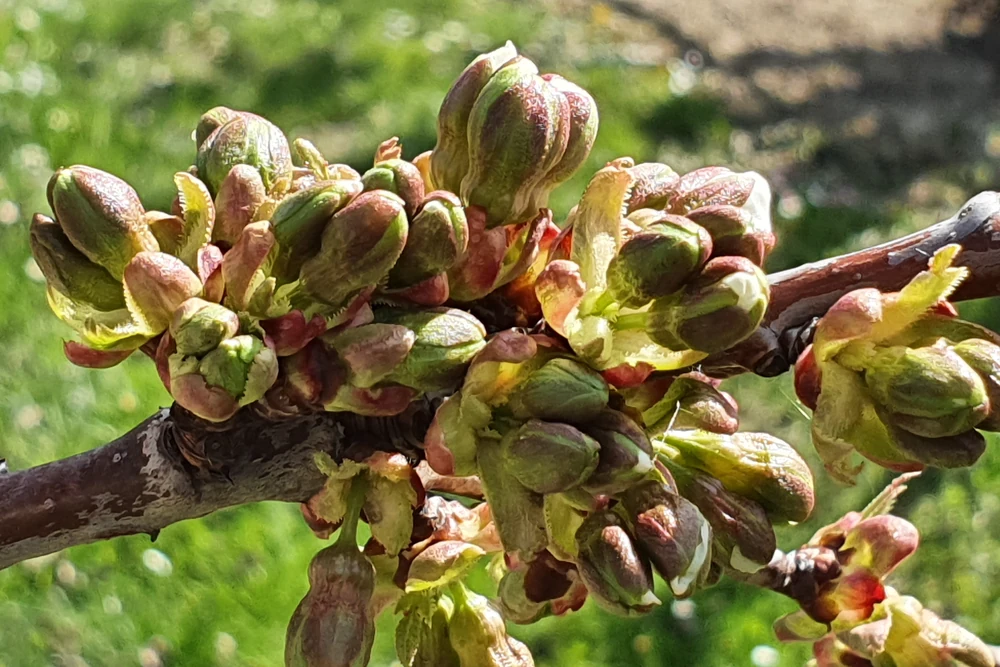 Source: Stefano Lugli
One of the main challenges in cherry production is achieving good yields and large fruit size. The flowering process plays a fundamental role in achieving these objectives.
This season we are facing a spring characterized by unstable weather conditions and the recurring presence of rainfall, factors that can compromise the flowering and pollination period.
In this scenario, it will be essential to carry out constant monitoring of phenology and weather conditions, with the aim of promptly taking advantage of favorable windows for pollination and promoting adequate fruit set.
I suggest applying ethylene inhibitors, mainly on self-incompatible varieties or those requiring cross-pollination, such as Royal Dawn, Rainier, Bing, Regina and Kordia.
The objective is to allow the flowers to maintain a viable pollen tube and an ovary receptive to pollen for longer, delaying tissue senescence and therefore extending the useful period for fertilization.
In this way, it is possible to promote better fruit set of the fruits, improving the useful period for fertilization.
It is important to remember that during flowering the plant experiences one of the main peaks in ethylene synthesis. It is therefore advisable to counteract the effect of this hormone, which is responsible for accelerating tissue senescence processes.

For self-incompatible varieties such as Bing, Royal Dawn, Rainier, Regina and Kordia, I recommend using 15 hives/ha and one 144 g pack of pollen distributed at the hive entrances, starting from the beginning of flowering until full bloom.
For self-fertile varieties, such as Lapins and Santina, 10 hives/ha can instead be considered.
Bee and Bombus colonies should be placed when approximately 10% flowering is reached.
The hives should be placed outside the orchard, along roads or farm tracks, so that they can accumulate heat more quickly during the early hours of the day and thus encourage greater bee activity.
As a supplement, I also suggest using 2-3 colonies/ha of Bombus (bumblebees) Koppert.
In orchards characterized by a shortage of pollinizer cultivars and where it is necessary to compensate for an insufficient availability of pollen, it is advisable to use assisted pollination, distributing pollen throughout the orchard using specific technologies, such as electrostatic systems or drones.
Specific assisted pollination services can also be used for this purpose.

To stimulate and encourage bee activity on the flowers, I suggest applying a bee attractant, capable of increasing the time insects spend foraging on flowers and thereby contributing to their fertilization.
It is advisable to apply the attractant when approximately 30% flowering is reached, in order to increase the efficiency of pollinating insects during stages when temperatures allow good flight activity.
I suggest applying auxins to promote fruit set, fruit size and fruit retention.
Auxins help strengthen the flower abscission zone and promote the synthesis of endogenous gibberellins, which are involved in fruit set processes.
The objective is therefore to promote the retention on the tree of a greater quantity of fruit after fruit set, reducing fruit drop.

Phase I of cell division begins with the onset of flowering and ends approximately 25 days after full bloom.
Cytokinins are the hormones primarily involved in promoting cell division. For this reason, an exogenous application at this stage can be strategic in promoting the formation of a greater number of cells.
In this way, a fruit with greater cellular potential is developed, a condition that can contribute to increasing fruit size and, at the same time, improving firmness and fruit quality.


In orchards that begin budbreak showing excessive vigor, particularly when associated with poor flowering, or in orchards grafted onto very vigorous rootstocks such as Colt, Mazzard or MaxMa 60, I suggest intervening to contain vegetative growth.

This application can promote the induction and formation of fruiting centers on 2-3-year-old branches in variety/rootstock combinations characterized by slow entry into production, such as Lapins/Colt and especially Santina/Colt.
The treatment also makes it possible to:

Among the main causes of product rejection at destination are rots caused by fungi responsible for postharvest disorders, such as Botrytis cinerea and Alternaria spp.
Control of these pathogens must begin in the orchard.
The most critical phenological stages are:
These fungi can in fact affect the different development stages, from the flower to the ripe fruit.
It is therefore necessary to ensure effective control using the most appropriate tools, in order to preserve both flower health and product quality when it reaches destination markets.

At the indicated phenological stages, it is essential to carry out the pathogen control program.
At other stages, such as fruit set, green fruit or the straw-color stage, it is advisable to intervene if predisposing weather conditions occur, such as rainfall, or damage caused by weather events.
Opening image source: Stefano Lugli
Patricio Morales
Agro Asesoria