Welcome to Cherry Times




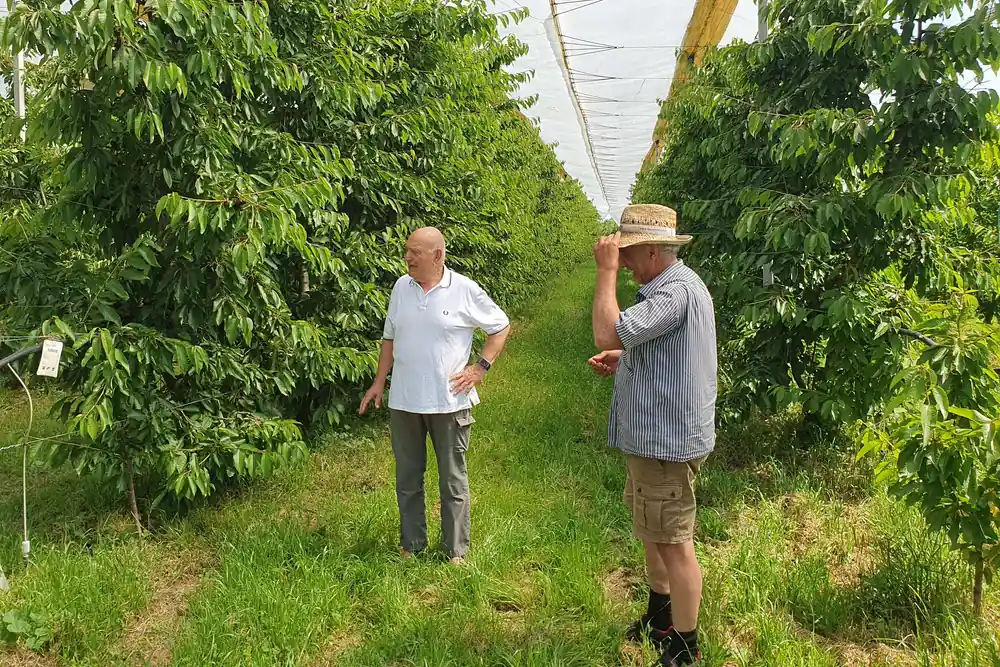 Source: Stefano Lugli
Water connects the plant to the soil through the activity of its roots, enabling the uptake of nutrients from the soil solution. It also performs other important physiological functions, such as cooling, which always remains a priority for the plant.
Water is also the main mechanism for transporting oxygen through the soil, which is vital for roots and soil microflora. In addition to its fundamental role in hydration, it enables the upward and downward transport of hormones within the plant.
Given the importance of water in plant physiology, proper irrigation management throughout the season is essential. Irrigation events must deliver a high hydraulic load to ensure an appropriate balance between water and oxygen in the soil, as irrigation significantly affects both plant cooling and respiration.
Depending on the crop’s phenological stage, ONLY the frequency, rather than the duration, of irrigation should be changed.

We must always remember that what we irrigate is the soil. Irrigation criteria must therefore take into account soil type, texture, structure and any limiting factors. “Long” irrigation events delivering a high hydraulic load not only provide the plant with an appropriate balance between water and oxygen, meeting its water requirements according to its development and phenology, but also help maintain optimal soil conditions, preventing compaction and promoting salt leaching.

An orchard with high salt levels in the soil, managed using long irrigation events that move salts away from the root zone, preventing plant toxicity.
Insufficient irrigation provides inadequate plant cooling and respiration, causing root asphyxia — to which MxM 14 and 60 rootstocks are particularly sensitive — resulting in iron chlorosis in the leaves, iron deficiency and root death.
This sends a negative signal to the plants: hormonal regulation changes, the amount of inhibitors (ABA) decreases and that of promoters (CK) increases, causing disturbances that affect phenology and growth, as a strong signal is generated for the production of ethylene and abscisic acid, indicating stress.
As shown in the image, irrigation for 3 hours every 4 days in the Regina variety grafted onto Gisela 12 results in an insufficient wetted soil volume. A large proportion of the roots is clearly located in dry soil at the permanent wilting point, exposing the plant to stress that is detrimental to the vegetative development and productivity of the orchard.


To determine irrigation frequency more precisely, it is essential to inspect soil profiles regularly using observation pits, adjusting the frequency to the needs of the soil and crop. Remember that only irrigation FREQUENCY should be changed, never irrigation DURATION.
To ensure that irrigation criteria meet the species’ water requirements, these pits must be checked regularly to verify that the selected duration and frequency are appropriate. Although irrigation monitoring technologies, such as soil moisture probes, are now available, their data must be verified directly in the field using an observation pit.
This monitoring must therefore be a key orchard activity, especially during the months of highest water demand: an irrigation error can directly affect fruit quality and yield, as well as influencing disease and plant stress.
During the inspection, consider the following:
1. The pit must be sufficiently deep to allow the observation of soil horizons containing roots.
2. It must be dug in sectors and near plants that are representative of the orchard.
3. Inspect the wetted soil volume, checking the lateral extent and depth of wetting.
4. Check that moisture is sufficient and reaches field capacity, and inspect porosity.
5. Check the degree of compaction at different depths.
6. Observe the direction of growth and the areas where roots are concentrated.
7. Check root activity and growth, identifying the peak in root growth.
8. Check root health, ruling out attacks by soil insect larvae, locally known as “burritos” and “pololo de San Juan”, diseases caused by Phytophthora spp. or Armillaria mellea, and pathogenic nematodes.
To calculate fertilization requirements, consider variables such as: variety/rootstock combination, tree age, phenology, production history, estimated yield, soil analysis, leaf analysis, fruit analysis, annual shoot growth, vigor index (1–5), irrigation water analysis, nutrient recycling, irrigation system and soil drainage limitations.
On this basis, calculate the amounts of fertilizer nutrients to apply during the season. It is important to note that nutritional requirements depend on the rootstock and estimated production.


Use nutrient sources such as sulfates and nitrates, as cherry trees are sensitive to toxicity from muriates and chlorides.
Avoid fertilizing bearing orchards with urea, as it tends to reduce fruit firmness during production.
Calcium fertilization must be completed before shuck fall and, at the latest, by pit hardening.
In orchards with excessive vigor, suspend spring nitrogen fertilization and apply nitrogen only after harvest.


To ensure the production of high-quality, firm fruit, supplement mineral fertilization with readily absorbed fertilizers, particularly for nutrients such as calcium, which are responsible for plant tissue firmness. Use one of the following alternatives:

1. Obtain a chemical soil analysis.
2. Calculate nutrient inputs according to the variety and rootstock.
3. Adjust the program to the estimated yield.
4. To achieve good efficiency, fertilize according to phenology.
5. The fertilization program should provide 40% of inputs as sulfates and 60% as nitrates, as cherry trees have low tolerance to muriates.

A healthy root system is essential to ensure quality and productive yield. The development of abundant, high-quality roots should therefore be encouraged from the first year of planting. The main functions of roots are the uptake of water and nutrients, respiration, anchorage and the accumulation of reserves.

The most important root growth peak occurs in spring and lasts approximately 14 days. Its importance lies in its coincidence with the period of greatest demand for water and nutrient uptake to produce high-quality fruit.
To grow, roots require oxygen, moisture and temperatures above 7 °C. Proper irrigation management is therefore essential to obtain new growth points. Monitor soil temperature to determine the timing of application: the ideal temperature is above 13.2 °C, with white root tips present.


Over time, the physical and chemical characteristics of the soil change. Compaction can result from various factors, such as repeated machinery traffic, loss of microorganisms, insufficient soil preparation before planting, poor irrigation management or the inherent characteristics of the soil.
Compaction is one of the problems facing fruit growing today, owing to the continuous use of agricultural soils and the succession of different crops. It causes a gradual reduction in pore space and, consequently, in the movement of water and nutrients through the soil.
Its main effect is increased soil resistance to root penetration, hindering normal development. This reduces the supply of water and nutrients to the plant, resulting in poor vegetative development and low yields.
It is therefore essential to adopt strategies to prevent or correct compaction: improve irrigation management by delivering high hydraulic loads that supply the soil with water and oxygen; maintain and preserve soil microflora; and prepare the soil properly before planting, improving the structure of the soil volume that will be explored by roots in the mature orchard through subsoiling to depths greater than 90 cm.

In heavily compacted soils that prevent proper plant development, carry out the following applications:

After application, it is essential to inspect observation pits regularly to determine the number of treatments needed and assess their effect on the degree of compaction. Repeat these inspections periodically throughout the season to check soil conditions directly in the field and identify any limiting factors preventing the orchard from reaching its yield potential.
To maintain soil microflora and prevent compaction caused by the loss of microorganisms, replenish organic matter. As a guideline, apply 20 m³/ha of stabilized manure every two seasons: this is a standard strategy that should be adjusted case by case according to soil analyses.
Adding organic matter helps keep soils active. Cation exchange capacity (CEC) should also be maintained at optimal levels for cherry production, helping achieve maximum yield potential and stable production.
Opening image source: Stefano Lugli
Patricio Morales
Agro Asesoria