Welcome to Cherry Times




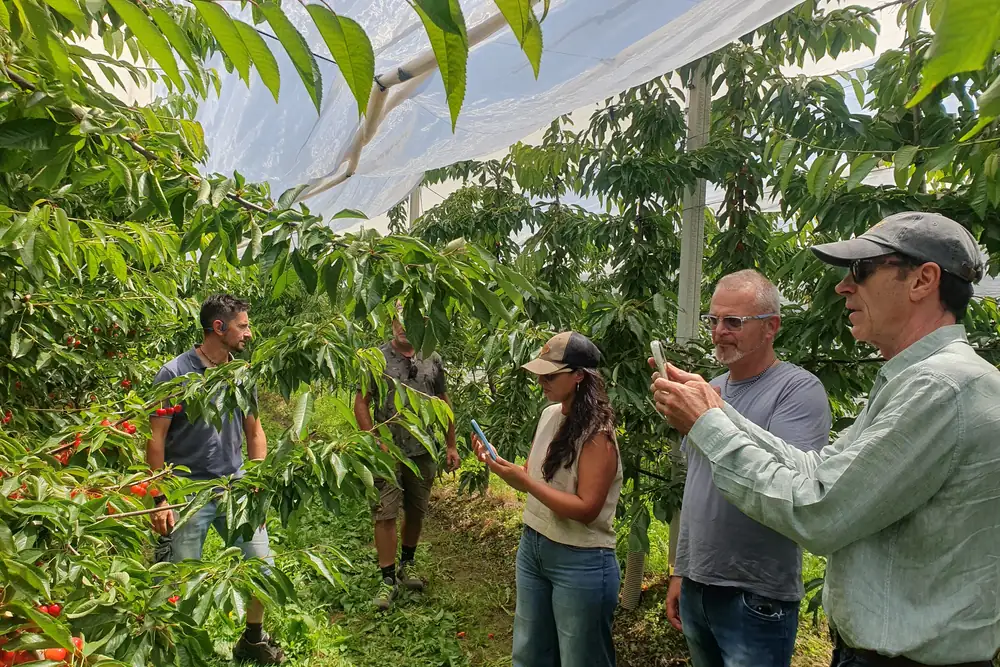 Source: Stefano Lugli
Precision irrigation, artificial intelligence, covers, advanced genetics and robotics: which technologies can already be adopted in cherry orchards, which are still experimental, and how to prioritize investment to produce exportable fruit with lower risks.
For two decades, success in cherry production was measured in hectares planted and tonnes shipped. Today, that measure is no longer enough. The value of a cherry orchard depends on its ability to supply uniform, firm, well-sized fruit within a specific marketing window, while reducing exposure to climate, water and labor risks.
In Chile, cherry cultivation now covers more than 80,000 hectares, and between September 2025 and April 2026 cherries accounted for 49.1% of the value of fruit exports. At this scale, every improvement in quality or efficiency has an enormous economic impact.
In this context, agricultural innovations are no longer a technology showcase; they are tools for managing risk. This article examines ten technologies that could transform cherry growing: what they are, what scientific evidence supports them, how mature they are, what is needed to adopt them, and which results it is still too early to promise. The aim is to give growers, advisors and business managers a clear framework for distinguishing technologies that already deliver returns from those that remain a strategic bet.
The analysis uses the Technology Readiness Level (TRL) scale as a reference, not as an official certification: TRL 8–9 indicates a largely commercial technology; 6–7, a technology at the demonstration or early-adoption stage; 4–5, a prototype or applied research; and 3 or below, research still far from routine use. The timelines are indicative estimates as of October 2026.
TRLs and timelines follow the values given in the article; investment levels are described qualitatively.
| Technology | TRL | Timeline | Investment |
|---|---|---|---|
| Precision irrigation | 7–8 | Now to 3 years | Medium to high |
| Remote sensing and computer vision | 6–8 | Now to 3 years | Low to high |
| Covers and macrotunnels | 9 | Already available | High |
| Smart frost protection | 7–9 | Now to 3 years | Medium to high |
| Dwarfing rootstocks and planar canopies | 9 | Already available | High, at planting |
| Markers and genomic selection | 7–9 | Already in use; further development over the next 5 years | Supported by breeding programs |
The 2025/26 season clearly exposed the fragility of the export model. Between September 2025 and February 2026, Chilean cherry exports fell by 8% in value and 9% in volume compared with the same period a year earlier; China accounted for 87% of both the value and volume shipped. According to ODEPA, the season was marked by an early harvest and a later Chinese New Year, on February 17, 2026. This led to oversupply, downward price pressure and longer storage times, which partly compromised fruit condition.
In a market this concentrated, postharvest quality and the ability to control timing become a direct competitive advantage.
Cherry growing also has characteristics that increase the value of innovation: high-value fruit, a short harvest window, high sensitivity to rain and frost, and strong reliance on labor, since harvesting accounts for about 50% of total production costs.
Climate adaptation measures such as plastic covers also alter radiation, temperature, humidity and wind. As a result, irrigation, nutrition, pollination and crop protection are increasingly interdependent. A review by the University of Concepción concludes that growing under covers requires a rethink of the tree’s overall management, rather than simply installing covers over a conventional system].
The evidence reviewed suggests that no single technology will transform cherry production on its own. The opportunity lies in combining biological, digital and physical innovations. Some are already commercial, while others are at the early-adoption stage; a few have high disruptive potential, but also involve longer timelines and greater technical risks.
Precision irrigation combines soil-moisture probes, sensors that measure tree water status, maps of soil variability, flow meters, weather stations and controllable valves. The aim is to stop irrigating every block as if it were uniform. Individual components are commercially available; variable-rate irrigation within the same orchard is still at the advanced-demonstration stage or in early applications.
Evidence specific to cherries is promising. In a commercial orchard in Türkiye’s Gediz Basin, management zones were delineated using satellite NDVI imagery from 2020 to 2022; variable-rate irrigation was then applied in 2023 and 2024.
Water savings reached 35–49% in the first year and 25–36% in the second. In 2023, water productivity reached 1.38 kg/m³, compared with 0.70 kg/m³ in the control. By combining variable-rate irrigation and fertigation, the same program saved about 25% of nitrogen and phosphorus and 33% of potassium in 2023, with no significant differences in quality between zones.
Percentages reported in the cited studies. Bars start at zero and use the same scale, up to 50%.
Gediz Basin, Türkiye — first year: 35–49%
The bar shows the lower end of the range, 35%; the upper end is 49%.
Gediz Basin, Türkiye — second year: 25–36%
The bar shows the lower end of the range, 25%; the upper end is 36%.
‘Bing’ orchard: 22.3% on average
These results come from different trials and are not a direct comparison between systems.
In a ‘Bing’ orchard, a system based on soil-moisture and evapotranspiration sensors reduced the amount of water applied by an average of 22.3%, without causing water stress.
The most realistic goal today is not to increase yield, but to maintain production and quality while using less water and less energy for pumping. Risks include poorly installed sensors, maps that do not reflect the actual root zones, and algorithms that have not been locally validated. Separate irrigation blocks, flow measurement, connectivity and training in water-balance management are essential.
RGB, thermal and multispectral cameras mounted on drones, tractors or autonomous vehicles can estimate vigor, water stress, flowering, fruit counts and color. In a Spanish study on cherries, drones were used to develop a new vegetation index capable of detecting mild water deficit before harvest. The authors also combined several indices in machine-learning models to estimate yield and additional labor needs for harvesting.
In Chile, researchers from the University of O’Higgins and the Pontifical Catholic University combined a wireless network of agroclimatic sensors with videos recorded on mobile phones along orchard rows to estimate cherry color distribution and maturity in the field.
The core technology is commercially available, but reliable fruit counting and yield prediction that can be applied across different orchards remain open challenges. Canopy occlusion, overlapping fruit and changing light conditions continue to limit accuracy.
Scalability, by contrast, is advancing quickly: an autonomous drone system with a charging station assessed by Washington State University can survey up to 250 acres per day without a pilot, although validation was carried out in apple orchards. For precision agriculture, its value lies in planning harvest priorities, sizing crews and bins, and moving from uniform interventions to site-specific management.
From rain shelters to automated macrotunnels, plastic covers are the most mature innovation in this review. Their main purpose is to prevent rain-induced fruit cracking, but their effects go further.
In a frost-protection trial during flowering in the Czech Republic, damage was 34% for uncovered ‘Sandra’, compared with 5% under cover; for ‘Skeena’, it was 33% versus 11%. The covers raised the temperature by 1–2°C.
Protection, however, is not agronomically neutral. In a commercial orchard in central Chile, a rain shelter reduced total solar radiation by 50–60%, compromising firmness and sugar content in ‘Rainier’, ‘Bing’ and ‘Sweetheart’.
For this reason, irrigation, crop load, ventilation and calcium treatments need to be reconsidered under cover. Costs vary widely: macrotunnels can start at around US$40,000 per hectare and exceed US$200,000 per hectare when fully automated, with side and roof ventilation and electric motors.
The decision should take into account the historical frequency of rain and frost, the system’s useful life and the value of the protected fruit.
Frost protection is moving beyond simply reading a thermometer and switching on equipment. Sensor networks now measure the microclimate and, increasingly, the temperature of plant tissues.
The physiological reason is important: research in Washington State orchards has shown that, on frost nights, flower-bud temperature drops below 0°C earlier and faster than air temperature.
A WSU doctoral thesis based on measurements in cherry orchards from 2023 to 2025 recorded average differences of 0.75–1.75°C between air and bud temperatures and developed models to predict tissue temperature in real time.
This matters because spring frosts can cause yield losses of up to 70% in cherries. Activating fans or sprinklers based on air temperature may therefore mean intervening too late.
Rather than increasing yield potential, this innovation helps manage risk and costs: it protects the crop at the right physiological moment and avoids unnecessary pumping hours or energy use.
Sensor placement must be representative of the orchard: automating an inaccurate measurement amplifies the error.
Dwarfing rootstocks and systems such as UFO, KGB, pergola and fruiting walls turn complex three-dimensional canopies into accessible surfaces. They bring together genetics, labor efficiency and future automation.
Combining the planar UFO system with GiSelA 12 increased harvesting speed by 72% compared with the traditional open-vase system. An intensive orchard on GiSelA 5 with ‘Sweet Saretta’, planted at 3.5 × 0.5 m, reached a cumulative yield of 73.3 t/ha in its sixth year.
In Chile, a 2026 study on ‘Lapins’/‘Colt’ found that the pergola system intercepted 83% of light, compared with 36% for the central-leader system, and had 66% more leaf area per tree.
Higher planting density, however, does not automatically guarantee better results. In an 11-year trial with ‘Lapins’, ‘Regina’ and ‘Hudson’, cumulative yield increased with density, but fruit size decreased. In the self-fertile ‘Lapins’, GiSelA 5 and 6 caused overcropping and smaller fruit.
The combination of cultivar, rootstock and soil needs careful selection: the wrong orchard design is a difficult investment to reverse.
Instead of waiting years for seedlings to produce fruit, molecular markers make it possible to discard early those that lack the desired genetic combinations. In a Pacific Northwest U.S. program, 259 seedlings derived from 22 parents were evaluated over several years to identify genomic regions associated with cracking and firmness.
These studies led to DNA tests: two SNP markers explained 16–30% of the variation in cracking, while two others explained 22–28% of the variation in firmness. In Spain, a study of 372 individuals from five populations identified 20 stable regions associated with sugars and acids, key components of flavor.
The commercial value of these traits is tangible: the ‘Skeena’ patent reports an average cracking rate of 20% across 15 years of trials and about 19% soluble solids. For growers, the benefit comes through better cultivars, not as a tool for annual orchard management.
Genome editing could modify specific genes related to plant architecture, disease resistance, quality or climate adaptation without relying on the many generations of crosses used in conventional breeding.
In the genus Prunus, however, the bottleneck is not simply cutting DNA: the woody nature of these plants makes both plant regeneration and effective delivery of editing reagents difficult. Chilean research groups are working on this challenge in Japanese plum, cherry and peach.
An emerging line of research is graft-mediated editing, which uses the movement of components from the rootstock. Its effectiveness, however, remains variable and depends on compatibility between genotypes.
The regulatory framework also matters. From January to March 13, 2026, Chile’s SAG held a public consultation on formalizing the procedure for assessing crops developed using new breeding techniques. According to the sector, this procedure has been applied in practice since 2017. The consultation prompted debate between environmental organizations and the biotechnology sector. There are currently no commercially available cherry cultivars developed through genome editing: the benefits remain potential, not proven.
Precision pollination supplements bees and natural pollinators by distributing compatible pollen in a targeted way, often with electrostatic equipment. It is particularly relevant for self-incompatible cultivars and covered orchards, where physical barriers restrict pollen movement.
In a commercial orchard in Chile’s Central Valley, electrostatic pollination increased fruit set in covered ‘Regina’ trees from 14% to 20%, but did not increase final yield. In Washington State, a single supplemental application increased fruit set in ‘Tieton’ by 10–15% compared with open pollination.
Values reported for the Chilean trial on covered ‘Regina’ trees. Scale: 0–25%.
Without electrostatic pollination: 14%
With electrostatic pollination: 20%
In this trial, the increase in fruit set did not lead to an increase in final yield.
The Chilean result is an important reminder not to overstate the technology: higher fruit set does not necessarily mean more kilograms of exportable fruit. The additional crop load may increase competition for carbohydrates or be offset at a later stage. Successful use requires certified, viable pollen, proper storage, synchronized flowering and accurate monitoring of bloom.
Drosophila suzukii, the spotted-wing drosophila, damages fruit as it begins to change color on the plant. Other flies, by contrast, attack only overripe fruit. In Chile, the pest was first detected in 2017 in Pucón and Villarrica through SAG surveillance. In 2018, after it was found in Mulchén, a 4 km regulated area was established.
The SAG later indicated that the pest had become established and would not be eradicated, and that control would not be mandatory, leaving management responsibility with the grower.
The innovation combines frequent monitoring with biological control methods. The sterile insect technique (SIT), which involves releasing sterilized males, has already shown promising results in greenhouses. The French OPTIMISTII project (2025–2029), led by INRAE, aims to combine SIT with the incompatible insect technique (IIT), based on the bacterium Wolbachia, to control the pest in cherry orchards.
In laboratory trials, Wolbachia-carrying insect lines were sterilized with radiation doses four times lower than usual. The main limitation is scale: the technique requires large-scale insect production and coordination across extensive areas. A single orchard is therefore unlikely to capture all the benefits on its own.
Mechanized harvesting is developing along two paths: shaking trees and catching fruit on padded surfaces, and robots that identify and pick cherries one at a time.
In some trials, Washington State University’s shake-and-catch prototypes worked five to six times faster than manual harvesting while maintaining good fruit quality.
Researchers estimate that this technology could reduce harvesting labor costs by 80–90%. However, it produces cherries without stems, raising questions about market acceptance and postharvest storability.
For selective harvesting, computer vision is the key component. The Cherry-Net algorithm segments fruit ready to pick in real time despite occlusion and changing light, with pixel-level accuracy of 99.82%. Patents also describe robotic platforms that can operate autonomously or alongside pickers. The planar orchard architecture described in section 3.5 makes these systems much more feasible.
The following table summarizes the relative cost, timeline, impact and maturity of each innovation. Where no public, comparable figure specific to cherries is available, the value is listed as not specified.
| Technology | TRL | Timeline | Investment | Impact |
|---|---|---|---|---|
| Precision irrigation | 7–8 | Now to 3 years | Medium to high | Water savings and more efficient input use |
| Remote sensing and computer vision | 6–8 | Now to 3 years | Low to high | Monitoring and decision support; not quantified |
| Covers and macrotunnels | 9 | Already available | High | Protection from rain and frost; possible effects on quality |
| Smart frost protection | 7–9 | Now to 3 years | Medium to high | Optimizes intervention timing and costs |
| Dwarfing rootstocks and planar canopies | 9 | Already available | High, at planting | Harvest efficiency and readiness for automation |
| Markers and genomic selection | 7–9 | Already in use; further development over the next 5 years | Supported by breeding programs | Cultivar selection; not an annual management tool |
| CRISPR genome editing | 3–5 | 5 to 10 years or more | Very high in R&D | Potential, not yet proven |
| Assisted pollination | 6–7 | 1 to 4 years | Medium | Potential increase in fruit set; final yield may not increase |
| Drosophila suzukii control | 5–7 | 3 to 7 years at area-wide scale | Medium to high | Integrated control; depends on area-wide coordination |
| Mechanized and robotic harvesting | 4–6 | 3 to 8 years or more | High to very high | Potential labor savings; technical and market limitations remain |
Impact descriptions summarize the findings and limitations discussed in the article; they are not directly comparable economic estimates.
A reasonable roadmap does not assume that all technologies will mature at the same time. The timeline below groups them by their likely adoption horizon:
Covers; dwarfing rootstocks and planar canopies; markers and genomic selection. Precision irrigation and monitoring systems can also be adopted, with local validation.
Assisted and precision pollination; early adoption of remote sensing, computer vision and smart frost protection.
Area-wide autocidal control of Drosophila suzukii; mechanized and robotic harvesting, with timelines depending on the technology and its economic viability.
CRISPR genome editing, which still depends on progress in plant regeneration, cultivar validation and regulation.
Indicative timelines stated in the article, not guaranteed commercial release dates.
The longer timelines for genome editing and robotics reflect different obstacles. For CRISPR, the main challenges are plant regeneration, cultivar validation and regulation; for robotic harvesting, they include speed, occlusion, fruit delicacy and the economics of equipment used for only a few weeks each year.
The transformation of cherry orchards will be systemic. Growers generate data and define the problems; researchers validate models, genetics and management practices; suppliers turn prototypes into maintainable equipment and software; regulators oversee areas such as crop protection, drones, plant material and new breeding techniques.
The greatest competitive advantage is likely to go to businesses that can coordinate these interactions, rather than those that simply buy more sensors.
Two relationships deserve particular attention. The first links orchard architecture to computer vision and robotics: a planar canopy with clearly visible fruit makes both counting and automated harvesting easier. UFO systems already show efficiency benefits even before robots are introduced.
The second concerns the relationship between covers and microclimate: protecting the orchard from rain simultaneously changes radiation, temperature and humidity. For this reason, irrigation, pollination and nutrition need to be redesigned as one integrated system.
The first priority is to build the necessary infrastructure: irrigation divided into measured blocks, a weather station, field connectivity, georeferenced plots, spray records and harvest data by block. It may be less eye-catching than a robot, but this investment increases the value of almost every other technology and makes it possible to measure returns.
Variable-rate irrigation results show why: without maps of variability and the ability to manage separate zones, an algorithm produces information only; with valves and separate irrigation blocks, it can deliver tangible savings.
The second priority, especially in areas exposed to rain or frost with a high economic impact, is to reduce catastrophic losses before trying to maximize production potential. Covers and frost-alert systems may justify substantial investment, but they should be assessed with a probabilistic cash-flow analysis that considers the historical frequency of the event, avoided losses, useful life, maintenance and effects on quality. They are not agronomically neutral forms of protection.
The third priority is to design every new orchard with labor needs and future automation in mind. An orchard planted today will produce for many years; a layout incompatible with platforms, side-view systems or assisted harvesting can become an unrecoverable cost.
Finally, it is useful to distinguish technologies that may deliver immediate returns from strategic bets. Smart irrigation, covers, sensors and training systems belong in current budgets; genomics can be followed through nurseries and cultivar programs. CRISPR, SIT and harvesting robots warrant pilot projects, university collaborations and technology monitoring, but their budgets should not assume commercial benefits that have not yet been demonstrated.
Plastic covers, dwarfing rootstocks combined with high-density training systems, and precision irrigation are the most mature technologies. They are already commercially available and can be introduced in an orchard today.
In a variable-rate irrigation trial in cherries, water savings were 35–49% in the first year and 25–36% in the second, with no significant losses in fruit size, weight or firmness. Results depend on soil variability within the individual orchard.
Yes. They reduce rain cracking and frost damage, but also reduce radiation and may lower fruit firmness and sugar content. Irrigation, crop load, ventilation and calcium treatments therefore need to be adjusted.
Mechanical shake-and-catch harvesting could be adopted in suitably designed orchards between 2029 and 2033. Selective robotic harvesting with stems, suitable for high-quality fruit, will probably take longer, potentially until the mid-2030s.
No. Genome editing in cherries is still at the research stage because of the difficulty of regenerating woody plants and delivering editing reagents. In Chile, these materials must also be assessed case by case by the SAG.
The next major improvement in cherry production will probably not come from a single cultivar, sensor or robot, but from an integrated, measurable orchard: genetics selected for the environment and market, canopy architecture designed for efficiency, water applied according to actual variability, a protected microclimate, monitored pollination and plant health, and reliable enough data for automation to make decisions.
The agricultural innovations reviewed here have very different levels of maturity. Precision irrigation, plastic covers, smart frost protection and dwarfing rootstocks already offer measurable returns. Remote sensing and targeted pollination are approaching early adoption; autocidal control of Drosophila suzukii, mechanized harvesting and genome editing still require patience, pilot projects and collaboration.
In an export business exposed to quality, climate and market-concentration risks, as the 2025/26 season confirmed, the most valuable innovation will be the one that reduces both production variability and the cost per exportable kilogram. Growers who organize their data, divide irrigation into separate blocks and design new orchards with automation in mind will be better prepared to capture the value of future technologies.
Opening image source: Stefano Lugli
Source: PortalFruticola