Welcome to Cherry Times




A genetic component associated with varietal susceptibility has been described: Santina, Lapins, Regina and Sweetheart are among the most sensitive varieties, while Bing and Rainier are among those with lower incidence.
In the fruit industry, and particularly in the sweet cherry sector (Prunus avium L.), fruit quality and condition requirements have reached unprecedented levels of competitiveness. Today, large sizes, high sugar levels (Brix degrees), balanced flavour or firmness capable of withstanding shipment to distant destinations are no longer enough. The visual appearance of the fruit is a determining and critical factor in the final consumer’s purchasing decision, as it reflects the overall quality and freshness of the cherry.
In recent seasons, there has been an increase in the occurrence of a physiological disorder affecting the fruit’s appearance, mainly developing during cold transit to the destination in the post-harvest phase and, to a lesser extent, before harvest in the orchard. This alteration affects the fruit epidermis, compromising its appearance and reducing its market value, which is why it has become commonly known as “Lizard skin” or “Orange peel”.
This alteration is characterized by the appearance of roughness on the epicarp, that is, the fruit skin, resembling the surface of orange peel. Studies conducted in Germany and Chile have shown that the phenomenon mainly appears from the first days after storage, although in extreme cases it may already occur pre-harvest, in the orchard. The disorder directly deteriorates the fruit’s visual appearance, both in terms of surface topography and brightness, without compromising the integrity of the mesocarp, that is, the flesh, nor the flavour or internal appearance.
Despite its growing impact, the scientific literature on Lizard skin remains limited, and the factors influencing it have not yet been fully clarified. However, a genetic component associated with varietal susceptibility has been described: Santina, Lapins, Regina and Sweetheart are among the most sensitive varieties, while Bing and Rainier are among those with lower incidence.
This uneven behaviour among varieties may be associated with differences in the integrity and elasticity of the cell wall among different genotypes, resulting in greater or lower susceptibility to the damage caused by this physiological disorder.
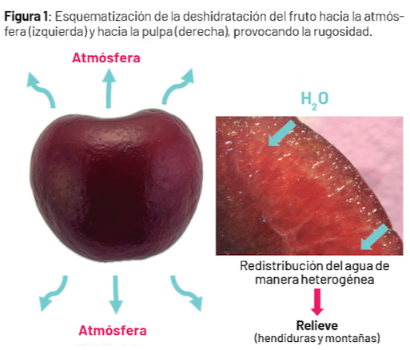
It has also been described that the phenomenon may result from dehydration of the fruit skin, caused by the loss of water vapour from epidermal cells to the atmosphere, a loss that increases in environments with low relative humidity, and/or towards the flesh, as a consequence of its more negative osmotic potential (Figure 1). This process generates a heterogeneous redistribution of water within the cellular space, particularly in the mesocarp cells, giving the fruit its characteristic wrinkled appearance.
In this context, the present study, carried out jointly by the INIA-Biofrutales Cherry Breeding Program (PMG) and the Post-harvest and Virology Laboratories of INIA La Platina, aimed to compare the incidence of the Lizard skin disorder across a group of varieties and advanced selections, at different ripening stages and storage times, and to explore possible tissue-level abnormalities in fruit affected by this disorder. The objective was to provide valuable technical information to the cherry industry and to the genetic improvement of the species.
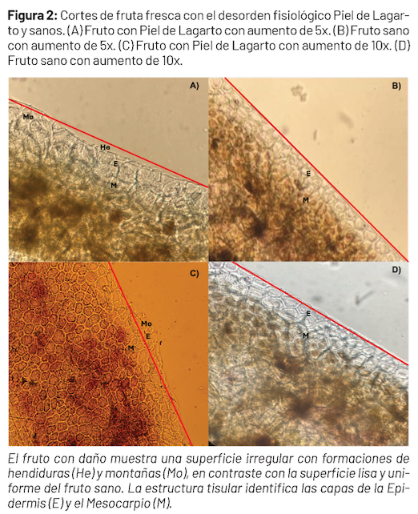
The observation of cross-sections of fresh fruit under the microscope made it possible to identify, in healthy fruit, an organized cellular structure, characterized by a layer of uniform epidermal cells, subepidermal parenchyma and a mesocarp with a normal appearance; this reflects an adequate water balance between cellular compartments and the environment. By contrast, in fruit showing symptoms of the disorder, the epidermal cells were observed to be compressed, flattened and, in some cases, deformed, while the inner layers, such as the subepidermal cells and the mesocarp, showed no morphological alterations. This phenomenon may be the direct result of localized and severe dehydration of these cells.
Through a macroscopic analysis of fresh fruit sections, undulations in the cuticle were observed in samples from fruit affected by Lizard skin (Figures 2A and 2C), resulting in the characteristic tactile roughness of the fruit, in contrast with the smooth, non-undulated cuticle observed in healthy fruit (Figures 2B and 2D).
In addition to the histological observations described above, several commercial cultivars and advanced selections were selected in order to represent the genetic variability present in the Chilean industry. The plant material included the varieties Santina, Lapins, Regina, Sweetheart, Bing, Kordia, Rainier, Brooks and Selection 21 (S-21). The latter is an advanced bicolour selection from the cherry PMG, currently undergoing pre-commercial evaluation. All fruit was harvested during the 2024/25 season in the experimental orchard of the INIA-Biofrutales cherry PMG, located in Buin, in the Metropolitan Region.
Using this plant material, the incidence of the Lizard skin disorder was characterized from harvest up to 30 days of cold storage. The results made it possible to classify the cultivars into three categories, differentiated according to the level of incidence of the disorder studied, highlighting disparities in the levels of damage observed.
The first group, identified as the most susceptible, was led by the Lapins variety, which recorded an average incidence of 50%, confirming it as the genotype most vulnerable to the disorder in this study. It was followed by the cultivars Regina (46%), Santina (45%) and Brooks (42%), after the 30 days of storage considered in this trial (Chart 1). Therefore, for the industry, these genotypes represent the greatest logistical risk, as they account for more than 80% of the national planted area.
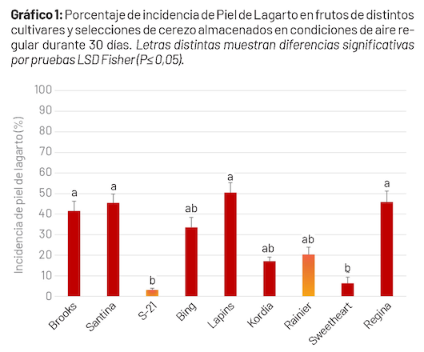
At the opposite end, genotypes with a very low incidence level were identified, particularly Selection 21 (4%) and the Sweetheart variety (7%). These recorded significantly lower incidence levels than the most susceptible group, demonstrating a greater ability to maintain the integrity of the epidermal membrane during post-harvest.
Finally, the study identified a third segment composed of the Bing (33%), Rainier (20%) and Kordia (18%) varieties, which formed a group with intermediate susceptibility.
On the other hand, to study the effect of the fruit’s ripening stage and its response to this disorder, the study considered three stages based on the colour of the epidermis at harvest: Ripening Stage 1, Ripening Stage 2 and Ripening Stage 3 (Table 1).
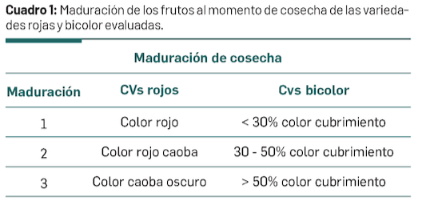
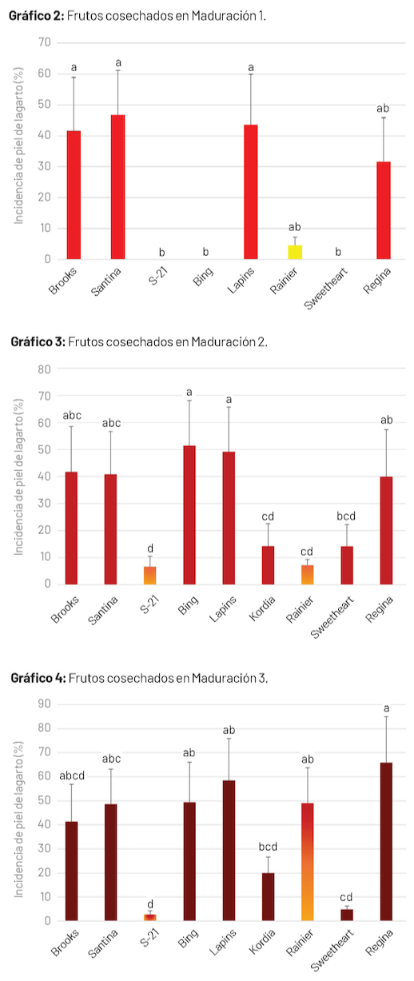
When analysing fruit at Ripening Stage 1, corresponding to early harvest, a marked statistical difference was observed among the cultivars evaluated. At this stage, varieties such as Bing showed 0% incidence, suggesting considerable structural robustness of their epidermis, a behaviour also shared by Selection 21 and Sweetheart.
On the other hand, Regina and Rainier began to show an intermediate level of damage, without reaching the extremes of the most affected varieties, including Santina (47%), Lapins (44%) and Brooks (42%), which showed the highest incidence levels of the season (Chart 2).
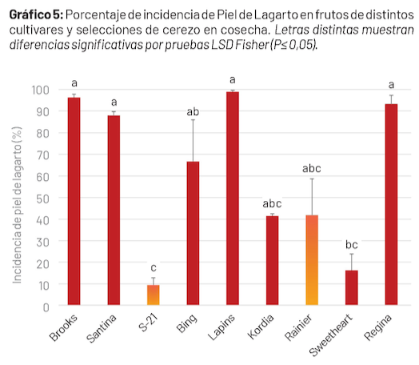
Moving on to Ripening Stage 2, corresponding to intermediate harvest, susceptibility levels underwent drastic changes, particularly in the critical case of the Bing variety. While at the early stage, with red colouring, it showed no damage, once it reached mahogany-red colour its incidence increased to 51%, making it the most affected cultivar in this group and placing it at the top of the highly vulnerable varieties, together with Lapins (49%), Brooks (42%), Santina (41%) and Regina, which had already reached 40% damage. By contrast, Rainier maintained considerable tolerance, with only 8% incidence, entering the group with greater resistance together with Sweetheart (15%), Kordia (14%) and Selection 21 (7%) (Chart 3).
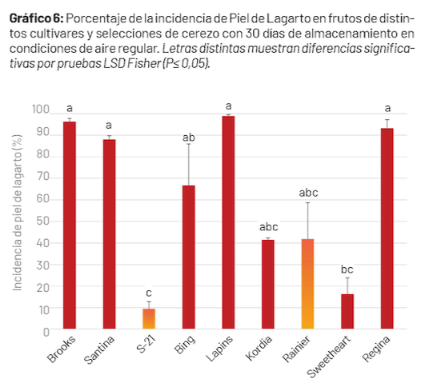
Finally, the evaluation at Ripening Stage 3, corresponding to late harvest, showed a generalized exacerbation of the disorder, with the Regina variety reaching its critical point at 66% incidence, leading the group with the greatest technical risk. This figure is particularly alarming, since dark mahogany colour represents the commercial harvest standard for this cultivar. Rainier also showed a significant increase, reaching 49% damage (Chart 4). These results underline that, for varieties such as Bing, Regina and Rainier, delaying harvest decisively increases the risk of epidermal cellular disorganization due to dehydration, resulting in a critical increase in Lizard skin.
The effect of the fruit ripening stage is not relevant to the incidence of the disorder in all varieties, but it clearly plays an important role in specific cases, such as the Bing, Regina and Rainier varieties, which showed evident increases in incidence. This could be explained by a greater loss of epidermal integrity due to fruit overripening on the tree, which would lead to increased damage, with compaction of the epidermal cells and disorganization of the epidermis caused by dehydration. Furthermore, it remains clear that the varietal factor is decisive in the development of the disorder, due to the uneven behaviour of each variety regardless of fruit ripening.
Another type of analysis conducted was related to the length of time the fruit remained in refrigerated storage at 0 °C, under normal atmosphere conditions. Three evaluations were carried out: at harvest, after 15 days of storage and after 30 days of storage.
During the initial trial, at the time of harvest, it was found that most cultivars entered storage with excellent integrity. However, two varieties already showed a certain level of damage at this stage, particularly Rainier, which recorded the highest incidence, at around 11%, ranking as the most susceptible genotype pre-harvest, followed by Regina with 3% (Chart 5).
After 15 days of storage at 0 °C, the results showed a critical increase in the appearance of Lizard skin, especially in the most sensitive varieties. At this stage, Lapins (52%), Santina (47%) and Regina (41%) showed the greatest increases in damage, demonstrating that just two weeks of cold storage are enough for these cultivars to reveal their high susceptibility. On the other hand, Selection 21 (S-21) ranked as the most tolerant, with 0% incidence, marking a clear difference compared with the rest of the materials evaluated.
Finally, upon reaching 30 days of storage, the damage was practically generalized in the most vulnerable cultivars: Lapins (99%), Brooks (96%), Regina (93%) and Santina (88%) ended the period with almost all fruit affected by this severe superficial damage (Chart 6).
This loss of condition contrasted sharply with Selection 21, which after one month in cold storage recorded only 9% damage, followed by Sweetheart with 16%. These results confirm the potential of these latter genotypes for long-distance shipments, while the other varieties, Bing, Kordia and Rainier, were positioned at an intermediate risk level, with damage ranging from 41% to 67%. This indicates that the initial level of damage would not be a reliable indicator of fruit storage condition during longer transits. As observed in the present study, variety is a factor that defines the commercial risk of the fruit.
From the results, it can be concluded that Lizard skin is caused by dehydration of the epidermal cells, which generates their disorganization. It is important to emphasize that this process does not affect the flesh or the flavour of the fruit. Microscopic analysis confirms that healthy fruit maintains its cellular structure, while affected fruit shows relief patterns with “peaks and depressions”, due to compression, deformation and disorganization of the skin cells. This alteration is the direct cause of the roughness perceived to the touch and the severe depreciation of the fruit’s visual appearance. Sensitivity to this problem depends directly on the variety, indicating that each genotype has a different genetic capacity to maintain the elasticity and integrity of its epidermis. In this trial, the varieties Lapins, Regina, Santina and Brooks were characterized as the cultivars with the highest level of damage, reaching critical values.
By contrast, Selection 21 and Sweetheart showed a particularly relevant low susceptibility, maintaining minimal damage even after 30 days of storage. This confirmed that variety is one of the determining factors in the risk of developing this disorder in cherry cultivation, under the conditions studied.
Although most varieties enter cold storage with a healthy appearance, natural senescence triggers water loss in the skin. This causes sensitive varieties to shift from the absence of damage at harvest to high incidence after 30 days of cold storage. These data highlight the urgent need to understand which agronomic, pre- and post-harvest management factors, as well as which climatic conditions, may trigger this disorder, in order to work on mitigating its economic impact and, at the same time, on the need to develop new and improved varieties for the cherry industry in Chile.
Future studies will be conducted by INIA, together with RANCO, Bioamerica and Vals, as part of the 2026-2029 FIA project entitled “Strategies to mitigate Lizard skin damage in export cherries”. The project will integrate the analysis of field environmental conditions and agronomic management into the research, with the aim of gaining a more comprehensive understanding of which other factors may be associated with this issue.
Source: Mundoagro
Opening image source: Stefano Lugli