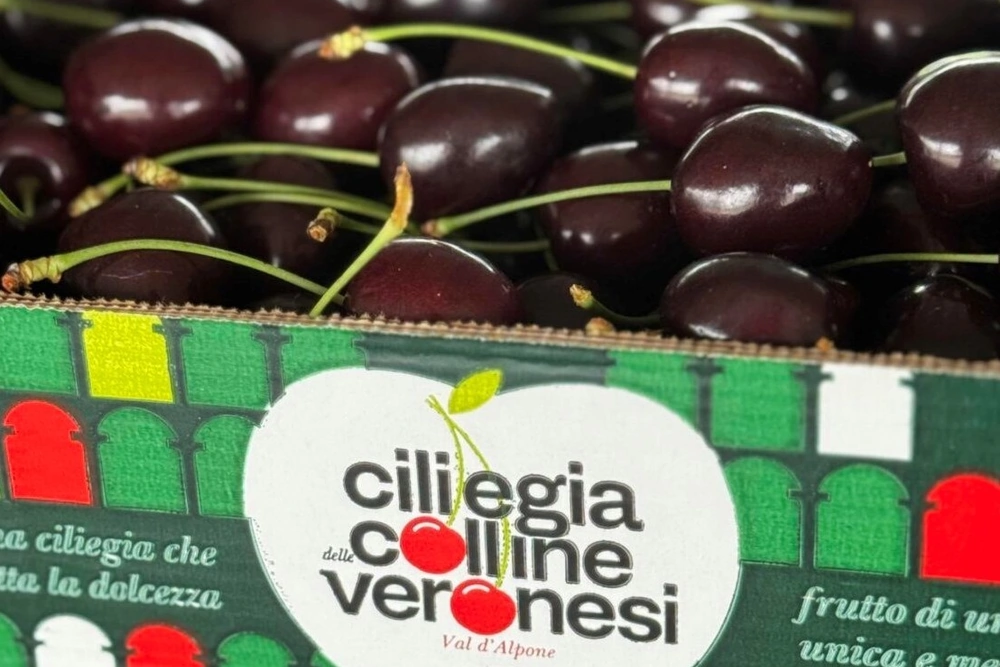
A new step brings the Ciliegia delle Colline Veronesi closer to PGI status.
The public verification meeting promoted by the Ministry of Agriculture, Food Sovereignty and Forestry, in collaboration with the Veneto Region, concluded successfully in the Conference Room of the VeronaMercato Management Congress Centre.
The meeting verified that the proposed product specification complies with the procedures set out in EU Regulation No. 2024/1143, which establishes the single European regulatory framework for the protection of Geographical Indications.
Recognition has not yet been granted: the subsequent national and European stages still need to be completed.
For the area, this would be a new addition to its protected designations, following Pesca di Verona PGI, recognised in 2010. Previously, the EU designation had been awarded to Riso Vialone Nano Veronese PGI in 1996, Marrone di San Zeno PDO in 2003 and Radicchio di Verona PGI in 2009.
The specification: 54 municipalities and manual harvesting
The hearing was attended by representatives of the municipalities concerned, professional and trade organisations, growers and business operators.
Ministry officials Armando Morelli and Beatrice Bernabei read out the proposed product specification, supported by Alessandra Scudeller from the Agri-food Directorate of the Veneto Region, which had already issued a favourable opinion on the text.
The document covers the fruit of the sweet cherry tree, Prunus avium L., and defines a production area encompassing 54 municipalities in the province of Verona. The area includes a hilly zone with calcareous soils and the Val d’Alpone area, characterised by volcanic and basaltic soils.
The permitted cultivars are classified by ripening period, from very early to late varieties.
The specification also establishes minimum fruit size and Brix levels, requires exclusively manual harvesting and regulates packaging and labelling, providing for the official logo to be accompanied by the European PGI symbol.
A project launched in the 1990s
The public hearing marks a key milestone in a process that began in the 1990s to protect the product's identity and reputation.
Included in the National List of Traditional Agri-food Products in 2000, the Ciliegia delle Colline Veronesi enjoys an established market presence and a documented production history dating back to the 16th century.
The application concerns a supply chain that, across the province, comprises more than 1,200 hectares under cultivation and over 2,300 farms involved in cherry growing. The recognition aims to support its prospects for economic and environmental development.
The growers' voice
Davide Danese, president of the Cherry Growers' Association for the Ciliegia delle Colline Veronesi, the organisation behind the application, sees the outcome of the meeting as confirmation of the growers' unity.
A supply chain ready, he stresses, to promote a fruit associated with the quality, flavour and tradition of Verona's hills on the national and European markets.
For Alex Vantini, president of Coldiretti Verona, the shared approval of the specification reaffirms the economic value, as well as the social and cultural value, of local cherry growing. PGI status would provide growers with a means of protection and consumers with a guarantee of origin.
The contribution of technical experts
Vantini thanked the farms that have continued to support the project and the technical experts involved in bringing it to fruition.
Among them, Giorgio Girardi, Head of the Fruit and Vegetable Sector at Coldiretti Verona, has followed the process from its inception, contributing to the necessary documentation.
Girardi attributes the result to collaboration among growers, associations, technical experts and institutions, recalling that several steps will still be needed before registration.
The 2026 season and the issue of recognisability
The assessment of the 2026 cherry season shows a 25% increase in production at the start of harvesting, with satisfactory prices until early June.
The arrival of larger volumes of cherries from other Italian and foreign origins then made it more difficult to secure value for the Veronese product, pushing prices even below production costs.
According to Danese, the absence of a distinctive label makes it difficult for consumers to recognise and repurchase cherries they have previously enjoyed.
Demand was also affected by high temperatures, which encouraged purchases of other summer fruits, such as peaches, melons and watermelons, and less expensive products.
The future PGI therefore has a tangible commercial purpose: making the origin of the cherries recognisable and enhancing the value of the work carried out by farms.
Institutional support
Members of the European Parliament Flavio Tosi and Daniele Polato highlighted the protection of quality products and reciprocity in trade.
Polato recalled the European commitment to defending geographical indications, while Tosi cited the ban on meat from Brazil as an example of the application of reciprocity.
Matteo Pressi and Alberto Bozza attended on behalf of the Regional Council. The latter acknowledged the contribution of the expertise of the Veneto Region in overcoming the difficulties encountered.
Collaboration with the local area
Pietro Trincanato, speaking on behalf of the Municipality of Verona, emphasised the link between the centuries-old history of cherry growing and care for the land.
The mayor of San Giovanni Ilarione, Luciano Marcazzan, conveyed greetings from the six municipalities that launched the project: San Giovanni Ilarione, Soave, Monteforte d’Alpone, Vestenanova, Montecchia di Crosara and Roncà.
Alessandra Scudeller identified collaboration with local businesses and the tourism sector as a key element in promoting the product, telling its story and strengthening its connection with its places of origin.
The next steps towards PGI status
The process will continue with the ministerial formalities and publication of the proposal in the Official Gazette. This will be followed by a period of 30 days for submitting any objections to the Ministry of Agriculture.
The objections will be examined through discussions with the applicant, with the aim of reaching an agreement and assessing whether to continue the procedure. If none are received, or if they are deemed inadmissible, the documentation will be forwarded to the European Commission.
The EU examination may involve requests for comments and additional information. It generally takes at least one year from the public hearing to final publication: a process that still needs to be completed and from which the supply chain expects new opportunities for protection and value enhancement.
Source: coldirettiverona.it
Image source: Associazione Ciliegie delle Colline Veronesi
Cherry Times - All rights reserved