Recent rains and hailstorms are affecting fruit production in central Chile unevenly, making it difficult to estimate their impact on output. According to Víctor Catán, president of Fedefruta, the cherry crop could reach around 100 million boxes, or fall below that level. He also urges growers not to ship fruit that fails to meet the quality requirements of international markets.
Cherry production estimate
A preliminary estimate from the Fedefruta president, while damage is still being assessed.
The final volume could be lower
The estimate is below initial projections and is not yet a final assessment.
Estimate reported by Víctor Catán, president of Fedefruta.
Uneven damage and a preliminary assessment
Fedefruta is gathering information to assess the effects of the latest weather events, but it is too early to provide a definitive assessment. Damage varies considerably from one farm to another: some orchards have been seriously affected, while others, even nearby, have escaped with little or no damage.
In the past, the North-South Highway often marked a divide between areas more affected to the east and those less affected to the west. This year, however, the effects have appeared rapidly from one area to the next. Peumo, where hail is uncommon, has also reported damage.
Some affected crops had not yet reached flowering or fruit set. Catán therefore considers it too early to quantify losses. Pasture sowings are among the most exposed, both to hail and excess water: in some cases, the entire planting has been lost and may need to be resown, if the weather allows. Processing tomatoes and some other vegetables are also facing difficulties.
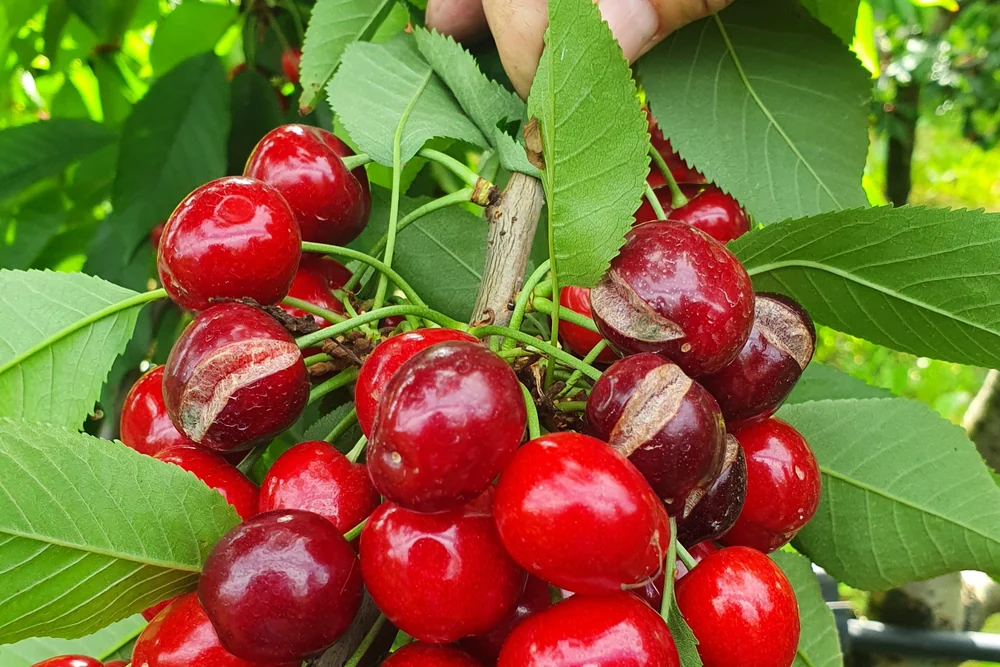
Cherry output may fall below projections
After several challenging seasons for growers, the cherry harvest may also fall short of initial estimates. Catán expects a significant decline, with output close to 100 million boxes or even lower.
The outlook will depend on how the weather develops and on the differences between individual orchards. For this reason, Fedefruta will continue monitoring production areas before issuing an overall assessment.
Quality starts with the grower
For Catán, quality control must begin on the farm. Packing and shipping fruit that is unsuitable for transport can undermine an individual grower’s financial results and, at the same time, damage the reputation of Chilean fruit in international markets.
Available packing capacity or favourable market conditions should not encourage growers to ship fruit that is not in suitable condition. As the Fedefruta president points out, growers know their fruit and must carefully assess whether it is fit for sale. If non-compliant fruit is shipped, good-quality fruit can also suffer the consequences.
From a technical standpoint, preventive measures should be taken before weather events occur. After the rains and hailstorms, growers will need to assess whether curative or preventive treatments are appropriate ahead of further events, which may continue to occur.
Infrastructure for water security
Out-of-season rainfall poses a threat to crops, but it also brings water management back into focus. At Fruittrade a few weeks ago, Fedefruta called for stronger water security, alongside the other security priorities identified by the organization.
According to Catán, Chile needs to invest in infrastructure such as reservoirs and pressurization systems to manage increasingly intense weather events and retain more of the available water. The Fedefruta president cites the regions of Valparaíso, Metropolitana and O’Higgins: the Aconcagua and Maipo river basins, as well as the O’Higgins Region, lack headwater reservoirs.
Water security: areas cited by Fedefruta
Three regions that Catán identifies as lacking headwater reservoirs.
Valparaíso
Aconcagua River basin
No headwater reservoir
Metropolitan Region
Maipo River basin
No headwater reservoir
O’Higgins
Region cited by Catán
No headwater reservoir
El Yeso: Catán clarifies that the reservoir is intended to secure drinking water for Greater Santiago and human consumption.
Catán clarifies that the El Yeso reservoir is intended to secure drinking water for Greater Santiago and human consumption. He adds that new projects may also require farmers to contribute to their financing. Concessions are one possible mechanism he suggests.
The cherry production estimate remains provisional as growers continue assessing the damage. The challenge for the sector will be to manage the effects of severe weather without lowering quality standards, while moving forward with the investment needed to strengthen water security.
Source: coagra.cl
Image source: Stefano Lugli
Cherry Times - All rights reserved