The varieties showed good fruit size, firmness and sugar levels in commercial orchards planted in 2020 and 2021, with positive results despite the season’s climatic challenges.
With a harvest 7–10 days earlier than Santina in comparable blocks treated with similar rates of cyanamide, Sweet Aryana® is confirming its early-season performance in the Maule Region. This trait is accompanied by good yields and fruit quality, as observed during the technical visit on Tuesday, 10 November, to Fundo Pencahue, owned by Agrícola Mercedario. The visit also confirmed the good performance of Sweet Lorenz® and Pacific Red.
Sweet Aryana® harvest lead
Difference from Santina in comparable blocks treated with similar rates of cyanamide.
Sweet Aryana®: reference Santina: 7–10 days later
0 days 7 days 10 days
Sweet Lorenz® was observed with a harvest date 2–3 days apart from Sweet Aryana®; the text does not specify whether it was earlier or later.
After recording more than 80 mm of rain and some hailstorms in certain orchards, the company considers the results so far better than expected.
Sweet Aryana® fruit stood out for its size, with a predominance of 2J and 3J sizes, as well as for its good firmness and sugar levels. The variety’s performance has been rated positively by the company’s team, which continued planting new orchards in 2026.
Sweet Lorenz® was observed in the same block alongside Sweet Aryana®, with a harvest date just two or three days apart. Its fruit showed very good quality, sweetness and firmness, and an even larger size distribution than Sweet Aryana®. “We didn’t expect that. It was a pleasant surprise,” the company’s technical team said.
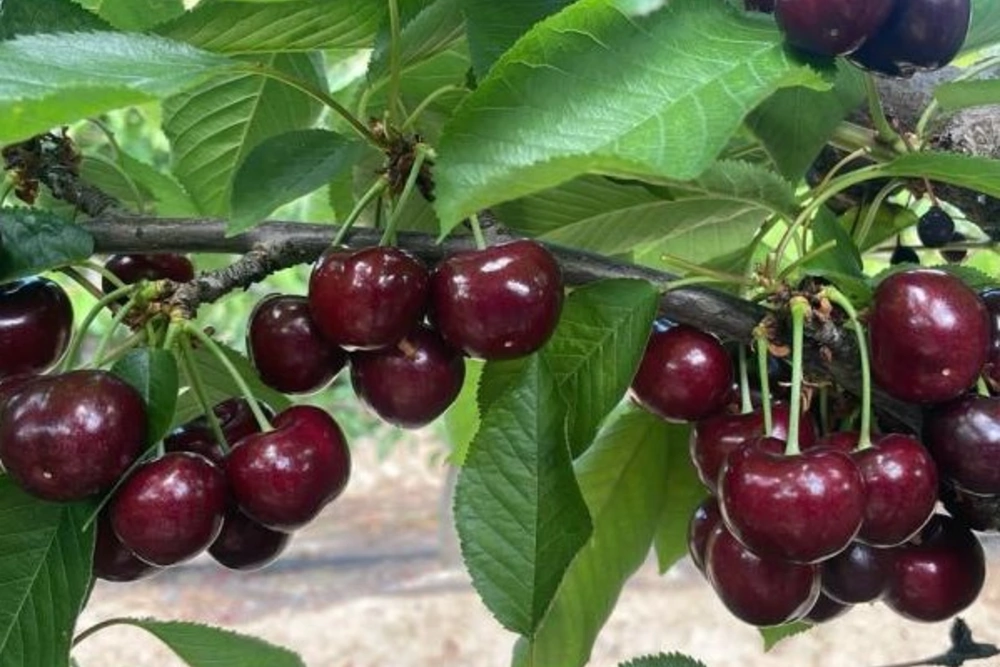
Pacific Red, in turn, showed a favourable combination of fruit size and firmness. During the visit, the harvest criteria were reviewed, with a colour score close to 3.5 considered a reference for starting picking. It is worth noting that differences in exposure and elevation across the property led to variations in maturity between blocks; harvest dates should therefore be interpreted in light of the conditions in each area.
These results are particularly significant in a season marked by heavy rainfall and episodes of soil saturation. In this context, the company’s team highlighted the importance of its drainage network and the nutritional and growth-stimulation practices carried out during the season. The fruit nearing harvest that was observed during the visit was in good condition, with better firmness and sweetness than the first picks.
Discussions with growers and technical teams made it possible to compare management experience and harvest criteria, providing useful information for further assessing the potential of these self-fertile varieties in the early-season cherry offering. ANA Chile® will continue sharing results from commercial orchards to support production decisions across the industry.
Source: anachile.cl
Image source: ANA
Cherry Times - All rights reserved