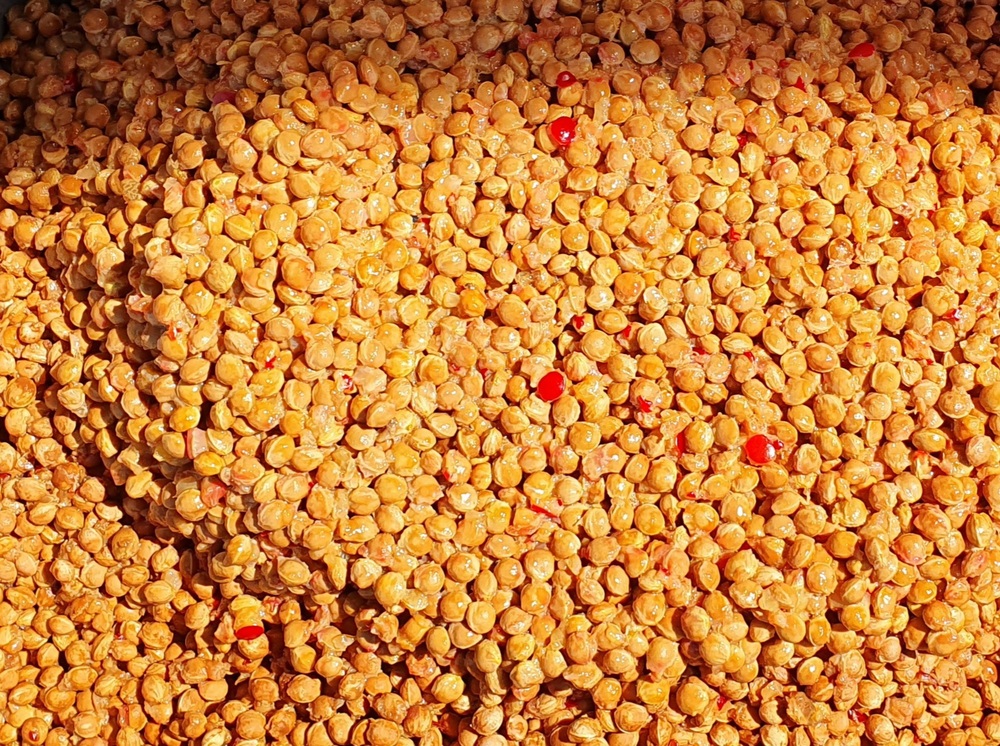
The accidental presence of pits in cherries intended for industrial processing represents a significant issue for both product quality and consumer safety. Traditional inspection methods may be limited in terms of speed, accuracy, or their ability to operate non-destructively.
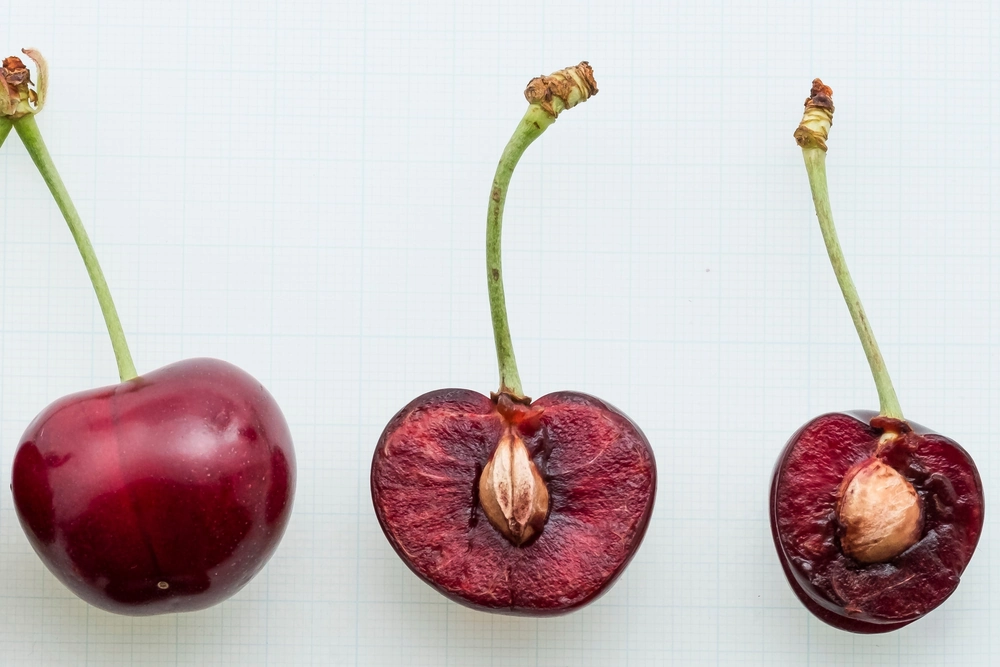
To address this challenge, a study conducted at Michigan State University (USA) developed an innovative pit-detection approach based on short-wave infrared (SWIR) hyperspectral imaging, with the goal of automatically distinguishing properly pitted cherries from those that still contain a pit.
For this investigation, the researchers designed a hyperspectral imaging system operating within the 900–1700 nm wavelength range. The system was configured in transmission mode, allowing the measurement of the amount of radiation passing through the fruit and providing information about its internal structure.
Sample analysis
Cherries from two different cultivars were analyzed in multiple orientations, both before and after the pitting process, to assess the robustness of the method against natural sample variability. Mean transmittance spectra were extracted from the acquired hyperspectral images and subsequently used to develop classification models.
Spectral analysis revealed significant differences between pitted and unpitted cherries, particularly within the 1000–1050 nm wavelength region. In this range, pitted cherries exhibited higher transmittance values, likely due to the reduced attenuation of radiation in the absence of the woody pit structure inside the fruit.
To improve computational efficiency and identify the most informative spectral features, the authors applied several wavelength-selection techniques. Initially, the Backward Interval Partial Least Squares (BiPLS) method was used to reduce data dimensionality and identify relevant spectral intervals.
Wavelength selection
This was followed by the application of Competitive Adaptive Reweighted Sampling (CARS) and the Successive Projection Algorithm (SPA), which were employed to select key wavelengths. The resulting wavelength sets were further optimized using a genetic algorithm, enabling the identification of a compact group of highly discriminative spectral bands.
Model performance was evaluated using machine-learning algorithms, including Random Forest and Support Vector Machine classifiers. The results were remarkable: within the 1007–1057 nm spectral interval, both classifiers achieved 100% accuracy, precision, recall, and F1-score in distinguishing cherries with pits from those without.
In contrast, wavelengths above 1436 nm produced substantially lower accuracies, ranging from 50% to 67%, indicating limited discriminative power in that spectral region.
Classification performance
A particularly noteworthy finding was that individual wavelengths—specifically 1007, 1014, 1032, and 1236 nm—were sufficient to achieve perfect classification performance. This suggests that costly full hyperspectral systems may not be necessary for industrial applications.
Instead, simpler and more affordable multispectral or even monochromatic imaging systems could potentially be developed for real-time, in-line inspection.
Finally, the classification models proved highly robust to variations in fruit orientation during image acquisition, a crucial requirement for integration into automated processing environments.
Industrial potential
Overall, the study demonstrates the strong potential of SWIR hyperspectral transmittance imaging as a non-destructive technology for detecting pits in cherries. The findings pave the way for faster, more reliable, and real-time quality control systems that could significantly enhance efficiency and safety in the food processing industry.
Source: Naseeb Singh, Yuzhen Lu, Non-destructive detection of pits in cherries using shortwave infrared hyperspectral transmission imaging, Food Bioscience, Volume 75, 2026, 108201, ISSN 2212-4292, https://doi.org/10.1016/j.fbio.2025.108201
Image source: Stefano Lugli
Melissa Venturi
Ph.D. in Agricultural, Environmental, and Food Sciences and Technologies – Fruit Tree Physiology and Cultivation - Bologna, Italy
Cherry Times - All rights reserved