Agri-photovoltaics aims to integrate agricultural and energy production. Various crops can benefit from the protection against weather conditions or the shading provided by solar panels, while electricity is generated at the same time.
A visit to the first commercial agri-PV system for cherry trees in the Canton of Aargau and to the FiBL experimental facility highlights the potential of this technology, but also the obstacles and questions that remain unresolved. The exchange of experiences on agri-photovoltaics in fruit growing was organized by FiBL and the Liebegg Agricultural Centre.
Agri-photovoltaics and cherry trees
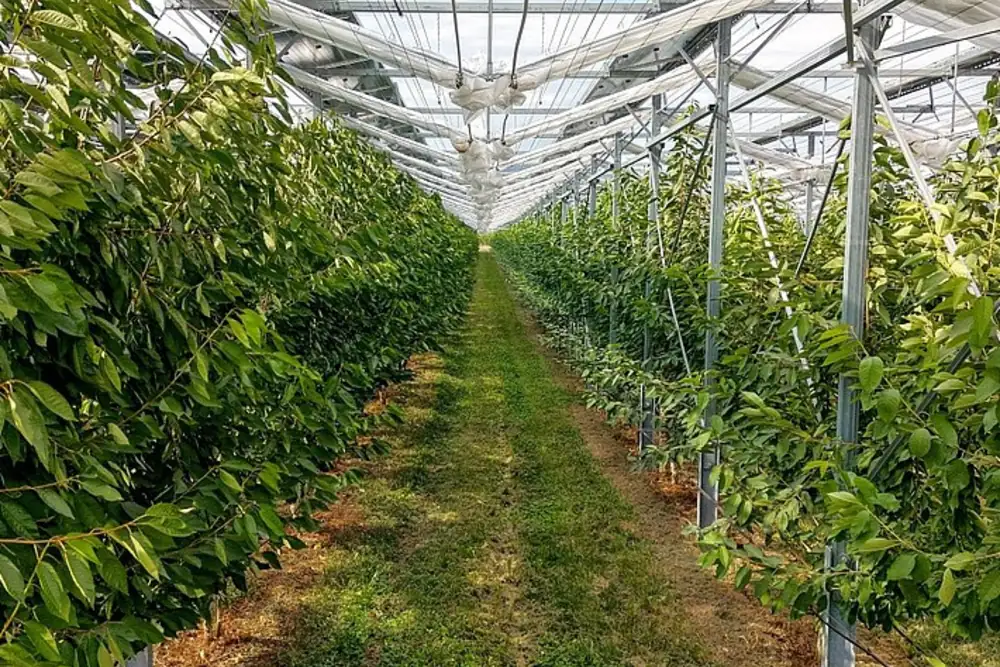
Instead of traditional protective netting, in Leuggern, in the Canton of Aargau, a structure made of solar panels and steel profiles stretches above the cherry trees.
“Around 300 tonnes of steel were used to build the system,” explains Hansjörg Erne. Together with Ruedi Obrist, he manages almost ten hectares of orchards as part of the ‘Chilspeler Obst’ farming partnership.
The two growers cultivate cherry trees, apple trees, pear trees and 290 standard fruit trees, mainly plum and quince trees.
Since 2024, a special cherry orchard has occupied 1.4 hectares of their land: 1.12 hectares are covered by an agri-photovoltaic system, abbreviated as agri-PV. It is the first privately owned commercial system of its kind in the Canton of Aargau.
When two people have the same idea
The idea came independently to both Erne and his wife, and to Obrist, after reading a newspaper article.
While harvesting plums together, they realized that they were both considering the same possibility.
Tobias Beeler, project manager at Insolight, supported the two fruit growers from the planning and permitting stages through to finding investors, construction and commissioning of the system.
The investor is Energie 360. The system cost around 1,200 Swiss francs (approximately EUR 1,275) per kilowatt-peak, in addition to grid connection costs. “At present, there are actually more investors than concrete projects,” says Tobias Beeler.
The permit took time
The process leading to the construction of the system, however, was longer than expected. In general, systems of this kind are still relatively uncommon in Switzerland.
Under the Spatial Planning Ordinance, agri-PV is permitted only if it provides added value to agricultural activity.
Moreover, it was the first commercial system not intended for research purposes and it bordered an area subject to landscape protection. These were all aspects that the Canton of Aargau first had to assess.
To obtain the permit, it was necessary to demonstrate, among other things, that the cherry trees would receive sufficient light despite being covered by the solar panels.
The panels reduce the amount of light by around 25%. “This is essentially comparable to traditional protective netting used in cherry cultivation,” explains Tobias Beeler, project manager at Insolight.
A long wait, a high output
The fruit growers waited one year before receiving the Canton’s decision. In the meantime, the cherry trees were already ready at the nursery.
“In the end, we decided to plant the trees anyway,” says Erne, “even though we knew this would complicate the subsequent construction of the system.” In the summer of 2024, the good news finally arrived: the permit was granted.
The system has an installed capacity of 732 kilowatt-peak. “Under full solar irradiation, it produces more energy than can be fed into the grid,” says Erne.
The transformer is designed for a maximum feed-in capacity of 630 kilowatts. According to Beeler’s estimates, around one quarter of the electricity produced should be generated during the winter.
Protection from rain
The solar panels can provide a certain degree of protection against weather conditions. The cover alone, however, is not sufficient to protect delicate cherries from rain.
For this reason, the system has also been equipped with a dynamic rain protection system using sheeting. The transparent cover can open and close automatically. A number of sensors detect rainfall, temperature and wind, while the system can also be controlled via an app.
“In five minutes, the sheet roof can be fully opened or closed,” says Erne. Rapid opening is important to prevent excessive humidity from accumulating under the cover.
Around midday, part of the tree is in the shade of the panels, potentially helping to reduce heat stress. At the same time, however, it must not be forgotten that the trees need sufficient light.
“The orientation of the panels is therefore crucial,” explains Erne. So far, he has observed no negative effects on the cherry trees. However, long-term scientific data are still lacking.
“Practice is outpacing research”
“In some respects, practice in this sector is outpacing research,” says Hans-Jakob Schärer of FiBL.
As part of the AgiSolar research project, FiBL, together with the Liebegg Agricultural Centre and the Canton of Aargau, is studying which crops are suitable for agri-PV, as well as aspects related to spatial planning, technology and economic sustainability.
The effects on disease pressure and the management of water and soil are also being analysed. At the agri-PV experimental facility in Frick, covering around 600 square metres, not only solar panels but also numerous sensors have been installed since 2024.
Among other parameters, these measure leaf wetness, temperature, the amount of light and soil moisture. Yields, flower bud formation and any potential delay in ripening are also monitored. One trial compares the development of the Gala and Rustica varieties with and without agri-PV.
Schärer describes these systems as providing a kind of “climate balancing”: they can mitigate both heat peaks during the day and the most severe frosts.
Water management is becoming increasingly important
At the FiBL experimental facility, gutters have been installed to better channel the water coming from the solar panels.
At present, the water is still discharged through the drainage system, but in the long term there are plans to create a semi-natural retention basin beneath the system.
The collected water could then be used to irrigate the crops while simultaneously helping to create a habitat that supports biodiversity.
Irrigation and future prospects
“Water management should always be taken into account when designing a system of this kind,” stresses Schärer.
In the ‘Chilspeler’ cherry orchard, meanwhile, Agroscope measures the trunk diameter of the trees using a dendrometer. These data make it possible to determine the water requirements of the plants and automatically adjust irrigation accordingly.
Many questions remain unanswered, and only in the future will it be possible to determine whether this technology will provide substantial benefits to agriculture, which crops it will truly be effective for, and whether it will help reduce the use of plant protection products.
“In a few years, we will know,” concludes Schärer.
Image source: Mathias Ludwig, FiBL
Michelle Knecht
FiBL
Source: BIO Aktuell - FiBL
Cherry Times - All rights reserved