Recent heavy rainfall, together with hailstorms that have hit central Chile, has triggered a complex production and phytosanitary crisis, with serious repercussions for the agro-export supply chain. The greatest damage is concentrated across the Metropolitan, O’Higgins and Maule regions.
Impact on Chilean cherry production
Output expected to fall below 100 million boxes
Initial season estimate 140 million
Estimated output after the damage less than 100 million
Comparison on a scale proportional to the initial estimate of 140 million boxes. The bar for expected output represents a figure below 100 million.
Production damage
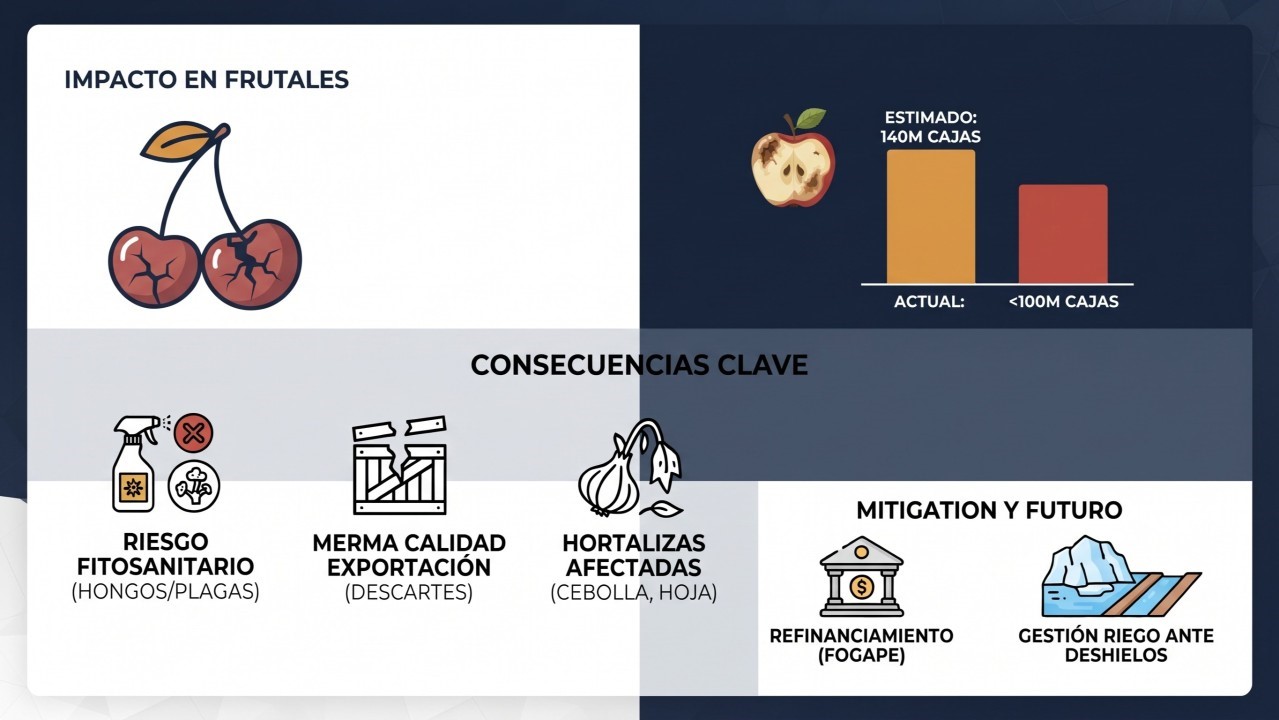
- Decline in cherry production: initial estimates pointed to a record season, with 140 million boxes. However, damage to more sensitive varieties such as Regina and Kordia, combined with problems affecting flowering and fruit set, is expected to bring production below 100 million boxes.
- Financial losses for individual growers: particularly severe cases, such as those reported by growers in Colín, in the Maule Region, involve total losses exceeding 15 million Chilean pesos per hectare directly hit by hail.
- Lower yields: in the Metropolitan Region, orchards that typically have a potential yield of 10–12 tonnes per hectare are currently producing 3–4 tonnes. The physical impact of hail and flooding has affected up to 50% of cultivated areas.
- Vegetables and traditional crops: onion seedbeds have suffered total losses, with 25% of seedlings unable to be transplanted on schedule. Significant damage has also been reported to leafy vegetables, including cabbage, spinach, broccoli and lettuce, which are oxidising rapidly due to excess moisture. Waterlogged soils have also delayed maize planting.
Main impacts and risks
- Phytosanitary risks and pest pressure: persistent rainfall has prevented growers from applying adequate crop protection and nutritional treatments at key times. High humidity creates favourable conditions for fungal diseases such as apple scab, requiring strict product rotation to prevent resistance and significantly increasing post-harvest costs. There are also concerns about the emergence of highly damaging pests, including Drosophila suzukii and San José scale, if growers cut back on maintenance work in response to low expected returns.
- Logistical challenges and lower export quality: hail-damaged fruit develops microcracks that can provide entry points for pathogens. Some lots intended for the fresh market will therefore have to be rejected and diverted to processing. Strict packing standards will be needed to protect the image of Chilean fruit in international markets.
- Financial pressure and need for public support: reduced fruit availability in domestic and export markets could push prices higher, partly offsetting lower volumes. Experts warn, however, that support from banks and public instruments—including an urgent increase in the amounts and terms available under the FOGAPE programme and refinancing schemes—will be essential to prevent hundreds of growers from becoming insolvent. Many have lost infrastructure, including greenhouses and hail nets, as well as production potential for the next three to four years.
- Risks in the coming weeks: rising temperatures could accelerate snowmelt, seriously threatening canal intakes and creating critical challenges for summer irrigation.
Opening image credit: Stefano Lugli
Cristiano Olmos Iriarte
Management Control and Finance | Business Intelligence
Cherry Times – All rights reserved