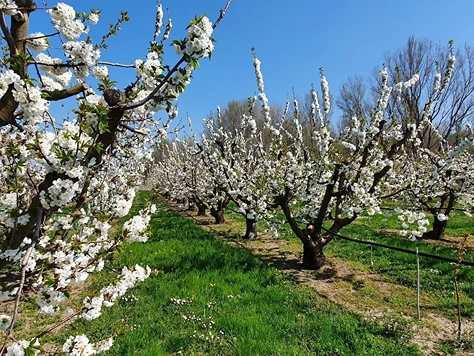
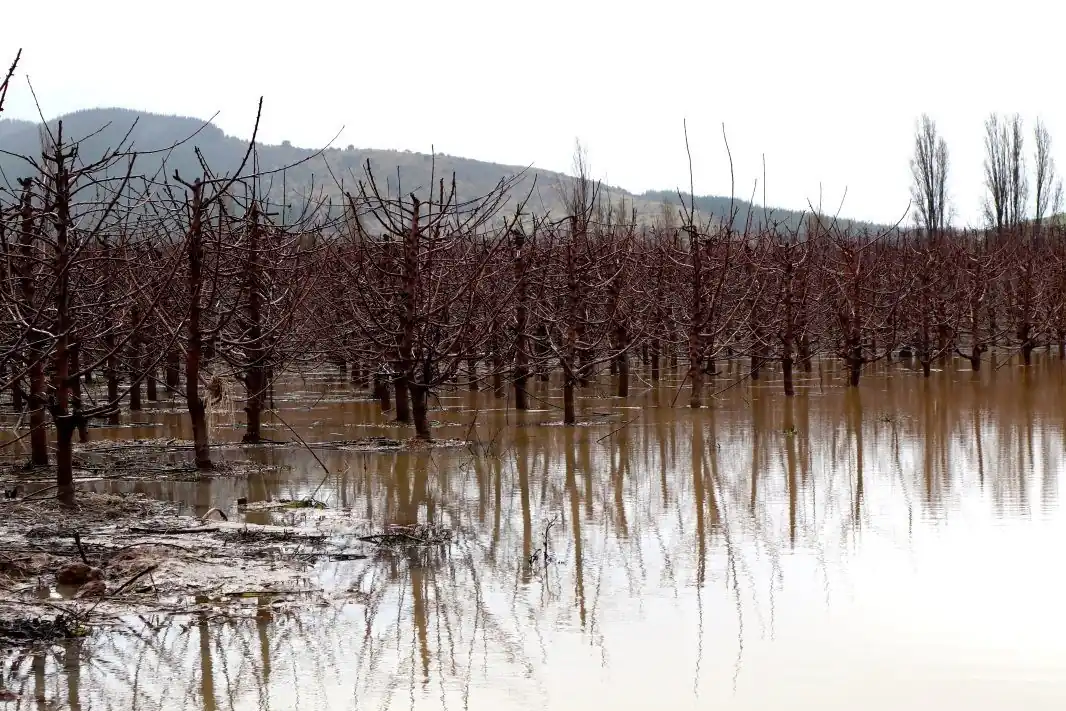
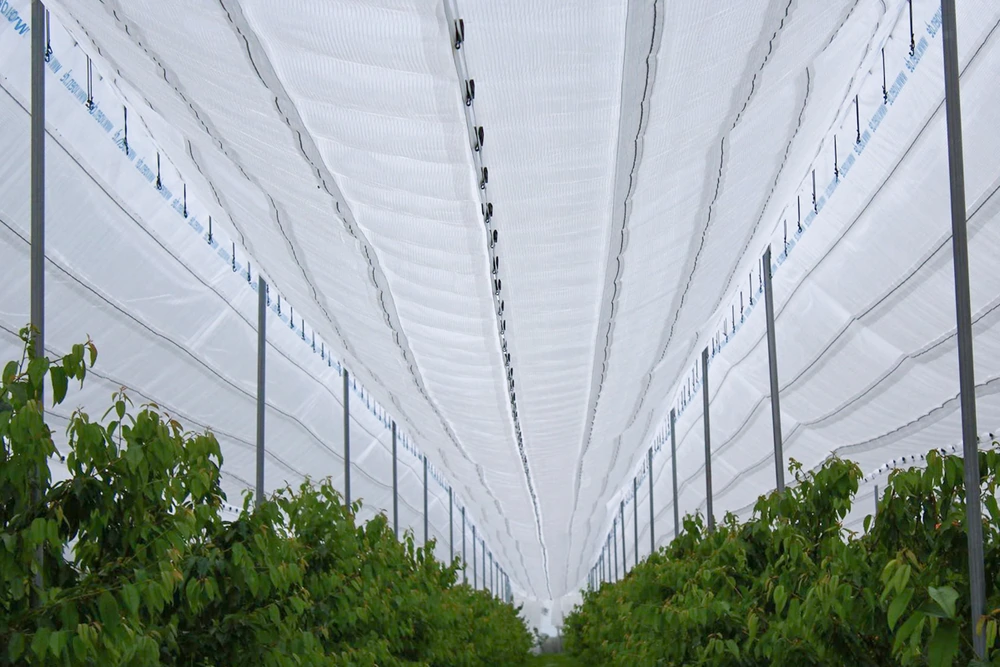
The use of protective systems is an increasingly widespread strategy in modern fruit production, particularly in sweet cherry, a crop highly sensitive to adverse weather events. A recent study investigated the effects of self-ventilating rain covers on orchard microclimate under Australian conditions (New South Wales), providing useful insights into the potential of these systems in the context of climate change.
The results show that such covers not only provide physical protection to trees and fruit, but also induce changes in temperature and relative humidity, with effects that depend on seasonal climatic conditions.
Warm conditions
Under warm conditions, defined by daily maximum temperatures equal to or above 27°C, the covers showed a mitigating effect on maximum air temperature, with reductions of up to approximately 4°C compared to the uncovered control. At the same time, an increase in minimum relative humidity of around 17% was observed, indicating reduced evaporative stress. Conversely, under cooler conditions (maximum temperatures below 27°C), the impact of the covers on microclimate was limited, suggesting a dynamic system response depending on environmental conditions.
An interesting aspect concerns thermal accumulation, expressed as Growing Degree Hours (GDH). Despite lower maximum temperatures, trees under cover accumulated a greater amount of GDH compared to the control, due to longer periods spent near the optimal temperature for development. This may result in accelerated phenological processes and potentially earlier fruit ripening, although further experimental validation is required.
Thermal peaks
High temperatures (>30–34°C) are known to impair key processes such as sugar and anthocyanin accumulation and to promote floral abnormalities such as double pistil formation. In this context, the ability of self-ventilating covers to mitigate thermal peaks represents a significant agronomic advantage, with potential positive effects on fruit market quality. At the same time, the increase in minimum relative humidity may contribute to reduced irrigation requirements due to lower evapotranspiration.
Canopy-scale analysis revealed microclimatic differences between vertical layers, with limited but statistically significant effects on some quality parameters. In particular, fruit collected from the lower canopy (1.5 m) showed greater firmness compared to fruit from the upper canopy (2.5 m), with no significant differences in weight, size, or sugar content. This finding suggests a possible interaction between local microclimate and fruit quality, warranting further investigation.
Cover management
A notable variability in the observed effects was also detected, both between seasons and within the same season. This variability highlights the importance of on-farm microclimate monitoring using field sensors, in order to optimize cover management under specific conditions. Furthermore, comparison with other protection systems indicates that self-ventilating covers, due to enhanced airflow, may avoid the excessive heat buildup typical of more enclosed structures such as tunnels.
In conclusion, self-ventilating rain covers emerge as an effective tool for modifying orchard microclimate in sweet cherry under Australian conditions, capable of reducing thermal stress during critical high-temperature periods without significantly altering the microenvironment under milder conditions. In a context of increasing climate variability, the adoption of these systems could contribute to production stability and fruit quality, although further research is needed to better understand their interactions with quality traits and crop phenology.
Source: Song, X., Fearnley‐Pattison, J., Kelley, J. M., Allingham, D., Lawson, J., & Benter, A. (2026). Effects of Rain Covers on Orchard Microclimate in Sweet Cherries (Prunus avium L.). New Zealand Journal of Crop and Horticultural Science, 54(1), e70110. https://doi.org/10.1002/nzc2.70110
Image source: Waldis
Andrea Giovannini
PhD in Agricultural, Environmental and Food Science and Technology - Arboriculture and Fruitculture, University of Bologna, IT
Cherry Times - All rights reserved