In modern fruit systems, crop load management is a crucial factor for obtaining commercially competitive fruit. Manual thinning, although effective in reducing excessive fruit set and preventing the development of undersized fruit, presents significant limitations.
These include high labor costs, increasing difficulty in finding workers, and greater energy expenditure by the plant, as the intervention occurs when the fruit has already formed. The thesis conducted at the University of Chile examines the use of chemical agents as an alternative to manual flower thinning in sweet cherry.
Its aim is to improve fruit quality and size while maintaining high productivity levels. In this context, chemical flower thinning emerges as a more efficient strategy, as it allows intervention at early developmental stages, reducing the number of flowers that will develop into fruit.
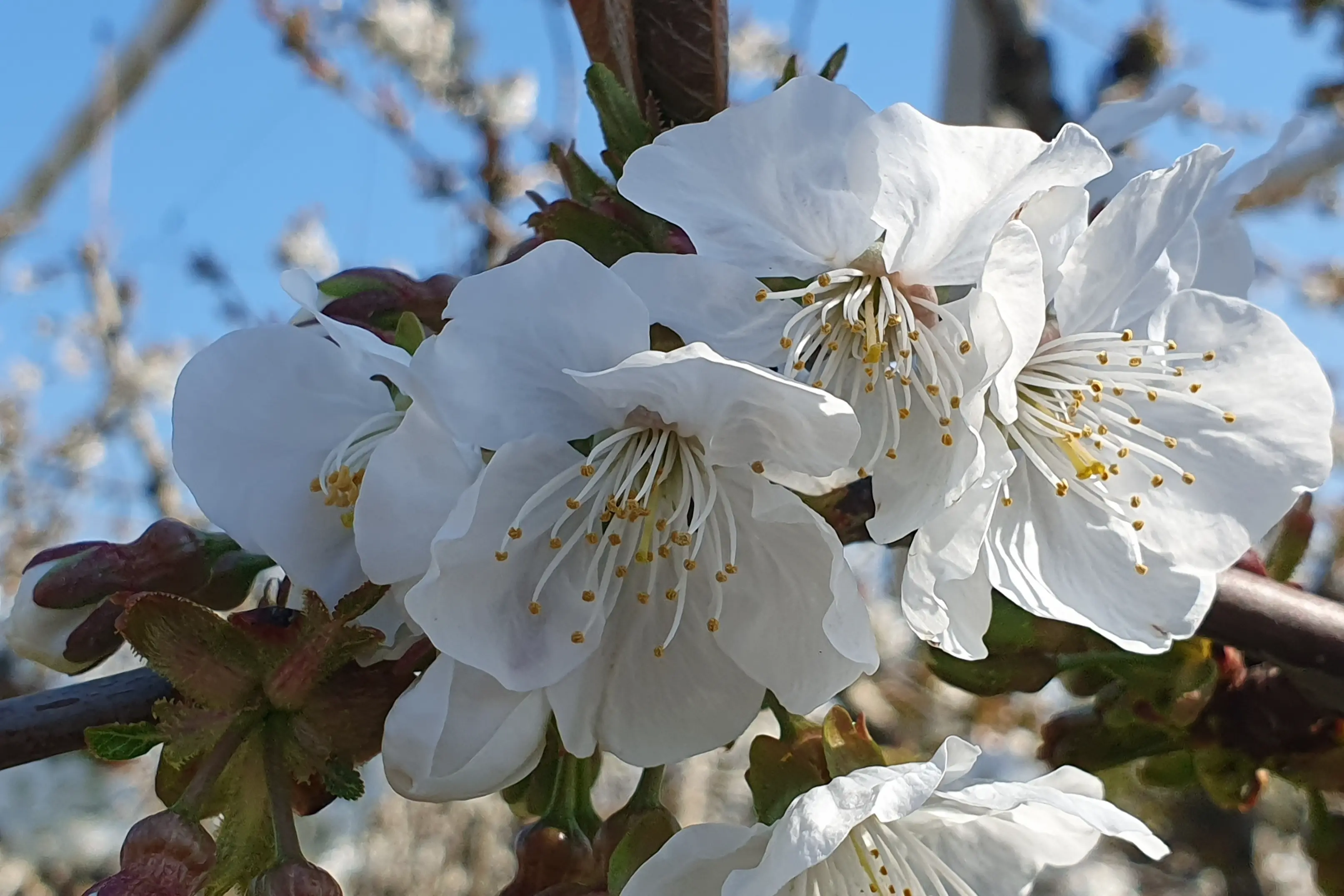
However, in sweet cherry
However, in sweet cherry, the effectiveness of these treatments is still under investigation, with results often varying depending on conditions and the products used. The study aims to evaluate the effectiveness of two chemical agents—ammonium thiosulfate (ATS) and 1-aminocyclopropane-1-carboxylic acid (ACC)—applied at different concentrations and at different stages of flowering.
Their effects were compared with manual thinning. The experiment was conducted in 2023 in a commercial orchard of ‘Regina’ variety, located in the O’Higgins region of Chile. The experimental design included multiple treatments, combining two concentrations for each product and three application timings.
These timings corresponded to 10%, 50%, and 80% of full bloom, as well as two controls: one untreated and one subjected to manual thinning. The evaluations considered several agronomic parameters, including fruit set rate, vegetative vigor, and the presence of possible phytotoxic damage.
And fruit quality attributes
They also considered fruit quality attributes such as size, sugar content, acidity, color, and size distribution at harvest. This comprehensive approach allowed for an integrated assessment of both treatment effectiveness and their impact on final fruit quality.
The results show significant differences among treatments. In general, ACC proved particularly effective in reducing fruit set, especially at higher concentrations, leading to a marked decrease in fruit number during the early stages following application.
This effect was faster and more intense compared to ATS, which instead showed a more gradual and progressive reduction over time. Regarding fruit quality, some chemical treatments led to improvements in soluble solids content, while no significant differences were observed compared to manual thinning in terms of average fruit weight and commercial size.
This suggests that chemical
This suggests that chemical thinning, when properly managed, can achieve results comparable to traditional techniques. A key finding of the study is the decisive role of application timing.
Plant response varies according to phenological stage, highlighting how the timing of treatment substantially influences both its effectiveness and the dynamics of fruit set. In conclusion, the research demonstrates that chemical flower thinning represents a valid alternative to manual thinning in sweet cherry, offering potential advantages in terms of efficiency and sustainability.
Source: https://repositorio.uchile.cl/handle/2250/207976
Image source: Stefano Lugli
Melissa Venturi
PhD in Agricultural, Environmental and Food Sciences – General Arboriculture and Tree Crops, University of Bologna, Italy
Cherry Times - All rights reserved