The accumulation of reserves in deciduous fruit trees, such as sweet cherry trees, is essential to ensure proper growth in the following spring.
These reserves provide carbohydrates, amino acids and essential nutrients for flowering, fruit set, shoot growth and early photosynthetic activity.
In springs with unfavourable weather conditions (very low night temperatures and maximum daytime temperatures below 20 °C), fruit set and fruit growth up to the final stage of pit hardening depend mainly on these reserves.
Therefore, when spring conditions are suitable (moderate night temperatures and maximum daytime temperatures between 22 and 25 °C), reserves contribute to early growth and then share the nutritional role with photosynthetic activity during fruit growth and development.
Reserve production
Although nutrient reserves are produced throughout the entire vegetative growth and development phase of the sweet cherry tree, most of the reserves accumulated for the following season are generated during the post-harvest period.
Especially when the fruit load has been high.
Therefore, post-harvest nutritional management is essential to increase leaf area development and the photosynthetic rate.
Studies carried out by various researchers worldwide have demonstrated the beneficial effects of applying nitrogen, amino acids, phosphorus, potassium, calcium, magnesium, zinc and boron, both to the soil and via foliar applications, during the post-harvest period.
Results of applications
For example, regarding nitrogen, several studies have shown that the best results in reserve accumulation are achieved with soil and foliar applications during the first 45–60 days after harvest.
For micronutrients such as boron and zinc, the best results are obtained with later applications.
However, the number of published studies provides contrasting results for some nutrients.
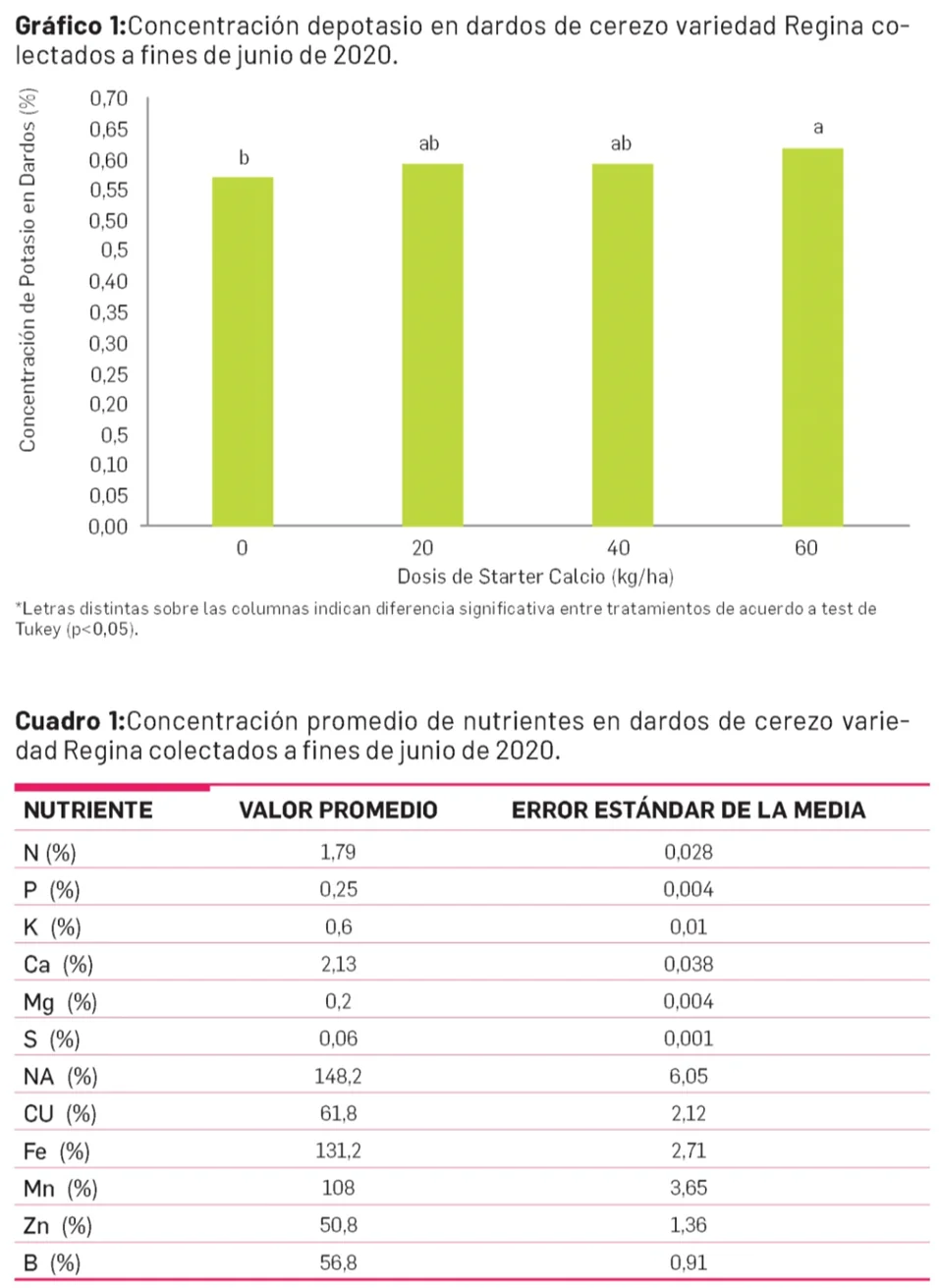
In addition, studies conducted on sweet cherry trees by the Agricultural Research Institute using calcium and potassium applied to the soil in formulations with carboxylic acids (Calcium Starter with 15% K, 0.14% Ca, 0.3% N and 40% carboxylic acids) have shown a positive effect of the molecule used on increasing potassium levels in shoots by the end of June.
Nutrient distribution
The effect is directly proportional to the applied dose (Figure 1).
Similarly, the average nutrient concentration in sweet cherry shoots is presented in Table 1.
As can be seen, the nutrient with the highest concentration in the shoots of this sweet cherry variety is calcium, followed by nitrogen and finally potassium.
As for micronutrients, higher concentrations of iron and manganese compared to zinc and boron are noteworthy.
Nutrient mobility
However, the mobility of the first two nutrients mentioned is very low, whereas the remobilisation of boron and zinc from reserves to flowers and vegetative primordia is high.
Among the components of the sweet cherry tree, the reserves used for spring growth and development come mainly from nutrients removed from leaves (nitrogen and magnesium).
As well as from those stored in high-sink structures (zinc), such as spurs, spur-bearing branches and roots.
Therefore, it is important to understand nutrient accumulation in each tree structure.
Agronomic factors
Consequently, it is necessary to estimate the potential contribution of mobile nutrients, such as nitrogen, phosphorus, potassium, magnesium and sulphur, from the permanent structures of the tree.
Nutrients with medium mobility, such as boron and zinc, and nutrients with low mobility, such as calcium, iron and manganese.
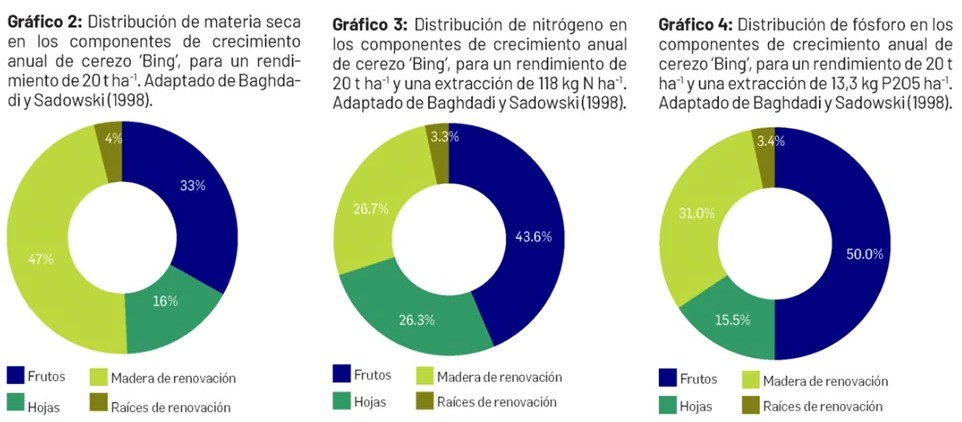
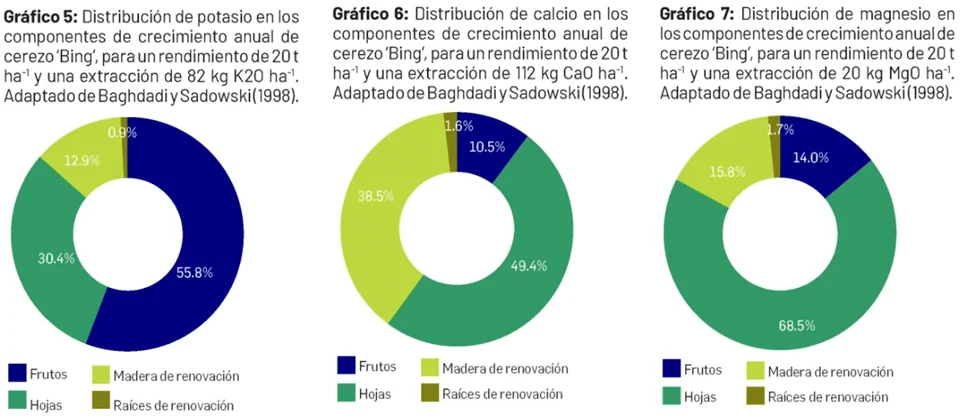
In this regard, Figures 2 to 7 show the allometric distribution of nutrients in the sweet cherry tree on a dry matter basis.
Another aspect to consider is the combination of cultivar and rootstock.
Management and recommendations
Planting density and the training system, given the differences in nutrient accumulation between cultivars and rootstocks, have a significant impact.
This must be taken into account when formulating fertilisation programmes and interpreting tissue analysis results.
When working with different rootstocks in the same environment, these differences can be explained by genetic factors and root architecture.
For nutritional management recommendations aimed at improving reserve accumulation in sweet cherry trees, it is suggested to formulate fertilisation programmes based on specific knowledge.
Fertilisation programmes
In general, it is recommended to concentrate nitrogen and magnesium soil applications during the first 45–60 days after harvest.
Apply phosphorus and potassium throughout the entire post-harvest period.
And concentrate calcium applications towards the final stage of this phase.
It is also recommended to carry out foliar applications of amino acids, seaweed and other products that reduce stress.
Juan Hirzel Campos
PhD, Agricultural Engineer, M.Sc. Quilamapu Agricultural Research Institute, Chile
Source: Mundoagro Magazine, special cherry issue, 2025
Opening image source: Stefano Lugli
Cherry Times - All rights reserved