When, how and at what intensity to apply flower thinning depending on the species, cultivar and climatic conditions during flowering.
Flower thinning consists of deliberately removing some of the flowers from a fruit tree before they develop into fruit. The aim is not to maximize the number of fruits, but to optimize the crop load per tree in order to achieve fruit size, quality, production consistency and economic value compatible with the actual potential of the orchard.
Its physiological rationale is simple but demanding: every flower or fruit that will subsequently be removed consumes carbohydrates and nutrients from the first few weeks after flowering; for this reason, early thinning tends to be more effective than a late intervention.
This guide brings together the basic principles, the available methods, the scientific evidence and the risks of flower thinning in apple, peach, plum, cherry and pear, while also explaining why this practice is difficult to justify in species such as almond.
1. Principles and criteria for deciding on flower thinning
Thinning aims to modify the source–sink relationship of the tree.
A plant carrying an excessive number of fruits distributes assimilates among too many sink organs, potentially reducing the individual weight and diameter of the fruit, soluble solids content, coloration and vegetative growth, while also impairing flower induction for the following season.
The negative relationship between crop load and fruit size is well documented, among other species, in pear and cherry.
Flower thinning is mainly justified when there is abundant flowering accompanied by a high probability of fruit set.
Vigor and crop load
It is particularly useful in mature, vigorous or early-bearing trees grafted onto rootstocks that induce high productivity, as well as in cultivars prone to overcropping or alternate bearing.
In young trees that have already entered production, an excessive crop load can compete with the development of the tree structure; in mature and low-vigor trees, on the other hand, the aim is to prevent excessive production from worsening the vegetative-reproductive imbalance.
Chronological age alone therefore does not determine the intensity of thinning: it is necessary to assess the vigor and potential crop load of each tree.
The climate during flowering is a determining factor. Frost, persistent rainfall, low temperatures, wind or conditions that restrict the activity of pollinators can naturally reduce fruit set; under these circumstances, it is advisable to assess the damage and confirm fertilization before carrying out irreversible thinning.
Climate and fruit set
Conversely, uniform flowering under conditions favorable to pollination increases the risk of overcropping.
The effectiveness of chemical thinners also varies according to temperature, phenological stage and cultivar, which is why parameters such as the percentage of full bloom or fruit diameter should be used rather than calendar dates, allowing intervention criteria to be transferred across different latitudes and hemispheres.
Irrigation and fertilization, for their part, do not replace thinning: an excessive crop load subsequently subjected to water deficit has a lower capacity to achieve commercial fruit size, while increasing fertilization to “feed” an excessive crop does not correct the imbalance.
1.1 Species, varieties and justification for thinning
2. Flower thinning methods and recommended practices
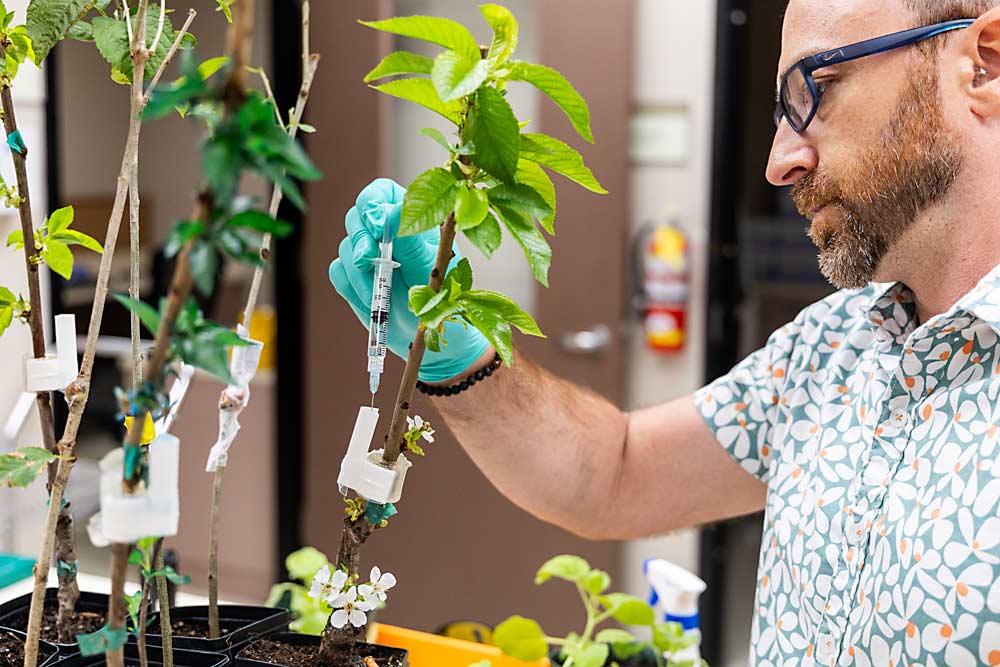
Manual flower thinning makes it possible to select specific positions, clusters or structures and is the method that provides the greatest precision, although its cost can be prohibitive.
It is also possible to wait until the young fruit stage and remove small, misshapen, damaged or poorly positioned fruit; however, the later the tree is relieved of these sinks, the smaller the physiological benefit obtained during the early stages.
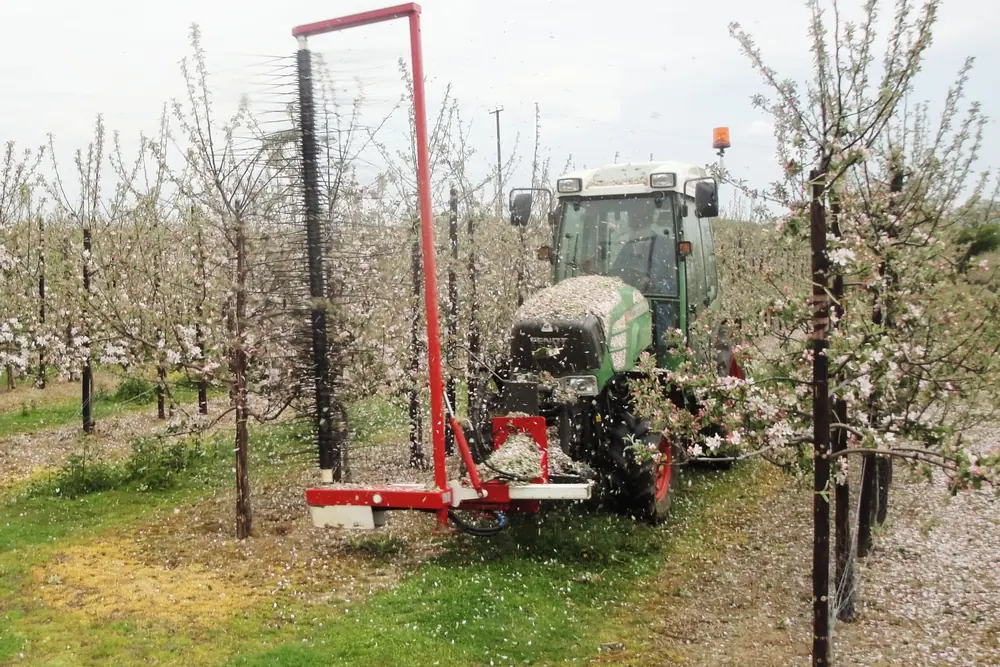
Mechanical flower thinning uses spindles, strings or rotating devices that strike or detach flowers and is particularly effective when the canopy is narrow, uniform and easily accessible.
In multi-site trials conducted on peach, equipment fitted with strings removed approximately 17% to 56% of flowers and reduced subsequent manual thinning work by between 19% and 100%, depending on the site and equipment settings.
Chemical thinning
Chemical thinning during flowering acts before or during fertilization. Desiccant products such as ammonium thiosulfate (ATS) damage stigmas and styles, reducing the probability of fertilization; a mixture of lime sulfur and oil is also used experimentally or commercially in some jurisdictions.
In apple, some guidelines issued by U.S. extension services report, as an experimental reference, the use of ATS at approximately 2.5–3% around 60% full bloom and lime sulfur at 2% plus oil at 2% around 60–80% full bloom.
These values do not represent a universal recipe: registration, formulation, label instructions, organic certification and pollinator-related restrictions vary depending on the country and product.
Post-bloom treatments
Post-bloom thinners or treatments applied to young fruit represent a second opportunity for intervention. In apple, BA, NAA, metamitron and their combinations are being studied; BA, for example, has been evaluated within an approximate range of 50–150 ppm.
In pear, the application window and response are more cultivar-specific, and the regulatory status may also vary: in the United States, metamitron, despite favorable international evidence, is not always registered for this use.
So-called “natural thinning”, meaning the spontaneous abscission of flowers or young fruit, is not really a controllable thinning technique: it should be taken into account when estimating the crop load, but relying exclusively on physiological fruit drop may result in losing the advantage of early intervention.
*The relative cost depends on wages, orchard size, machinery and training system; the labor savings provided by mechanization have been documented in peach and apple.
3. Scientific evidence: fruit size, yield and economic returns
Experimental trials confirm that more intensive thinning does not necessarily result in greater profitability. The economic balance point is reached where the increase in the value of individual fruit and labor savings offset the reduction in harvested kilograms; the outcome varies according to the price by size grade, cultivar, training system and season.
In cherry, for example, assessing only the kilograms produced per tree may make a thinning treatment appear unfavorable when, in reality, it has substantially increased the proportion of large-sized fruit: the correct economic variable is therefore not merely total yield, but marketable production by size category multiplied by the corresponding price, net of thinning and harvesting costs.
3.1 Quantitative example of the fruit-set response to chemical thinning
In the ‘Kala Amritsari’ cultivar, Rajput and Bhatia evaluated different flower thinners over two seasons. The chart summarizes the average fruit set obtained with each treatment; the percentage reductions compared with the control are calculations derived from these data.
Labor and mechanization
With regard to labor, research and technical literature from the Southern Cone report that, in apple, thinning can account for a significant share of the annual working hours required in an orchard, much lower than harvesting but higher than other individual operations.
This explains the growing interest in mechanization and chemical thinning as tools for containing costs.
4. Risks, mitigation and recommendations by production system
The main risk associated with flower thinning is excessive, irreversible thinning. The case of the ‘Fortune’ cultivar, where fruit set was reduced by more than 80% following the use of Armothin® at 2%, demonstrates that a concentration that is effective in one context may compromise profitability in another.
Mitigation strategies include conducting trials on individual blocks or cultivars, maintaining untreated control strips, calibrating spray coverage and application volume, and favoring sequential and moderate programs when the local response is not yet sufficiently understood.
Phytotoxicity represents another major risk. In cherry, the behavior of oils, ATS and other formulations depends on the cultivar, concentration and climatic conditions; studies conducted on self-fertile cultivars have shown inconsistent effectiveness and leaf damage at higher concentrations.
In the ‘Bing’/‘Gisela 5’ combination, moreover, vegetable oil emulsion produced very different responses from one year to the next.
Production systems
In high-density and pedestrian orchards, characterized by narrow, uniform or two-dimensional canopies, mechanical and precision thinning is of particular interest because the machine can maintain relatively uniform exposure; economic data for peach in fact show greater savings in perpendicular V systems than in open-vase systems.
In traditional orchards, which are heterogeneous and characterized by large canopies, greater emphasis should be placed on crop-load-regulating pruning, selective manual thinning and, where legally authorized, carefully calibrated chemical applications, since heterogeneous exposure increases the risk of leaving some areas insufficiently thinned while over-thinning others.
In organic production, the most robust strategy consists of preventing overcropping through pruning and mechanical or manual thinning, since chemical options are generally limited.
Some products, such as lime sulfur, may be compatible with certain organic production programs, but their admissibility must be verified according to the applicable regulations and the relevant certification body and cannot be assumed on the basis of trials conducted abroad.
Recommendations by species
By species: in peach, intervention should take place very early when flowering development is sufficiently predictable; in apple, the ideal program combines flowering assessment, moderate flower thinning and subsequent adjustment during the young-fruit stage; in pear, given the lower predictability of the response, sequential and conservative strategies are reasonable; in cherry grafted onto productive rootstocks, the priority is to avoid crop loads that result in small fruit without compromising yield; finally, in plum, the results obtained on ‘Fortune’ suggest that concentrations should not be transferred automatically from one cultivar to another.
Frequently asked questions about flower thinning in deciduous fruit trees
What is flower thinning and what is it used for?
It is the deliberate removal of some flowers before they develop into fruit, with the aim of regulating the tree's crop load and thereby improving fruit size, quality and production consistency, rather than maximizing the number of fruits.
Why is thinning during flowering preferable to waiting until the young-fruit stage?
Because every flower or fruit that will later be removed consumes tree resources from the first few weeks after flowering. Early thinning releases these resources sooner and therefore tends to have a greater effect on fruit size and flower induction than a later intervention.
Species and timing
In which species is flower thinning less justified?
In almond, it is not normally practiced as a commercial treatment, because reducing the number of potentially fertilizable flowers tends to reduce yield. In walnut, there is likewise no commercial flower-thinning protocol equivalent to those adopted in apple, peach or cherry.
What are the risks associated with chemical flower thinning?
The main risk is excessive, irreversible thinning: an effective concentration in a particular orchard or season may prove excessive in another context, leaving an insufficient and unprofitable crop load. For this reason, it is advisable to validate the dose locally before applying it on a large scale.
Can thinning be carried out after a frost?
It is not advisable to intervene immediately and aggressively. After a frost or another condition unfavorable to pollination, flower thinning should be postponed or reduced until it is possible to estimate how many flowers and fruits have actually survived.
Flower thinning is one of the most effective tools for managing crop load early in deciduous fruit trees, but it is also one of the most sensitive to errors.
Its main advantage over late thinning is that it preserves the tree's resources at an early stage and reduces subsequent labor; its main risk, however, is making an irreversible decision before the effects of climate, pollination and natural flower drop are fully known.
For growers, the main recommendation is not to define a “target dose”, but rather a target crop load: based on this, pruning, flower counts, frost and pollination forecasts, local trials of the selected method, fruit-set counts and, where necessary, corrective thinning of young fruit should all be integrated.
The thinning intensity that maximizes fruit size does not necessarily coincide with the one that maximizes income: the true economic objective is to maximize commercial value per hectare net of costs, while at the same time maintaining production consistency in subsequent seasons.
Trials conducted on cherry, peach and plum demonstrate that both the benefits and the potential damage caused by flower thinning can be highly significant. For this reason, every program must be adapted to the species, cultivar, rootstock and local conditions, rather than being transferred directly from another orchard or another region.
Source: www.portalfruticola.com
Image source: NP Seymor
Italian Berry - All rights reserved