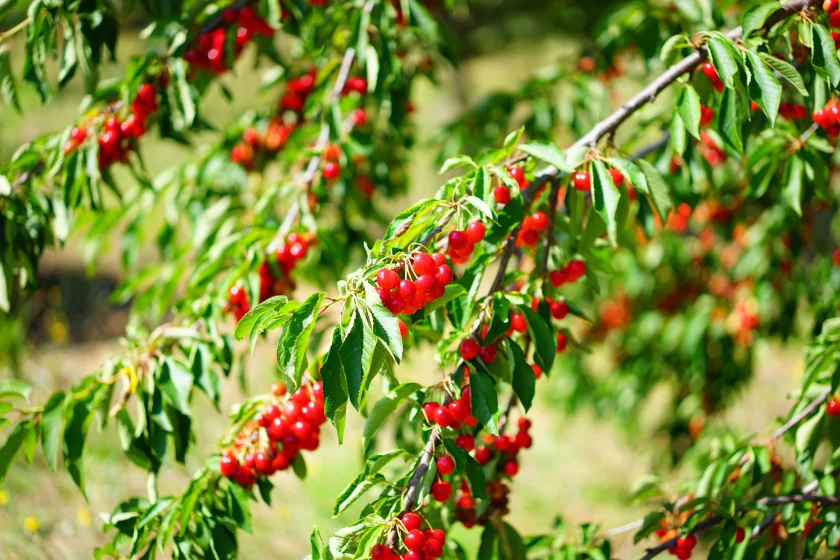
A new trial aims to help Tasmania’s cherry industry, valued at $66 million (approximately €40.3 million), cope with hotter, drier summers and increasingly frequent extreme rainfall events. The study focuses on rain covers and their impact on orchard microclimates, tree physiology and fruit quality.
The goal is to identify management strategies capable of protecting premium production, reducing climate-related risks and improving economic returns for growers.
A national project to optimise protected production
The research is being led by Dr Leticia Reis, a tree physiologist at the Tasmania Institute of Agriculture, as part of commercial field trials.
The activities are part of the three-year national project Optimising Protected Cherry Production (CY24004), coordinated by the NSW Department of Primary Industries and Regional Development.
The trial is examining how rain covers alter the orchard microclimate and the resulting effects on tree growth and cherry quality, with observations also conducted at individual branch level.
The findings are expected to contribute to the development of new management techniques, enabling growers to use covers more effectively and optimise fruit quality, productivity and commercial value.
Protection against cracking, but with changes to the microclimate
Rain covers are already widely used in sweet cherry orchards across Tasmania. According to Leticia Reis, they provide a practical and effective tool for reducing problems such as fruit cracking.
Cracking can occur when particularly heavy rainfall hits orchards during the harvest period, causing significant economic losses for growers.
However, the protection provided by the covers also alters the conditions within the orchard. It can reduce the amount of available sunlight and affect air temperature and humidity.
It also changes the quality of light reaching the canopy, producing an effect comparable to looking through a pair of tinted glasses. Trees respond to these environmental changes, and their responses can directly affect the quality characteristics of the cherries.
Sensors and real-time monitoring in the Tamar Valley
To better understand these effects, Leticia Reis has established a trial site within a commercial cherry orchard in Tasmania’s Tamar Valley.
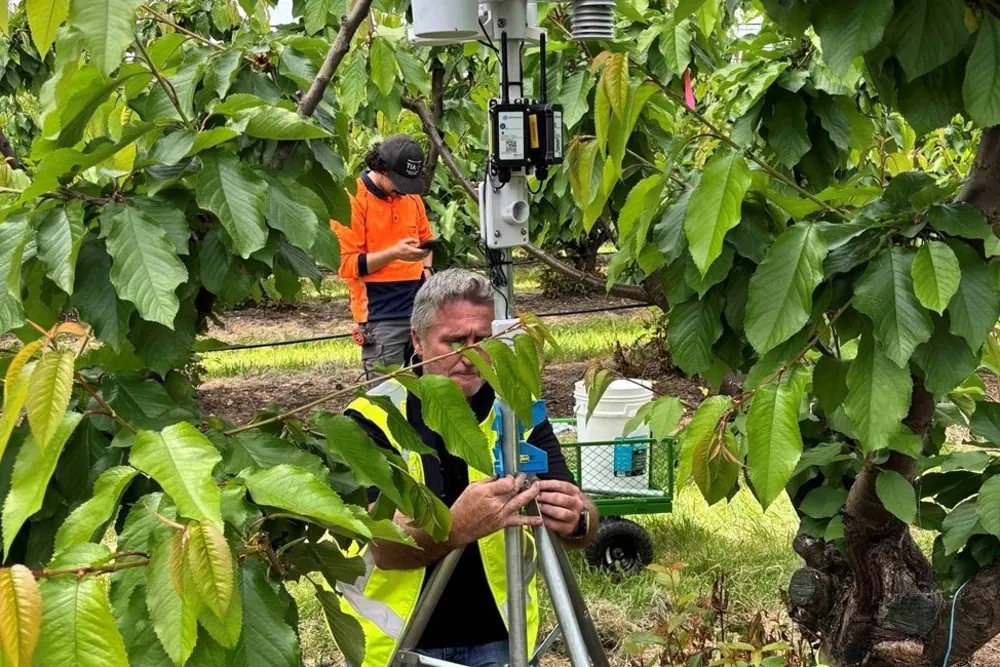
The orchard is equipped with several sensors designed to monitor light, the microclimate and leaf physiology. An additional assessment of fruit quality will be carried out at commercial harvest.
To develop the equipment and continuous monitoring system, the research team collaborated with the ag tech innovation studio at the Tasmania Institute of Agriculture.
The facility develops sensing, data acquisition and data management technologies to support agricultural research and industry innovation. For the cherry trial, customised sensors and systems capable of transmitting information in real time were designed.
The experience of Calthorpe Orchards
The trial is being hosted by Brent McClintock of Calthorpe Orchards, a company belonging to the AAAW Group. Rain covers have been used in his orchard for five years.
McClintock notes that many cherry-growing businesses in Tasmania have made significant investments in these structures in recent years. Given their increasing use, he finds it difficult to imagine the future of local production without protected cultivation.
The priority now is to understand how to use the covers as efficiently as possible.
According to the grower, time and resources must be invested in research to scientifically verify what is observed in orchards every day.
Reliable data and reduced light levels
Reliable data can give industry operators greater confidence in their decisions and clarify the actual impact of covers on cherry quality and farm productivity.
One of the main aspects still requiring further investigation is the reduction in light. Researchers need to quantify how much radiation is lost, determine whether this represents a significant limitation and understand the extent to which it may affect the trees.
The benefits of rain protection are clear, but they must be assessed alongside the potential challenges created by the new microclimatic conditions.
Growers involved in on-farm trials
The research team has invited cherry growers across Tasmania to participate in trials conducted directly in their orchards and in specific field surveys.
These activities will analyse how rain covers affect quality, yield and the production environment under different farm conditions.
The information collected will be used to develop case studies and technical reference materials for the entire industry.
In a climate scenario characterised by higher temperatures, dry periods and extreme rainfall, the ability to combine physical protection, digital monitoring and agronomic management could become crucial.
For Tasmania’s cherry supply chain, the challenge will not only be to protect fruit from weather events, but also to turn covers into a precision tool supporting quality and profitability.
Source: www.treecrop.com.au
Image source: Australian Tree Crop
Cherry Times – All rights reserved