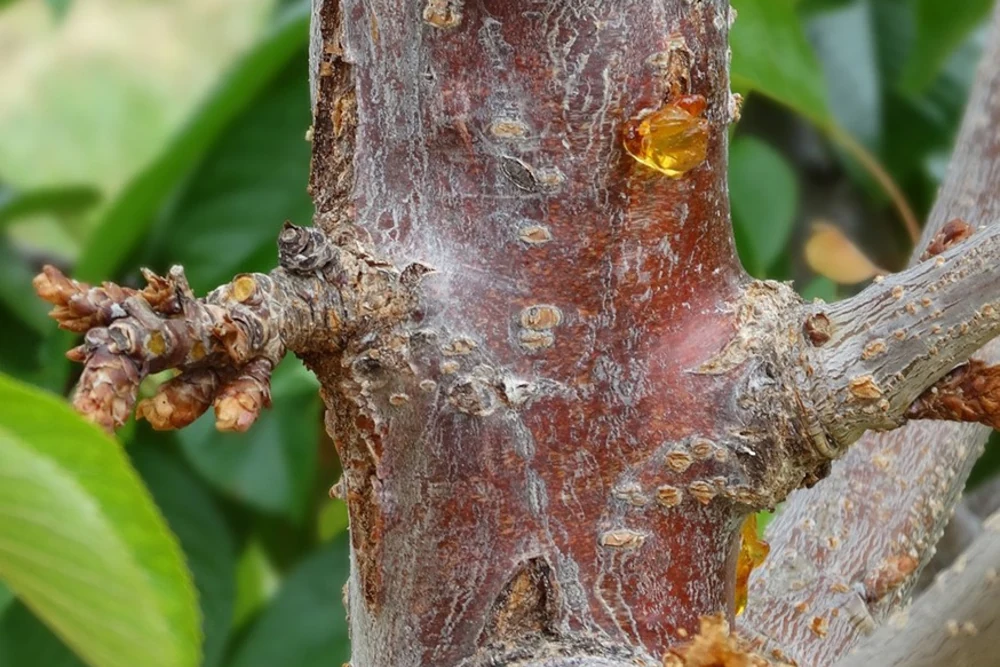
Bacterial canker is one of the major phytosanitary challenges affecting sweet cherry production, particularly in young orchards, where infections can impair tree development and, in severe cases, lead to tree death. The disease is primarily associated with Pseudomonas syringae pv. syringae (Pss) and P. amygdali pv. morsprunorum (Pam), bacteria that can enter plant tissues through natural openings and wounds. Among the latter, pruning cuts represent an important potential entry point, especially when pruning is carried out under environmental conditions conducive to infection.
A recent study conducted at Washington State University in the United States investigated the efficacy of different chemical and cultural strategies for managing infections associated with pruning wounds, providing interesting insights into the role of cultural practices.
Pruning and weather conditions
One of the main findings concerned the influence of weather conditions: infections and canker development were more frequent and progressed more rapidly under cool, humid conditions than during periods characterized by high temperatures and dry weather. These results confirm the importance of carefully selecting the timing of pruning operations and, whenever possible, avoiding cuts ahead of periods of rainfall or conditions characterized by high humidity and low temperatures. Several days of warmer, drier weather can help pruning wounds heal and reduce their susceptibility to pathogen entry.
Distance of sanitation cuts
A second aspect concerns the management of already infected trees. Through specific trials, the researchers determined the minimum distance from the visible edge of a canker at which sanitation cuts should be made. At distances of 2.5 and 3.8 cm beyond visible symptoms, the bacterium was still isolated from 100% and 97.4% of samples, respectively; at 7.6 cm, it was detected in 18.4% of cases. No bacterial recovery was obtained when tissue was removed to a distance of 12.7 cm beyond the symptomatic area.
Bacterial isolation after sanitation cuts
Positive samples by distance from visible symptoms
12.7 cm beyond the symptomatic area0%
No bacterial recovery
Bars are shown on a scale from 0 to 100%.
This finding highlights that removing only visibly affected tissue may not be sufficient to eliminate the pathogen and suggests that sanitation cuts should be made with an adequate safety margin beyond visible symptoms.
Evaluation of alternative substances
The study also evaluated several alternative substances for bacterial control. Lime sulfur showed concentration- and exposure time-dependent bacteriostatic activity in vitro, while clove essential oil rapidly eliminated the bacteria at higher concentrations (>0.0625%). However, the latter did not show significant efficacy under field conditions. The study also included trials with antibiotics, which are not authorized for use in plant protection in the European context.
An integrated approach to prevention
Overall, the findings show that bacterial canker prevention cannot rely exclusively on chemical treatments but requires an integrated approach. Selecting favorable weather conditions for pruning, making cuts correctly, and promptly removing infected tissues are essential practices for reducing the risk of infection and limiting pathogen spread within cherry orchards.
Source: Manna, M. S., Santander, R. D., & Zhao, Y. (2026). Efficacy of Chemical Treatments and Culture Practices in Managing Cut-Wound Infections by Pseudomonas syringae in Sweet Cherry. https://doi.org/10.1094/PDIS-03-26-0482-RE
Image source: Fresh Quarterly
Andrea Giovannini
Ph.D. in Agricultural, Environmental, and Food Sciences and Technologies – Fruit Tree Physiology and Cultivation - Bologna, Italy
Cherry Times - All rights reserved