Dormant pruning is a vital orchard task for maintaining crop-load quality and quantity, but it takes years to gain expertise. Given prolonged training periods and agricultural labor shortages, there is an increased interest in automating this decision process.
Beyond mechanical design and computer vision, a major challenge in automated pruning is determining where to make pruning cuts.
These decisions depend on complex, plant- and cultivar-specific factors, including tree and branch characteristics, growth history, tree architecture, environmental conditions, and production goals.
Expert knowledge
But how expert pruners map these factors remains largely unknown, as pruning decisions are often based on intuition and experience. Successful automation will require translating these implicit decision-making processes into explicit, algorithmic rules.
To capture these decisions, we conducted over four hours of in-field interviews and observed pruning at sites in Prosser, WA, across:
- Three stakeholder groups: (2) horticulturists, (2) growers, (2) pruners
- Two tree architectures: Upright Fruiting Offshoot (UFO), V-Trellis
- Three tree cultivars: Bing Cherries, Envy Apples, Jazz Apples
Being in the field allowed us to ground participants’ decisions in real-world tree morphology.
Field observations
From pruning observations, we also created a manually annotated dataset of 661 pruning cuts across the three tree cultivars (124 UFO, Bing Cherries; 229 V-Trellis, Envy Apples; 308 V-Trellis, Jazz Apples).
For each identified cut, we labeled the low-level features, such as branch length, branch vector, and number of buds, along with the corresponding cut decisions (e.g., cut placement and angle).
Afterward, we grouped cultivar cuts that exhibited the same cut decision into one of three horticultural goals: environmental management, crop-load management, and replacement wood.
These goals represent whole-tree- or orchard-level influences that affect cut decisions and were identified through the in-field interviews.
Decision mapping
An example decision grouping and horticultural goal for UFO, Bing Cherries can be found in Figure 1.
All instances of cuts labeled as longer than 6 inches (15.24 cm) and with a branch direction of into the interior (of the architecture) or out of the row were mapped to the cut decision to prune at the branch’s base, with an angle parallel to the main branch (see Figure 1 right, red lines).
This decision related to the horticultural goal of environmental management, which encompasses pruning decisions that alter the local environment, such as removing or pruning branches to optimize light distribution, increase air circulation, and prevent the spread of fungal or bacterial growth.
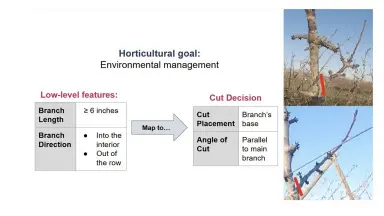
Figure 1. (Left) Mapping of low-level UFO Bing Cherries features to cut decisions with the corresponding horticultural goal. (Right) Two example cuts based on this mapping, marked by red lines.
Future work
We uncovered 6 additional mappings of horticultural guidelines to cuts, that were validated through interviews with horticulturists.
For the full set, see our paper (Flynn et al., 2026).
While these decision mappings provide a foundation for autonomous pruning, they are not exhaustive, and future work should expand our decision-capture framework through cultivar-specific studies and more diverse orchard conditions to capture additional decision-making strategies and edge cases.
Deanna Flynn e Cristina Wilson
Oregon State University
Source: Fruit Matters, WSU
Image source: Sdguanlv - Growing Fruit
Cherry Times - All rights reserved