Pollination is essential for sweet cherry productivity, particularly in self-sterile cultivars that rely on insect-mediated pollen transfer to achieve optimal fruit set.
Accurately understanding the frequency and quality of pollinator visits is therefore crucial, not only for improving orchard productivity but also for clarifying physiological phenomena that remain poorly understood, such as June drop.
However, directly monitoring pollinating insect activity generally requires an enormous amount of time and manual effort.
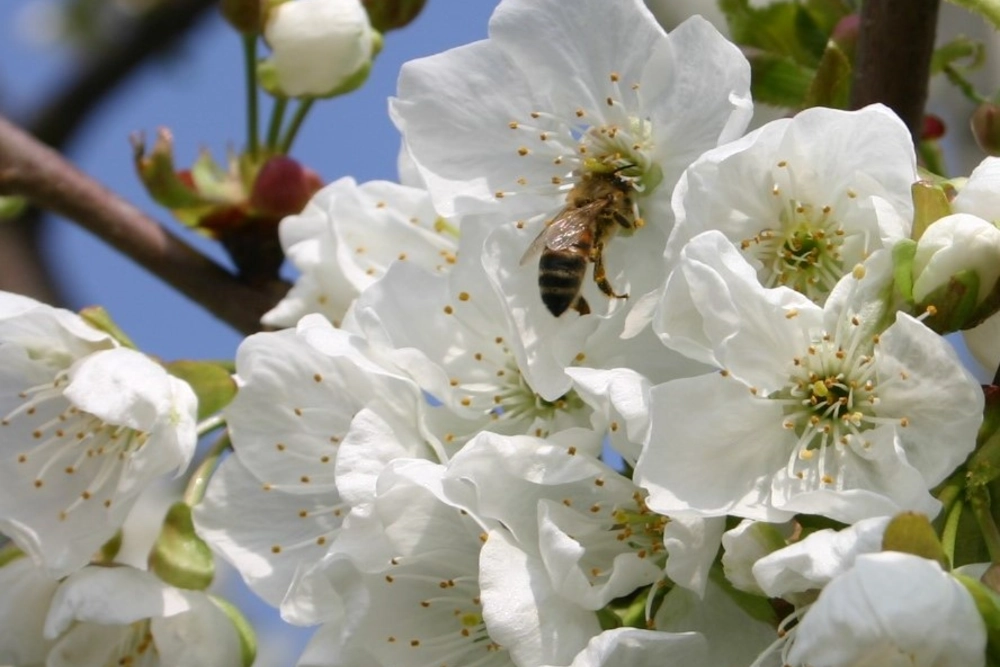
A recent study proposes an innovative artificial intelligence-based solution: researchers have developed BeeSAM2, an automated system capable of detecting bees in time-lapse images of sweet cherry flowers with an exceptionally high level of accuracy, opening new opportunities for research and pollinator monitoring in fruit production.
Testing in protected orchards
The study was conducted in protected sweet cherry orchards at the James Hutton Institute (United Kingdom), where time-lapse cameras captured flower images at one-second intervals during periods of peak bee foraging activity.
Manual analysis of the recordings required approximately 500 hours of work, highlighting the need for automated tools.
BeeSAM2 combines two advanced artificial intelligence models: Grounding DINO, a zero-shot object detector capable of identifying objects without task-specific training, and Segment Anything Model 2 (SAM2), designed to segment and automatically track objects throughout a video sequence.
The approach first employs Grounding DINO to detect bees in the images and then uses SAM2 to track their movement across the entire sequence, overcoming many of the limitations associated with conventional object recognition systems.
Accuracy of the integrated models
The optimal combination of the two models achieved a recall of 0.959 and an adjusted precision of 0.991, demonstrating that the system can identify nearly all bee visits while minimizing false detections.
These results substantially outperform the individual models used separately. Grounding DINO provides good precision but tends to miss numerous pollination events, whereas SAM2 detects a greater number of visits but may occasionally continue tracking incorrectly identified objects.
By integrating the two models, BeeSAM2 effectively exploits the strengths of both technologies.
An important advantage of this approach is its strong generalizability. Unlike many neural network-based computer vision systems, BeeSAM2 does not require extensive training using manually annotated datasets.
Adaptation to new scenarios
The researchers also evaluated the model on an independent dataset from a previous study involving different flowering plant species and honeybees (Apis mellifera), still achieving recall and precision values above 0.80.
Although these performances were slightly lower than those obtained with the original dataset, they confirmed the system’s ability to adapt to new scenarios with only minimal intervention.
The main limitations arise when bees are completely or partially concealed within the flower or when the system continues tracking plant structures that were mistakenly identified during the initial stages of processing.
Furthermore, BeeSAM2 does not distinguish among different pollinator species but simply detects their presence.
Prospects for fruit production
Nevertheless, the system can be readily integrated with species-specific classification algorithms.
Thanks to its high accuracy, BeeSAM2 represents a promising tool for automating the monitoring of flower–pollinator interactions, dramatically reducing image analysis time while providing valuable quantitative data to investigate pollination efficiency, evaluate pollinator management strategies, and improve our understanding of the relationships among foraging activity, fruit set, and yield stability in sweet cherry and many other fruit crops.
Source: Devlin, J., MacFarlane, F., Karley, A., Manfredini, F., & Williams, D. (2026). Detecting bees in cherry flowers using timelapse images and foundational models. Journal of Pollination Ecology, 41, 28–39. https://doi.org/10.26786/1920-7603(2026)897
Image source: Stefano Lugli
Andrea Giovannini
PhD in Agricultural, Environmental and Food Science and Technology - Arboriculture and Fruitculture, University of Bologna, IT
Cherry Times – All rights reserved