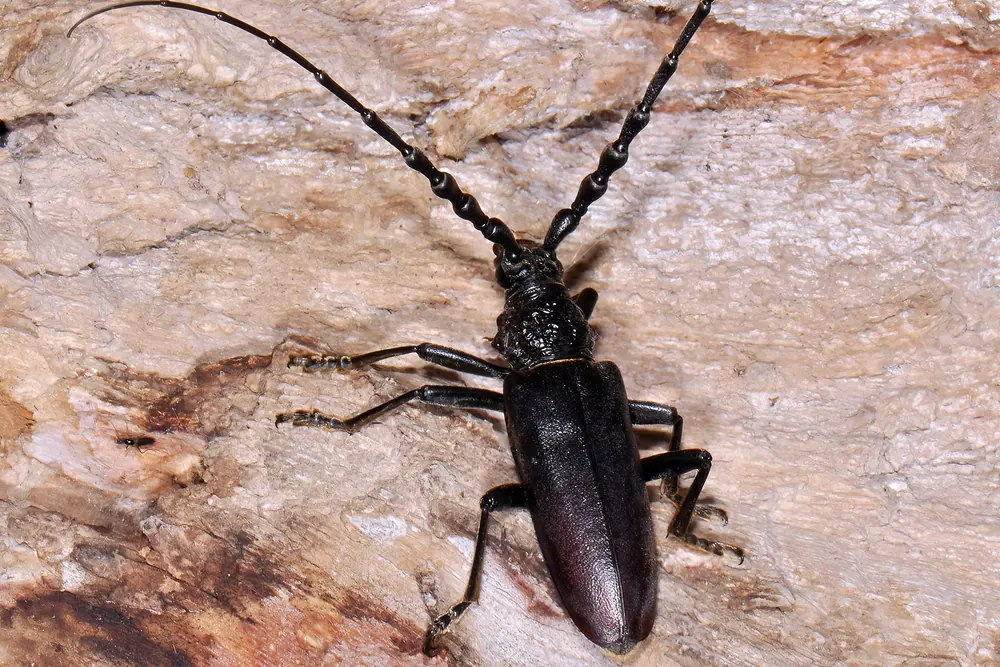
Longhorn beetles are generally considered minor pests in orchards; however, some species can cause significant economic losses. In particular, Cerambyx dux is an important pest of stone and pome fruit trees in the eastern Mediterranean. Its larvae bore galleries through woody tissues, impairing vascular function, weakening branches and reducing tree vitality, potentially leading to tree death in severe cases.
Diagnosis is particularly challenging because larval development occurs mainly inside the trunk and branches, while external symptoms, such as frass and exit holes, become apparent primarily in the later stages of infestation. Against this background, a recent study conducted in three cherry orchards in Israel investigated the use of seismic sensors to detect larval activity, while also examining the pest’s phenology and the spatial distribution of infested trees.
Phenology and intervention window
Monitoring helped establish a generally biennial life cycle under the environmental conditions examined. Adults are observed over a relatively short period, estimated at around 6–8 weeks, while young larvae, approximately from the first to the third instar, feed in the bark tissues between June and October. Later instars, from the fourth to the sixth, enter the xylem from November of the year in which eggs are laid and continue their activity until September of the following year. Frass expelled from the galleries generally becomes detectable from October–November, while adults overwinter inside the wood.
Life cycle of Cerambyx dux
Phenology overview observed in the monitored Israeli cherry orchards; the life cycle is generally biennial under the environmental conditions examined.
Adults Observed for around 6–8 weeks.
June–October Young larvae, from the first to the third instar, feed in the bark tissues.
From November Larvae from the fourth to the sixth instar enter the xylem.
Until September of the following year Larval activity in the xylem continues.
October–November Frass expelled from galleries generally becomes detectable.
Overwintering Adults overwinter inside the wood.
This sequence of phenological stages is important for pest management because the window for targeting adults and newly hatched larvae is limited. It partly overlaps with critical production stages, including fruit development and harvest.
Detecting larval activity with seismic sensors
The sensors used in the study record vibrations generated by larval feeding within woody tissues, converting the detected signals into indicators of insect activity. The results showed that uninfested trees generally exhibited low signal levels, whereas colonised trees produced stronger signals, particularly in late summer and autumn. The recorded activity also depended on the history of colonisation: trees affected by repeated infestations maintained elevated signal levels for longer.
The sensors showed greater diagnostic capability than visual inspection, which relies primarily on the presence of frass and exit holes. Although visual inspection provides reliable information, it is time-consuming and labour-intensive and may fail to detect infestations that have not yet produced external symptoms. In several cases, the sensors detected larval activity in trees classified as uninfested through visual assessment, suggesting that the pest could be identified before readily observable symptoms appear.
Infestation patterns and outlook
Agreement between the two methods varied among orchards and seasons, with discrepancies generally more pronounced in orchards where infestations were less evident or still at an early stage. Regarding the spatial dynamics of infestation, attacks tended to cluster among neighbouring trees, with stronger correlations at distances of approximately 3 m. These correlations declined rapidly as distance increased, reaching low and non-significant levels beyond approximately 30 m.
Overall, the findings indicate that seismic monitoring can effectively complement traditional inspections for Cerambyx dux, making it possible to track hidden larval activity and identify high-risk areas at an early stage. However, further validation is required before the technology can be implemented at commercial scale, particularly to standardise detection thresholds and assess how wood characteristics influence signal propagation. Seismic sensing does not replace visual diagnosis, but can support it and make inspections more targeted.
Source: Mendel, Z., Shapir, R., Voet, H., Samra, S., Sofer-Arad, C., & Ment, D. (2026). “Monitoring of Cerambyx dux (Coleoptera: Cerambycidae): insights from seasonal activity, seismic detection, and spatial spread.” Phytoparasitica, 54(5), 97. https://doi.org/10.1007/s12600-026-01427-2
Image Source: Michal Hoskovec
Andrea Giovannini
PhD in Agricultural, Environmental and Food Science and Technology - Arboriculture and Fruitculture, University of Bologna, IT
Cherry Times - All rights reserved