As Hortitool celebrates 11 years, we continue revisiting the discoveries that shaped our agronomy.
Our first article explored how plants respond to daylength. This time, we follow another seasonal signal: cold.
Imagine two batches of the same berry variety entering a greenhouse on the same day. They receive similar irrigation, nutrition and temperatures. Yet one develops rapidly and uniformly, while the other breaks bud slowly and unevenly.
Part of the explanation may lie in what happened before they arrived.
For a plant, winter is more than a pause in growth. Its temperature history can influence what happens next.
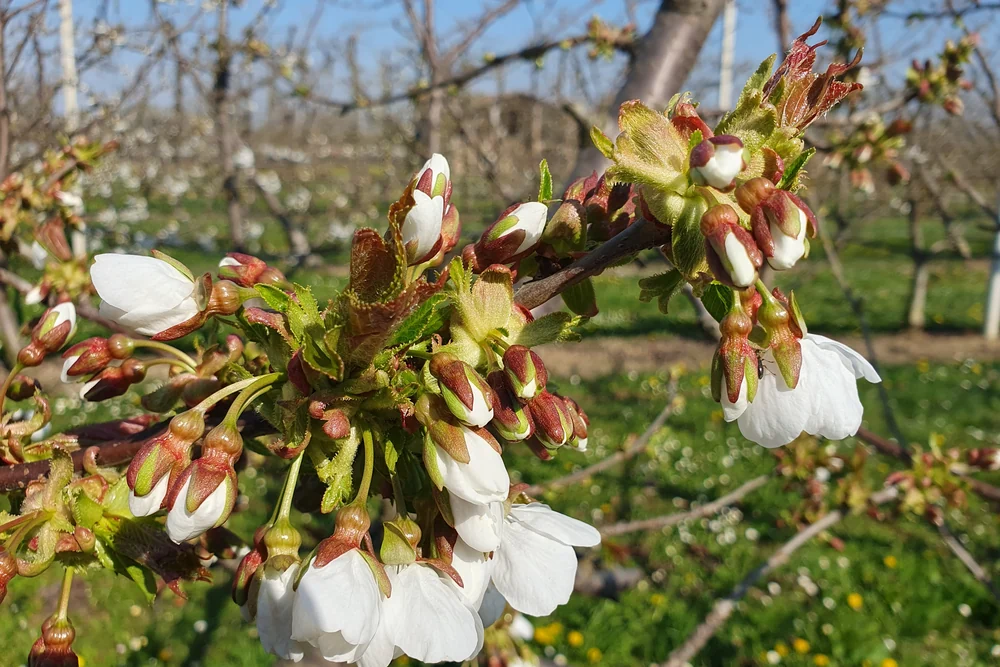
From cold exposure to biological memory
In 1918, Gustav Gassner demonstrated the importance of cold exposure for flowering in winter cereals. His work helped establish the basis of vernalization: the promotion of flowering by a period of low temperature.
Decades later, researchers began explaining how this response could persist after temperatures increased. In Arabidopsis, Sung and Amasino’s 2004 research identified VIN3 as an essential component of the process through which prolonged cold establishes chromatin changes associated with silencing FLC, a flowering repressor.
This provided a molecular explanation for part of the plant’s “memory” of winter. It did not establish that the same mechanism operates in every berry species.
A century of questions about winter
1918 · Vernalization
Gustav Gassner demonstrates the importance of cold exposure for flowering in winter cereals.
2004 · Molecular memory
Sung and Amasino identify VIN3 as an essential component of cold-associated chromatin changes linked to FLC silencing in Arabidopsis.
2023 · Forcing and development
Blackberry research relates forcing temperature to the time required for first flowers and ripe fruit.
2025 · Strategy matters
A blackberry study records 21–125 days to the first open flower across the tested varieties and cold-storage and forcing strategies.
For berry production, we need to distinguish three processes:
From winter conditions to flowering
1. Cold exposure
Temperature history contributes to the plant’s seasonal response.
→
2. Dormancy release
Chilling can remove an internal restriction on bud growth.
→
3. Subsequent development
Once buds are able to grow, suitable conditions—particularly warmth—drive progress toward budbreak and flowering.
Vernalization is related, but distinct: cold promotes the flowering response. These processes can interact, but they are not interchangeable.
Research on ‘Autumn Bliss’ raspberry illustrates this distinction. Carew and colleagues found that chilling improved growth and advanced flowering. In a separate experiment with actively growing canes, they identified a flowering-promoting effect distinct from dormancy release.
How much winter has the plant received?
Translating cold exposure into a useful number became an important step in crop management.
However, different models describe winter differently.
| Approach | How it represents temperature | What growers need to consider |
|---|
| Chilling Hours | Counts hours within a defined temperature range, commonly 0–7.2°C, although definitions vary. | Simple to calculate, but qualifying hours are treated equally and warm interruptions are not represented. |
|---|
| Utah Model | Assigns different chilling weights to temperature ranges and subtracts units during sufficiently warm periods. | Introduces temperature effectiveness, but warm conditions can produce problematic negative totals in mild-winter regions. |
|---|
| Dynamic Model | Represents chilling through a reversible intermediate that, once a threshold is reached, produces a stable chill portion. | Accounts for temperature sequence. The intermediate is a modeling concept, rather than an identified substance demonstrated in all crops. |
|---|
| Chill–forcing models | Link an estimate of dormancy release with subsequent temperature-driven development. | Move toward predicting budbreak or flowering, but require appropriate variety parameters and a clearly defined developmental endpoint. |
|---|
The Dynamic Model was developed from peach research. Its structure captures effects of alternating temperatures that simple hour counting misses, but its application to berries still requires validation.
The units also matter. Chilling hours, Utah chill units and chill portions are different quantities.
A global analysis covering 5,078 weather stations showed that their relationships vary geographically. There is no universal conversion factor that allows a chilling requirement measured in one metric and climate to be transferred reliably to another.
Different winters, different interpretations
For an agronomist working across regions, this has direct consequences.
Mediterranean
Cool nights may alternate with warm afternoons. A model’s treatment of warm periods can substantially change estimated chill. Evaluate the Dynamic Model while using local observations to test performance.
Cold continental
A more severe winter does not necessarily provide more effective chilling. In experiments with ‘Glen Ample’ and ‘Asker’, temperatures between −5°C and +5°C were most effective among the treatments tested; responses also depended on exposure duration.
Cool maritime
Connect winter temperature records with observed dormancy release and subsequent development. An AHDB project used a two-stage model for ‘Glen Dee’, ‘Glen Ample’ and ‘Glen Carron’, combining chilling with the warmer conditions required for budbreak.
Multi-site research has demonstrated how strongly model selection affects estimates, especially in warmer winter climates.
The raspberry results apply to the varieties and experimental conditions tested, rather than defining a universal storage prescription.
For refrigerated long-cane production, we must also distinguish field exposure from storage. A period at constant temperature is not automatically equivalent to the same number of qualifying hours under fluctuating outdoor conditions. The plant’s condition when it enters storage remains part of the interpretation.
These differences support a practical approach: select candidate models, then test them against the variety and production system where they will be used.
Chilling completion is not a flowering date
Once dormancy is released, the scheduling question changes: how quickly will the plant develop under the conditions provided?
Blackberry research published in 2023 developed models relating forcing temperature to the time required for first flowers and ripe fruit. This is the next step beyond estimating accumulated chill.
Yet the starting conditions still matter.
The outcome depends on the tested strategy
A 2025 study compared four blackberry varieties and six cold-storage and forcing strategies.
21–125 days
Recorded time to first open flower across the combinations tested.
Varied by strategy
Heat accumulation to flowering and fruiting differed with strategy within varieties.
Yields below expectations
Earlier flowering alone did not establish a successful production system.
What remains useful in 2026?
These discoveries remain valuable because they help us ask more precise questions.
Are the buds already floral? Has endodormancy been released? Are we measuring first budbreak, uniform budbreak along the cane, flowering or harvest? Does the model account for the temperatures actually experienced by the plants?
For practical scheduling, I would connect hourly temperature records, variety response, bud observations and forcing conditions, then compare predictions with actual flowering and yield over successive seasons.
The historical discoveries gave us the concepts. Models made those concepts measurable. Field observations determine how confidently we can use them.
Before deciding when to force the crop, do we know what its buds still need?
Image source: Stefano Lugli
Jorge Duarte
Managing Director of Hortitool Consulting and Champion of Innovation in Agriculture
Cherry Times - All rights reserved