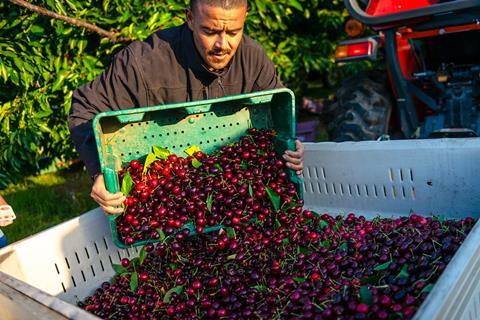
According to consultant and grower Jorge Astudillo, this year the area is expected to record its earliest harvest date ever, although he estimates that production could fall by 50%, dropping below 1,000 tonnes, compared with the approximately 1,500 tonnes reached in the 2025/26 season.
Much like what happened in 2023, this season is shaping up to be challenging for cherry growers in the Coquimbo region.
That season, growers achieved an ultra-early harvest, which began on 13 October, but due to weather-related difficulties, production was much lower than expected, with performance in some cases even proving erratic. This season, the outlook appears similar.
Ultra-early harvest and production decline
According to consultant and grower Jorge Astudillo, harvests this year could begin as early as 10 to 15 October, one of the earliest dates ever recorded in the area.
However, Astudillo estimates that production could fall by 50%, dropping below 1,000 tonnes, compared with the approximately 1,500 tonnes reached in the 2025/26 season in this northern area.
Despite this trend and the drop in production, Astudillo points out that the “glass-half-full” perspective is that, with lower production, the fruit could achieve larger sizes and a higher sugar content.
Fruit size, sugars and cracking risk
Astudillo explains: “The risk of cracking is obviously always present, especially for varieties such as Nimba or Brooks, which are the most susceptible. And if there is any rainfall from now on, we will clearly need to pay very close attention.
In terms of sugar levels, we should achieve good results because the high temperatures and sunny days we are experiencing, combined with fairly cool nights, support good plant performance.
I am already observing that during stage 1, the cell division stage, the fruit has reached a good size: in the case of Brooks, I have seen at least 16-17 millimetres in some cases, a size that doubles by the end of stage 2. We can therefore expect to comfortably exceed 30 millimetres.
These are the advantages offered by the lower fruit load and the El Niño phenomenon: reaching the market early, with larger fruit and higher sugar levels, while obviously ensuring adequate irrigation and nutrition, using biostimulants and constantly monitoring plant health”.
Alternative markets to China
Despite this, the main difference compared with the previous season is that this year fruit fly outbreaks will prevent many growers from exporting their cherries to China.
For this reason, the search for new markets will be essential in order to secure good economic returns.
“Growers have prepared by adopting the Systems Approach so they can export to South Korea, Japan or Vietnam. This is what we have been working on, so that growers in Ovalle have the opportunity to reach other parts of the world and not just China,” Astudillo told Redagrícola.
Botrytis pressure
One of the problems caused by the heavy rainfall recorded this season has been the unusual appearance of Botrytis in orchards across the area.
According to Astudillo, the pressure from the pathogen is mainly associated with orchards where the crop protection programme was not implemented rigorously enough, given the combination of rainfall and high temperatures recorded.
“We need to be extremely careful and follow the programmes very precisely, with a thorough understanding of product persistence and pre-harvest intervals, so that the best decisions can be made regarding treatment schedules,” Astudillo concluded.
Image source: Stefano Lugli
Miguel Patiño, Redagricola
Cherry Times - All rights reserved