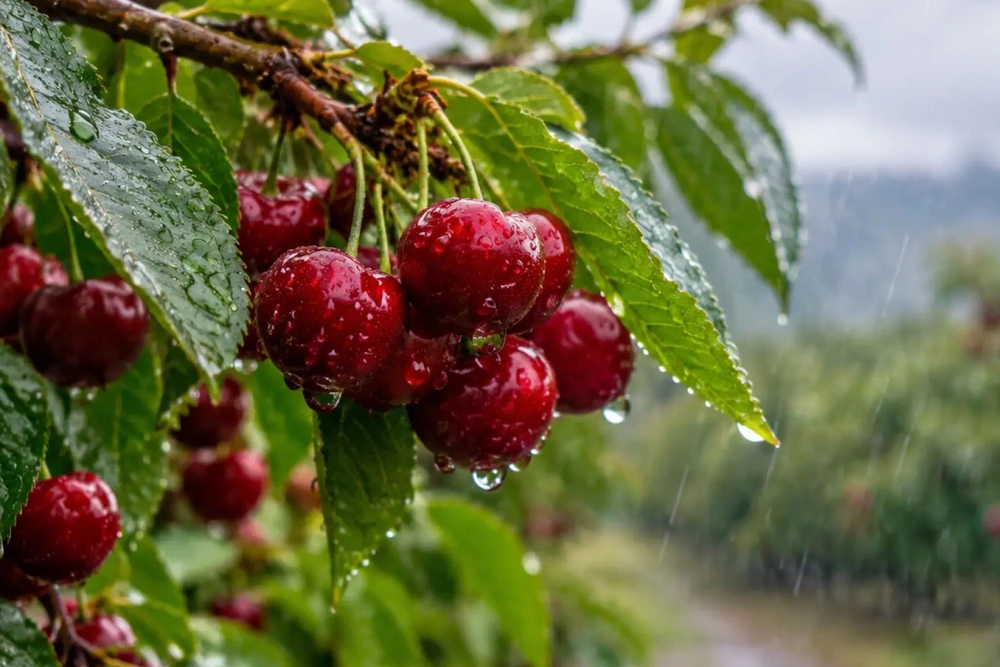
Rain and hail have reduced production prospects, particularly for cherries, while the truckers’ strike in San Antonio threatens to cause shipping delays. Both factors are adding uncertainty to production and exports.
The 2026–2027 fruit season is facing two factors that could affect its progress: weather conditions recorded during October and difficulties moving cargo through the port area of San Antonio. Rain, hail and periods of excessive moisture have damaged several crops, while the truckers’ strike continues to restrict access to logistics facilities.
Víctor Catán, president of Fedefruta, warned that the effects of the weather are already visible in several production areas. “Some areas have suffered significant damage from hail. In others, the damage is due to excess water. It will clearly be a challenging season,” he said. The industry leader added that weather forecasts for November and December point to conditions that could continue to concern growers.
From academia, Luis Sáez of the Department of Agricultural Management at the University of Santiago explained that hail can compromise the marketable quality of fruit such as cherries, apples, peaches, grapes, citrus and raspberries. Even when damage is superficial, it can prevent produce from meeting the standards required by export markets.
The specialist also highlighted the effects of moisture and temperature fluctuations on crops. These conditions can encourage fungal growth, flower drop and the deterioration of small fruit. In addition, rain and wind reduce bee activity and, consequently, the chances of adequate pollination.
Flooding poses another risk to production because it reduces the availability of oxygen to the roots. According to Sáez, this can cause flowers and fruit to abort. In the later stages of ripening, water accumulation can also cause fruit cracking, directly affecting quality and suitability for export.
Weather-related risks described in the article
Factor
Potential effects on crops
Reported consequences
Hail
Damage to fruit and crops
Potentially compromised marketable quality and failure to meet export standards
Moisture and temperature fluctuations
Fungal growth, flower drop and deterioration of small fruit
Potential crop damage
Rain and wind
Reduced bee activity
Lower chances of adequate pollination
Flooding and water accumulation
Reduced oxygen availability for roots; potential cracking in ripe fruit
Possible flower and fruit abortion, affecting quality and suitability for export
Source: statements by Luis Sáez cited in the article.
Weather conditions are a concern for fruit growers and exporters.Concern over weather conditions is growing
In the O’Higgins Region, Undersecretary of Agriculture Francesco Venezian chaired a meeting of the Regional Agricultural Risk Management Committee (CARGIR), attended by organizations including INDAP, CONAF and SAG. The meeting made it possible to compare reports gathered in the field with weather records, given that hailstorms have caused severe damage on some farms but had no impact on others located a short distance away.
Venezian said that support measures for small-scale farmers, INDAP beneficiaries and medium-sized producers are being assessed. He also reported that coordination is underway with the regional offices of the Economy and Labor ministries to monitor agricultural hiring during the season. As part of the field activities, he visited hail-damaged cherry orchards in the Lo de Lobos area of Rengo.
The outlook for the leading fruit export has also been reviewed by the National Agriculture Society. Its president, Antonio Walker, suggested that cherry production could fall below the industry’s initial estimate. “The estimate was 140 million boxes. I would say we won’t reach that production; I think we’ll be closer to 115 million boxes,” he said in an interview with Radio Pauta. This is the industry leader’s preliminary estimate, not a definitive sector assessment.
Cherry production estimates
Millions of boxes · scale from 0 to 140
Industry’s initial estimate140 million
Antonio Walker’s preliminary forecastabout 115 million
Walker gave the estimate of about 115 million boxes in an interview with Radio Pauta; it is not a definitive sector assessment.
Walker explained that hail can cause significant losses, including total losses in some cherry orchards, while rain on ripe fruit can lead to cracking because of the accumulation of sugar and color. The SNA president estimated that the cherry harvest could continue into the first days of January and warned that rainfall in recent weeks has added uncertainty to the production outlook.
Concerns also extend to other crops, including nectarines, peaches and plums. According to Walker, rainfall could have a greater impact on fruit production than on the wine sector. Although rain helps replenish snow, water and aquifer reserves, its intensity and concentration can create difficulties on farms. “Water is welcome, but in this case there was too much of it,” he said.
Diesel costs are one of the industry’s main concerns.A strike threatens the fruit season
Production challenges are compounded by the indefinite strike that began on October 28, called by the San Antonio Truck Owners’ Trade Association (Agreporsai). The protest stems from a demand for higher transport rates, which the association considers outdated in light of rising operating costs, and opposition to the installation of new TAG toll gantries on Route 78. The National Confederation of Truck Owners (CNDC) confirmed that the strike was still ongoing on Monday, November 2.
Manuel Araya, an Agreporsai representative, said that cargo-generating companies, including Sitrans, Agunsa and Maersk, remained blocked. According to Araya, the association met with representatives of these companies but received no response that would resolve the dispute. He said that rates for many services remain frozen and do not reflect increases in fuel costs. “In short, we have no concrete answers,” he said.
The cost of diesel is one of the association’s main arguments for seeking an update to transport rates. According to ENAP data, fuel prices rose by 91.5 Chilean pesos per liter from October 22, bringing the increase since late July to 401.4 pesos per liter. For transport operators, this change puts pressure on operating margins when service rates do not reflect rising costs.
The Chilean Maritime and Port Chamber (Camport) reported partial blockades at access points to San Antonio’s logistics and port area. The organization warned that the restrictions could delay container shipments just as the fruit export season begins, as well as affect vessel service windows, supplies and work shifts. In response, it called for normal operations to be restored and institutional dialogue channels to remain open.
Initial information on port activity indicated that STI and DP World continued operating while monitoring access conditions. Empresa Portuaria San Antonio had reported a schedule of 7,800 cargo movements involving the vessels Polar Colombia, Chastine Maersk and CMA CGM Carl Antoine: 3,850 export movements and 3,950 import movements. This figure refers to scheduled operations and does not, by itself, represent the volume of cargo actually affected by the strike.
Scheduled port movements
Operations listed for the vessels Polar Colombia, Chastine Maersk and CMA CGM Carl Antoine
Exports: 3,850 movements
Imports: 3,950 movements
Scheduled total: 7,800 movements. This figure covers scheduled operations and does not quantify the volume of cargo actually affected by the strike.
According to Sáez, fruit that does not meet the quality requirements of overseas markets could be directed to domestic consumption, increasing available supply and potentially moderating prices. This alternative does not offset production losses or the lower volume available for export. Weather conditions and the resolution of the transport dispute will be key to determining the extent of the difficulties facing the season.
"Expect nothing less as we prepare for another successful harvest - says Destiny Nash, cherry sales lead - "With a notable 30% increase in production capabilities, we are poised for continued growth and success".
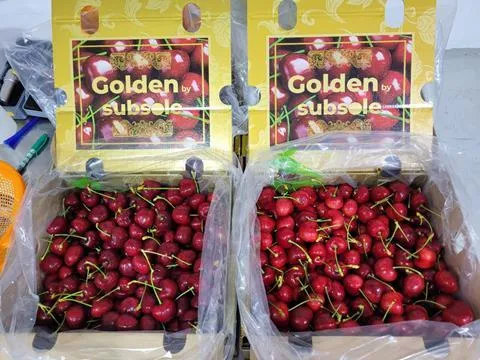
The container, supplied by grower-exporter Subsole, reached Mumbai on January 22. According to a statement from IG International, sales have since increased, and Indian consumers have responded positively to the quality and taste of the premium cherries.
Rain and hail in Chile have damaged crops, while a truckers’ strike in San Antonio threatens shipments. Cherry output could reach about 115 million boxes, below the 140 million estimate. Weather and logistics are clouding the 2026-2027 season and its export outlook.
Cherry leaf roll virus affects sweet, sour and black cherry trees. It is regulated in Canada, where symptoms may appear about five years after infection. The article outlines how it spreads and measures to prevent its introduction and contain the virus in orchards.