The truth is that we are facing a challenging season, an extremely challenging one. On the one hand, there are the weather conditions associated with an El Niño event that industry experts have described as the “Godzilla El Niño”, characterised by an abnormal rise in the surface temperature of the Pacific Ocean, capable of triggering climate changes worldwide.
The problem is that the forecasts for this season are deeply concerning. Most experts predict that, during September, October and November, weather conditions will be characterised by heavy rainfall and, at certain times, colder rather than mild temperatures, while temperatures will be more moderate during other periods.
Before continuing, it is important to remember that, at the end of the recent season, rather extreme weather conditions occurred, with heavy rainfall in mid-March, when nearly 30% of the grapes in the vineyards of the O’Higgins Region still had to be harvested.
Moreover, it was a season in which reports from the market suggested that favourable prices could be expected. Unfortunately, much of that fruit was lost because of its poor quality and most of it could not be exported.
Quality and weather-related risks
The fruit was therefore sold on the domestic market at prices far below expectations because, in the case of grapes, the priority at that point was to harvest them as quickly as possible.
These extreme weather conditions directly affect an issue of primary importance: QUALITY. Producing high-quality fruit is essential to retaining markets, achieving better economic results and, consequently, protecting the jobs of the thousands of people who depend on the agricultural activities associated with these crops.
This brings us to fungal pathogens: all these extreme weather conditions encourage the development of fungal rots, the main factor capable of compromising fruit quality in these three species.
If we therefore return to the question in the title, “What will this season be like?”, the answer is that it will be extremely challenging. Why?
Flowering and prevention
It will begin with flowering, one of the most critical periods for infections in all three species, in the presence of a high inoculum load. If the experts’ forecasts prove accurate and rainfall occurs during flowering, this inoculum will encounter extremely favourable conditions for its development.
It is therefore essential to try to eliminate it or at least reduce it in some way, and there is still time to do so. One possible solution, for example, is to remove contaminated plant debris from the orchard floor.
Another option is to apply biological formulations based on Trichoderma two or three weeks before flowering. A third possibility is to carry out preventive treatments using the products that are most effective against the fungal populations prevailing in each orchard or field.
To provide a clearer overview, we will examine the main plant health issues affecting cherries, table grapes and blueberries.
Cherry
In cherry trees, the currently prevailing weather conditions, characterised by high humidity during the pruning period, favour infections caused by Pseudomonas syringae pv. syringae, the causal agent of bacterial canker, as well as fungal cankers associated with wood-infecting fungi such as Cytospora sp. (C. leucostoma, C. sorbicola) and Calosphaeria pulchella.
In the case of bacterial canker, control measures include preventive treatments with products containing copper salts. For fungal cankers, in addition to copper treatments, it is essential to seal pruning cuts with pastes formulated with fungicides that are genuinely effective against bacterial and fungal pathogens.
Biological formulations based on Trichoderma spp. and Bacillus spp., applied before and after pruning, are also important tools. The main problem is that, during this period, one setback is piling on top of another. Consequently, there is very little we can do in terms of prevention: we are instead trying to contain the emergencies.
Postharvest rots
That said, in addition to the issues already mentioned, an equally or perhaps even more important problem—capable of compromising fruit quality and therefore profitability—is represented, in all three species, by rots caused by Botrytis spp.
In cherries, Botrytis is accompanied by Alternaria spp., the causal agent of black rot. These two fungal genera are responsible for the greatest postharvest losses caused by rots.
In this regard, it is important to highlight the results obtained by the Fruit and Molecular Plant Pathology Laboratory at the University of Chile as part of a project funded by the Foundation for Agricultural Innovation (FIA PYT-2023-0577), which also received support from Fedefruta F.G., Redagrícola and leading companies connected to the cherry industry. The research established that the relative importance of one plant pathogen or the other can vary from one season to the next, depending on the weather conditions recorded during flowering and in the period between the straw-coloured fruit stage and harvest.
Botrytis and Alternaria
During seasons characterised by mild to cool average temperatures, such as 2024–2025, Botrytis prevailed in both the O’Higgins and Maule regions.
During the most recent season, 2025–2026, which recorded slight increases in temperatures during flowering and pre-harvest, rots caused by Alternaria were more frequent in both regions.
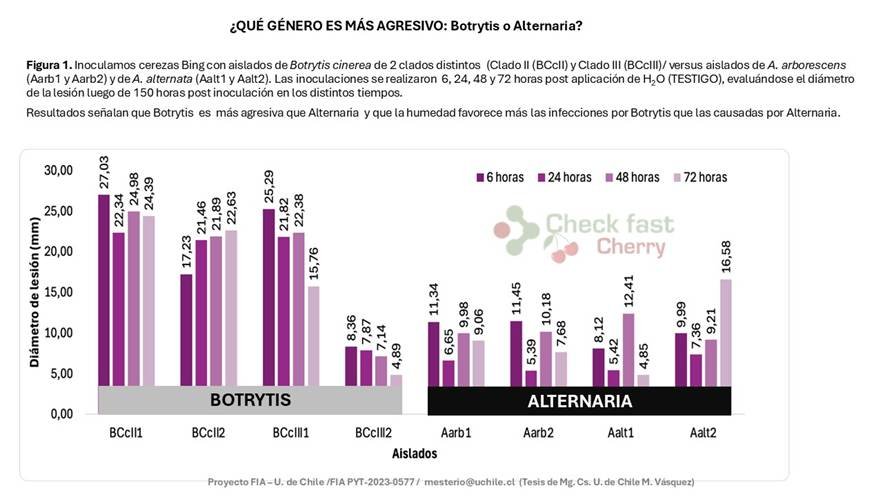
Another question we have often asked is: which of these fungal pathogens is the most harmful to cherries? Regardless of the weather conditions, the results of the biological assays conducted indicate that Botrytis is the most aggressive pathogen (Figure 1).
What measures should be taken to prevent the development of infections caused by these fungal pathogens in cherries?
Control strategy
To identify the most appropriate control strategy, we must first understand: what do we need to control? Which of these fungi predominates in the orchard? Which species of these pathogens are most prevalent?
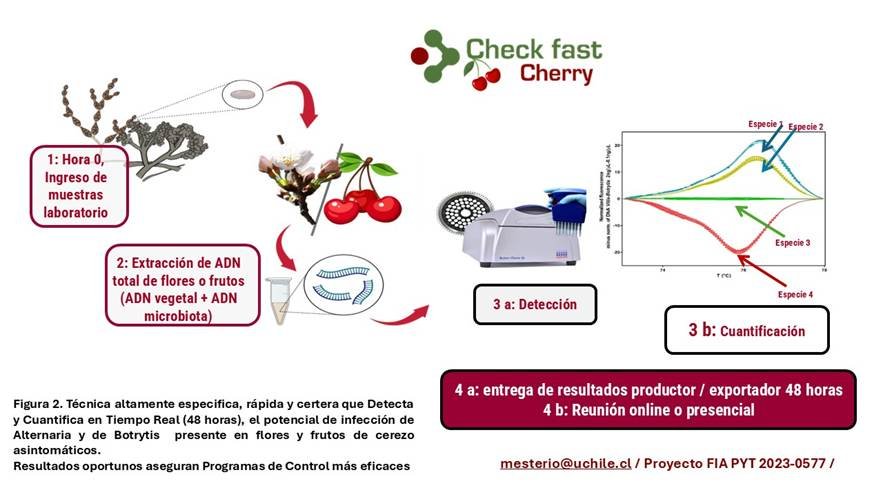
Why are all these questions necessary? Because, to develop optimal control strategies, we need all this information NOW. For this purpose, it was necessary to develop a technique capable of detecting and quantifying in real time—and within a single reaction—all fungi belonging to the genera Botrytis and Alternaria present on cherry flowers and fruit.
The first step was to identify all the other fungi present on cherry flowers and fruit that shared the same ecological niche as Botrytis and Alternaria. In other words, it was necessary to characterise the fungal microbiota of cherry trees and, based on the results, design highly specific primers and probes capable of recognising only Botrytis and Alternaria.
For this purpose, the CHECK FAST CHERRY technique was developed.
Cherry fungal microbiota
What may appear simple and straightforward proved to be far more complex. Analysis of the microbiota identified three groups of Botrytis and, in the case of Alternaria, nine different species.
Three of these had already been reported previously (A. arborescens, A. alternata and A. destruens), while five species had never previously been detected on cherry trees in Chile (A. lini, A. cerialis, A. herbiphorbicola, A. angustiovoidea and A. parvicaespitosa).
A new species (A. sp.), which is still undergoing identification, was also detected.
Why is Check Fast Cherry important for the cherry industry?
Check Fast Cherry
We believe it could become an extremely important tool for the cherry industry. By determining the infection potential in real time, just 48 hours after the plant tissue sample has been collected, timely decisions can be made TODAY about what genuinely needs to be applied TOMORROW.
The technique detects and quantifies the pathogens. Its results therefore make it possible to determine whether to apply a product with greater anti-Botrytis activity or one that is more effective against Alternaria.
If the infection level is low, it is even possible to adopt a lighter control programme that is more sustainable and less harmful to the environment, using, for example, products formulated with plant extracts or biological antagonists close to harvest.
This makes it possible to produce healthy fruit with a lower residue load, while also meeting the requirements of destination markets.
Monitoring and postharvest management
This technique will be available to the cherry industry starting this season as a service, with direct field monitoring conducted by laboratory personnel. A maximum of 10–15 services will be provided (Figure 2).
Finally, regarding cherries, it should be emphasised that the fungicide programmes applied in the field play a very important role in reducing the infection potential.
However, postharvest treatment and proper management of the cold chain are equally, or perhaps even more, important. For this reason, knowing the fruit’s infection level before harvest provides essential information for improving the management of the entire process.
Image source: Stefano Lugli
Marcela Esterio Grez
Associate Professor, University of Chile. Source: Fedefruta FG Communications
Cherry Times – All rights reserved