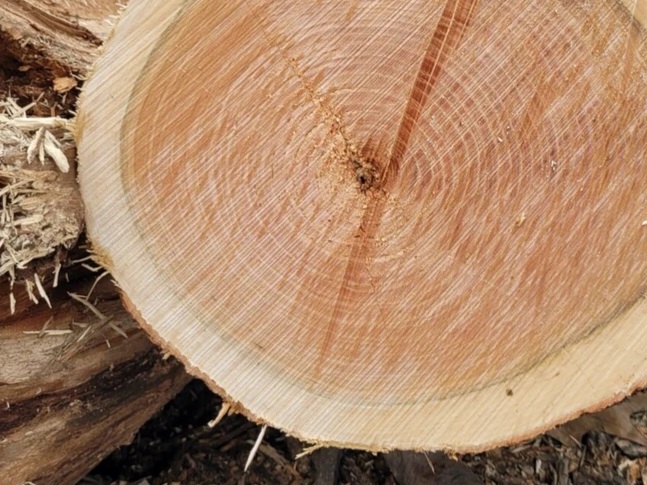
The growth rings of wild cherry trees can serve as a true “memory” of the climatic conditions the tree has experienced throughout its life. This is one of the most interesting conclusions to emerge from a study conducted on five populations of Prunus avium L. in western Poland.
Dendrochronological analysis showed that the annual growth of this species is closely linked, in particular, to water availability and temperatures during key periods of the growing season.
Although the results are preliminary, they open up new perspectives for understanding how wild cherry responds to environmental and climatic changes.
Wild cherry and its ecological value
Prunus avium, commonly known as wild cherry, is a tree species characteristic of the temperate regions of Europe and western Asia.
In addition to its economic importance, related to the quality of its wood and its value as a genetic resource for cultivated cherry, the species plays an important ecological role and also has significant cultural value.
In Poland, it is mainly distributed in the southern regions, where it grows in hilly areas and low mountain regions.
Dendrochronological analysis of 125 trees
To better understand the relationship between tree growth and weather conditions, researchers analyzed five populations located in western Poland.
A total of 125 trees were sampled, providing 196 samples. The analysis focused on annual ring width, a parameter that can provide valuable information about the environmental conditions experienced by a tree during each growing season.
One of the features that makes this approach particularly effective is the specific structure of the wood in this species. The boundaries between growth rings are clearly distinguishable, while the semi-ring-porous structure of the wood facilitates the identification, measurement, and dating of the rings.
Thanks to these characteristics, researchers were able to compare and synchronize the different dendrochronological sequences, establishing local chronologies for each population.
Temperature and precipitation influence growth
The next step was to relate growth patterns to climatic data. The results showed that temperature and precipitation conditions in March play a particularly important role.
July temperature also appears to have a significant influence on ring formation, while rainfall recorded at the beginning and during the first half of the growing season is crucial for supporting tree growth.
However, the trees did not respond to climatic conditions in the same way at all study sites. Significant differences were observed in the relationships between climate and growth among the populations.
The role of habitats in climate response
One possible explanation lies in differences in habitat characteristics. Some trees grow at forest edges, while others are located within the forest; some occur on level ground, whereas others grow on slopes.
Forest type, soil characteristics, and water availability may also substantially modify how trees respond to weather conditions.
These findings therefore suggest that climate never acts alone. Wild cherry growth results from the interaction between temperature, precipitation, and the specific environmental characteristics of the habitat in which each tree develops.
New perspectives on climate change
For this reason, further studies involving a larger number of populations, including sites outside the species’ natural range, will be necessary.
Expanding the sampling network will help researchers better understand the main factors controlling wild cherry growth and, above all, how this important forest species may respond to future climate change.
Source: Cedro, Anna and Cedro, Bernard, THE INFLUENCE OF CLIMATIC CONDITIONS ON THE TREE-RING WIDTH OF WILD CHERRY (PRUNUS AVIUM L.) GROWING IN POLISH FORESTS. Available at SSRN: https://ssrn.com/abstract=6467255 or http://dx.doi.org/10.2139/ssrn.6467255
Image source: Millwright
Melissa Venturi
Ph.D. in Agricultural, Environmental, and Food Sciences and Technologies – Fruit Tree Physiology and Cultivation - Bologna, Italy
Cherry Times - All rights reserved