The fruit industry is facing a new macroeconomic and regulatory landscape following the tariff measures recently imposed by the United States on several consumer and industrial products. The following sections provide an analysis of the impact, the political and commercial reasons behind the measure, and the technical response strategy.
1. Tariff framework and reasons behind the measure
The US administration has introduced an additional tariff of 12.5% on several fresh and processed agricultural products intended for export, also affecting fresh fruit, including cherries, blueberries, and table grapes.
Reasons behind the increase:
Regulatory and labor compliance mechanisms: Washington justified the country’s inclusion as part of a review involving 60 economies, raising concerns about traceability standards and regulations governing the monitoring of working conditions in global supply chains.
Protectionist trade balance policy: the use of safeguard measures and temporary additional tariffs as part of US tariff policy, with the aim of making imports of perishable products more expensive and supporting or protecting the domestic market.
2. Industry size and impact on exports
To put the industry’s exposure into context, cherries are the country’s leading exported fruit crop:
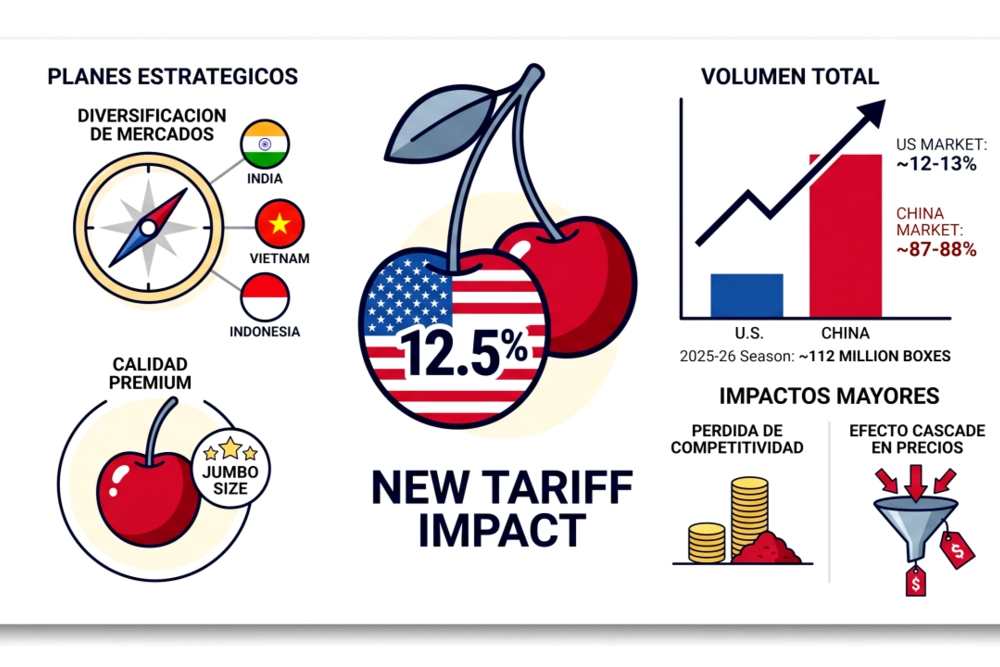
- Export volume in the 2025–2026 season: approximately 112 million boxes
- China’s market share: approximately 87–88% of total exports
- Market share of the United States and other countries: approximately 12–13% of global volume
- Recently introduced additional tariff: 12.5%, compared with the preferential rate of 0% established under the Free Trade Agreement
Main repercussions for the market:
Reduced margins for importers and distributors: the 12.5% tariff must either be absorbed by the margins of the distribution chain in the destination market or passed on to local buyers, reducing the product’s economic competitiveness on store shelves compared with domestic fruit or fruit supplied by competing countries not subject to the tariff.
Slowdown in diversification
Slowdown in diversification: the United States was becoming the main secondary market for expansion efforts aimed at reducing the excessive dependence on China, which absorbs approximately 88% of the fruit. The additional cost of the tariff is slowing down this strategy.
Knock-on effect on prices caused by the redirection of volumes: as the US market becomes less attractive, there is a risk that supply will become even more concentrated in China or Southeast Asian markets. If logistics were to cause congestion at these ports, this could exert downward pressure on prices in the Asian market.
3. Strategic and emergency plans for addressing the US market
In response to this situation, exporters’ associations, companies in the agro-industrial sector, and public authorities — the Ministry of Foreign Affairs and SUBREI, the Undersecretariat for International Economic Relations — are implementing a plan based on three pillars.
A. Diplomatic channel and bilateral negotiations
Request for a trade exemption: industry authorities, with the support of AmCham and the Undersecretariat for International Economic Relations, are holding meetings in Washington to negotiate technical exemptions from the list of products subject to the 12.5% tariff. The request is supported by the country’s full compliance with the social and labor clauses of the Free Trade Agreement and by the complementary nature of its marketing window, which coincides with the low season for US production.
B. Cost and supply chain optimization
Maritime transport efficiency – Cherry Express: offsetting the impact of the 12.5% tariff by reducing costs throughout the supply chain and consolidating direct shipments to strategic ports on the East and West Coasts of the United States. The aim is to reduce transit times, losses caused by product rejection, and fixed costs per container.
Premium quality selection: supplying the US market exclusively with larger-sized fruit — Jumbo and Super Jumbo cherries, as well as firm Bing and Lapins varieties — whose value per kilogram can absorb the additional tariff without compromising growers’ profitability.
C. Geographic market diversification
Accelerating expansion in Southeast Asia: increasing penetration in complementary markets covered by free trade agreements and a 0% tariff rate, such as Vietnam, India, Indonesia, and South Korea, thereby absorbing the volumes that will no longer be shipped to the United States.
Image source: Cristiano Olmos Iriarte
Cristiano Olmos Iriarte
Management Control and Finance, Business Intelligence
Cherry Times - All rights reserved