The search for more sustainable strategies in the micropropagation of fruit tree species is driving increasing interest in natural bioregulators capable of partially replacing conventional synthetic plant growth regulators.
A recent study investigated the use of water pollen extracts (WPEs) from walnut (Juglans regia cvs. Gustine and Pedro) and hazelnut (Corylus avellana) as an eco-friendly alternative to indole-3-butyric acid (IBA) for the in vitro culture of two widely used cherry rootstocks, CAB-6P and Gisela 6.
The rationale behind this research lies in the rich composition of pollen, which naturally contains phytohormones, carbohydrates, amino acids, vitamins, minerals, and other bioactive compounds capable of promoting plant growth and development.
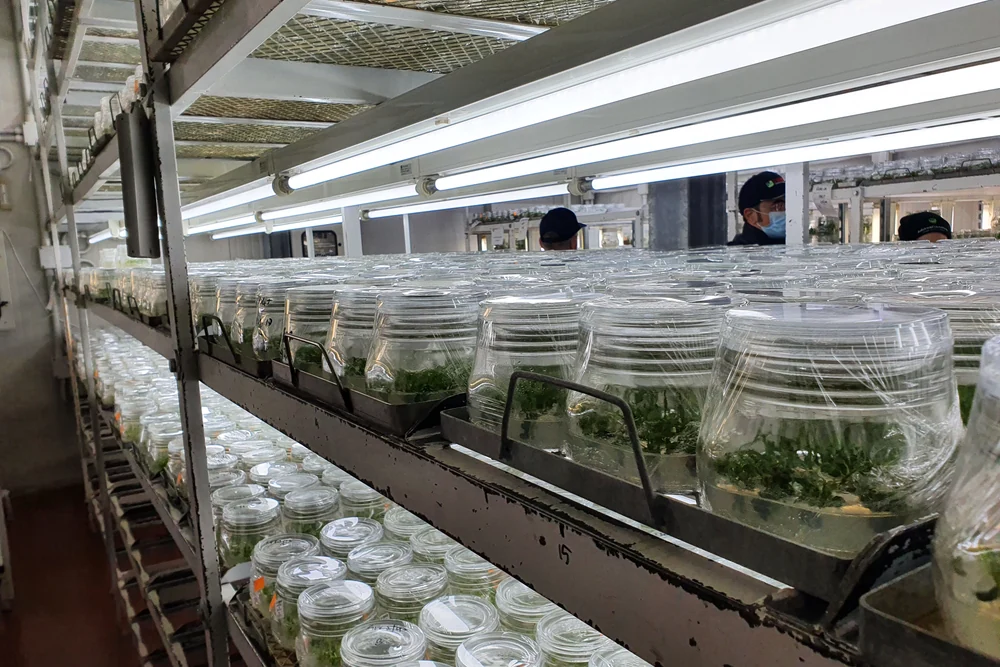
Experimental methodology
The researchers compared six concentrations of pollen extracts (50–600 mg/L) with different IBA doses, evaluating a wide range of morphological and biochemical parameters after ten weeks, including vegetative growth, root formation, chlorophyll, carotenoid and porphyrin contents, as well as carbohydrate and proline accumulation. The results revealed that plant responses strongly depended on both the rootstock genotype and the type and concentration of the pollen extract, confirming that no universal protocol exists and that optimal treatments must be tailored to each plant material.
For the CAB-6P rootstock, low to intermediate extract concentrations produced the most promising results.
In particular, 50 mg/L of walnut cv. Pedro pollen extract and 150 mg/L of hazelnut pollen extract significantly enhanced shoot growth.
Rooting performance was equally noteworthy: 150 mg/L of walnut cv. Pedro pollen extract achieved a 60% rooting rate, matching that obtained with 4 mg/L IBA. This treatment also increased root number and length, enhanced leaf chlorophyll and root carbohydrate contents, and reduced porphyrin accumulation, indicating an improved physiological status.
Results for Gisela 6
Similarly, pollen extracts produced encouraging results in the Gisela 6 rootstock.
Although the highest rooting percentage was achieved with 2 mg/L IBA (90%), walnut cv. Pedro pollen extracts at 400 and 600 mg/L reached rooting rates of 70%, demonstrating sufficient effectiveness to be considered a credible natural alternative during the initial stages of root induction.
In addition, 50 mg/L of hazelnut pollen extract promoted vegetative growth, while 600 mg/L of the same extract resulted in the greatest root elongation.
Beyond their effects on plant morphology, pollen extracts increased chlorophyll and carbohydrate contents in both leaves and roots without significantly altering carotenoid or proline levels, while reducing porphyrin accumulation in several treatments.
Physiological effects and conclusions
These physiological changes suggest improved photosynthetic efficiency and overall plant performance, factors that are likely to enhance the quality of micropropagated plant material and improve subsequent ex vitro acclimatization.
According to the researchers, these beneficial effects are attributable to the natural presence of phytohormones and their precursors, as well as numerous metabolites in pollen extracts, which collectively support vegetative growth, root development, and energy metabolism.
Overall, the study demonstrates the effectiveness of walnut and hazelnut water pollen extracts in the micropropagation of cherry rootstocks.
Although they do not completely replace IBA under all experimental conditions, these natural extracts represent a valuable alternative for specific stages of micropropagation protocols.
Source: Sarropoulou, V., Sotiropoulos, T., Dimassi-Theriou, K., & Therios, I. (2026). Walnut and hazelnut pollen extracts enhance rooting, growth, and biochemical traits of cherry roostocks in vitro. Plant Cell, Tissue and Organ Culture, 164(2), 35. https://doi.org/10.1007/s11240-025-03298-7
Image source: Stefano Lugli
Andrea Giovannini
PhD in Agricultural, Environmental and Food Science and Technology - Arboriculture and Fruitculture, University of Bologna, IT
Cherry Times – All rights reserved