With a seasonal target of around one million kilograms of fresh cherries exported, Frutos del Valle Patagónico has established itself as the second-largest exporter in the province of Chubut, Argentina. Based in Trelew and led by Viviana Bircher and Horacio Salinas, the company has become a benchmark in the cherry supply chain thanks to a winning combination of technology, traceability and entrepreneurial vision.
The cherries, harvested in orchards located in the Lower Valley of the Río Chubut (VIRCh) and in the Los Antiguos area of Santa Cruz province, are processed at the company’s modern temperature-controlled facility in Trelew, from where they are shipped to Europe, Asia and North America. This takes place through an uninterrupted cold chain, a strategic element to ensure quality and freshness.
From the first 4 hectares to one million kilos
According to the local newspaper El Chubut, the company is expected to reach an export volume of one million kilograms this year. A major milestone for a business founded in 2003 with just four hectares of orchards in Treorcky, near Gaiman, which today operates an integrated platform encompassing production, packing and logistics.
The company’s growth has been gradual, supported by targeted investments and strategic collaborations with Patagonia-based growers.
Traceability and precision
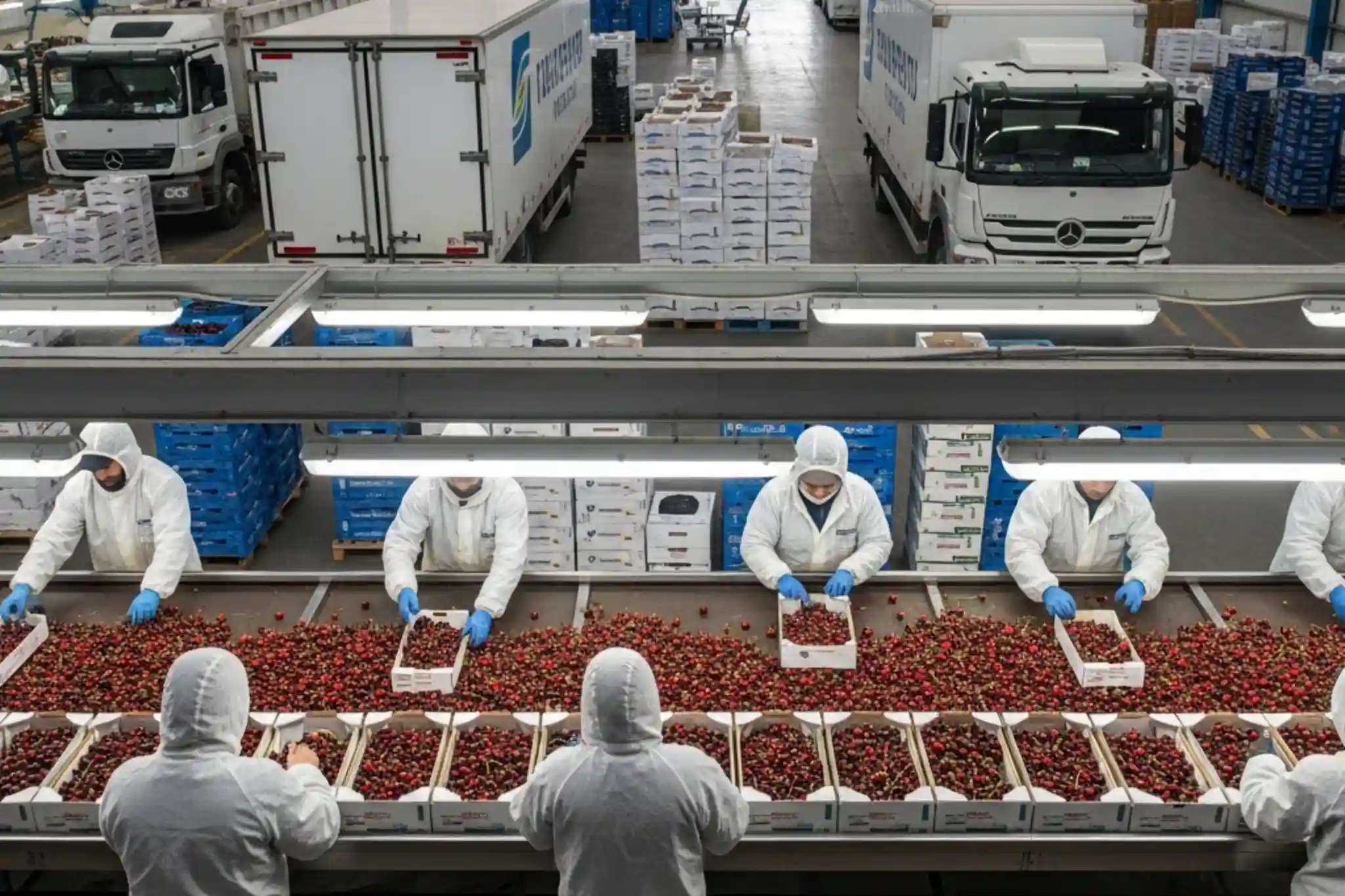
Every stage of processing is handled with meticulous care. Harvesting begins at dawn and, within a few hours, the cherries are immersed in cold, chlorinated water to rapidly lower pulp temperature from 20°C to around 4°C. A second water treatment protects the stems before the fruit is conveyed onto automated sorting belts that select cherries by size.
Packing is carried out in 2 to 2.5-kilogram clamshells, each fitted with barcode labels for full traceability, from the orchard of origin to the outbound flight. “A cherry leaving our facility must arrive in New York or China in perfect condition,” said Viviana Bircher during a seasonal visit to the production line, alongside her husband and daughter Sofía, who is now actively involved in the business.
Tailor-made air logistics
After packing, refrigerated pallets are loaded onto trucks bound for Trelew Airport, where cargo flights depart for Buenos Aires and then, via overnight connections, to major international markets. Air freight is the preferred channel because, as Bircher herself puts it, “time is flavor” when it comes to cherries.
Maritime transport remains a secondary option, used only for nearby destinations such as Brazil and Chile, and only when delivery can be completed within two weeks.
Agricultural innovation and resilience
Success does not come without challenges. Rising transport costs and currency fluctuations are putting pressure on margins, while extreme weather conditions—frost, hail and out-of-season rainfall—represent a constant threat.
To address these risks, the company has invested in multifunctional anti-hail nets and a production site diversification strategy to reduce frost-related exposure.
On the varietal front, Asian demand for larger, darker cherries has driven a shift toward cultivars such as Santina and Regina, while the European market continues to favor traditional varieties, including Bing.
The cherry as a lever for regional development
The role of Frutos del Valle Patagónico fits into a broader context of agricultural transformation in the region. Local authorities view cherries as a viable economic alternative to the area’s historic wool and livestock-based economy.
With more than 100 seasonal workers, the company also contributes to employment stability in a region where tourism slows during the spring months.
At the Trelew facility, the pace is now intense, with shifts lasting up to 18 hours a day, forklifts in constant motion, and monitors displaying destinations such as Amsterdam, Shanghai and Miami.
And as the one-million-kilogram milestone approaches, attention is already turning to the future. Bircher has announced plans to expand controlled-atmosphere storage and assess carbon offset solutions to further enhance sustainability.
Conclusion: a vision that looks ahead
With steady growth, a solid strategy and an almost obsessive focus on quality, Frutos del Valle Patagónico stands as a virtuous example of Patagonia’s new fruit-growing model.
Its rise as the second-largest cherry exporter in Chubut is not merely a business achievement; it signals a sector in full transformation, ready to gain ground and reputation in the world’s most demanding markets.
Source: thepackagingbuyer.news
Image source: Frutos del Valle Patagonico
Cherry Times - All rights reserved