The growing demand for organically produced fruit has intensified the debate over the quality differences between fruit grown under organic and conventional production systems.
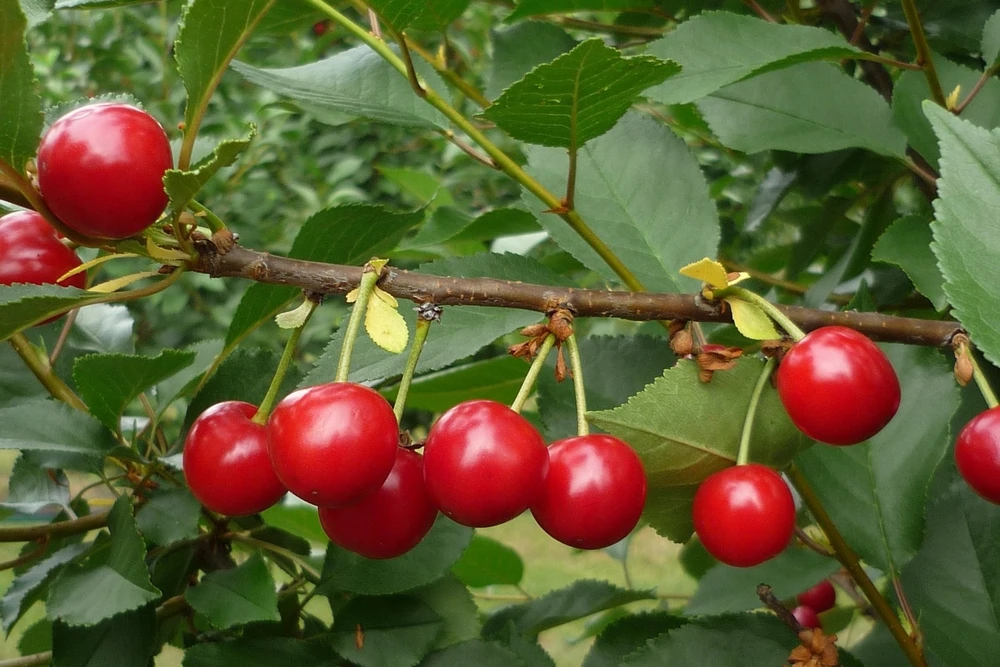
A recent three-year study conducted in Poland on four sour cherry cultivars: ‘Kelleris 16’, ‘Oblačinska’, ‘Pandy 103’, and ‘Debreceni Bötermö’, demonstrates that the cultivation system alone is not sufficient to consistently determine the nutritional and sensory quality of the fruit.
The findings show that the interactions among cultivar, environmental conditions, and growing season often exert a greater influence than the orchard management system itself.
Cultivation systems and environmental conditions
Over three consecutive growing seasons, the researchers compared sour cherries produced under organic and conventional management, using HPLC analysis to determine the concentrations of sugars, organic acids, and vitamin C.
The objective was to assess whether organic cultivation promotes a greater accumulation of metabolites responsible for both fruit sensory quality and nutritional value.
During the first year of the experiment, organically grown sour cherries contained higher concentrations of fructose, glucose, sucrose, and total vitamin C than conventionally grown fruit.
This finding appeared to support the hypothesis that the lower nitrogen availability typical of organic systems may stimulate the synthesis of sugars and other carbon-based secondary metabolites.
Changes over the growing seasons
However, this advantage did not persist over time.
In the following two years, conventionally grown sour cherries exhibited higher concentrations not only of sugars and vitamin C but also of most of the organic acids analyzed.
The year-to-year differences suggest that climatic factors such as temperature, water availability, and seasonal weather patterns strongly influence fruit metabolism, to the extent of masking or even reversing the effects attributable to the cultivation system.
Consequently, studies limited to a single growing season may lead to misleading conclusions regarding the qualitative superiority of one production system over another.
Influence of cultivar genetics
Alongside seasonal effects, the genetic background of the cultivars also proved to be an important factor.
Among the cultivars evaluated, ‘Oblačinska’ showed the best performance in terms of sugar accumulation, achieving the highest average total sugar concentration throughout the experimental period.
This characteristic makes it particularly suitable for organic production, where sugar content is one of the key quality attributes for both fresh consumption and industrial processing.
Regarding vitamin C, the cultivar ‘Pandy 103’ recorded the highest average concentrations.
Organic acids and sensory quality
The organic acid profile, which plays a fundamental role in determining the characteristic taste balance of sour cherries, was also strongly influenced by both cultivar and environmental conditions.
Similarly, the sugar-to-acid ratio, a key parameter for both sensory perception and technological quality, showed substantial variation from one year to the next.
Overall, the study demonstrates that, under the conditions investigated, neither production system consistently outperformed the other in terms of sour cherry quality.
Rather, fruit metabolic responses result from the complex interaction among genetic background, environmental conditions, and cultivation practices.
Conclusions for organic production
For this reason, the researchers emphasize the need for multi-year experiments and, whenever possible, multi-location trials to better understand these interactions.
Finally, under Polish growing conditions, the cultivar ‘Oblačinska’ emerged as the most promising choice for organic orchards aimed at producing high-quality sour cherries.
Source: Ponder, A., Kazimierczak, R., Żebrowska-Krasuska, M., Średnicka-Tober, D., Głowacka, A., & Hallmann, E. (2026). The Effect of Organic Production on the Sugar and Organic Acid Concentration in Different Sour Cherry Cultivars. Applied Sciences, 16(2), 1092. https://doi.org/10.3390/app16021092
Image source: Stefano Lugli
Andrea Giovannini
PhD in Agricultural, Environmental and Food Science and Technology - Arboriculture and Fruitculture, University of Bologna, IT
Cherry Times - All rights reserved