Precision agriculture is no longer just a concept; it is an approach that enables growers to monitor, understand, and respond to orchard conditions in real time. Fruit cracking, a persistent issue in many fruit crops, can significantly reduce both yield and quality. How can growers anticipate when cracking might occur? Which tools provide the insights needed to make timely irrigation and management decisions?
In this blog, you will discover how modern sensors and data collection strategies help farmers monitor tree growth, soil moisture, and microclimatic conditions to reduce fruit cracking and optimize production.
Orchard mapping and understanding spatial variability
Even within a single orchard, conditions vary. Small differences in elevation, slope, or sunlight exposure can affect tree growth and stress responses. Precision agriculture begins by mapping these variations. Satellite imagery, combined with soil analysis, helps identify zones with similar conditions.
While these maps do not provide exact measurements, they reveal patterns in soil, elevation, and vegetation that guide management practices. By recognizing these zones, growers can tailor irrigation, fertilization, and monitoring schedules to local conditions.
For example, trees in a sunnier and drier area may require slightly different water management than those in a shaded, more humid zone. By mapping spatial variability within the orchard, growers can better understand field-level differences and adjust management practices accordingly.
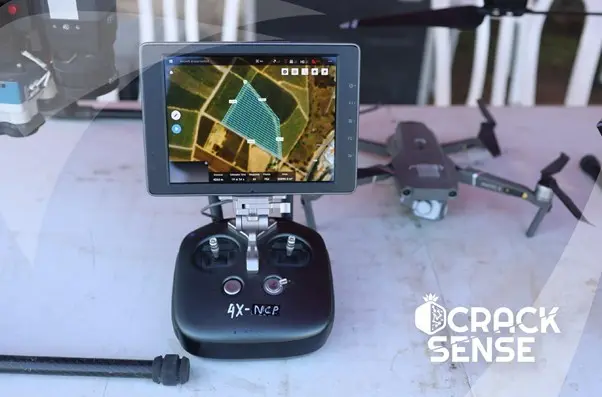 Screenshot of a chart after mapping; Author: CrackSense Project
Soil monitoring: the foundation of fruit health
Soil moisture is a critical factor influencing fruit cracking. Precision agriculture relies on a range of sensors to continuously measure soil conditions. Tensiometers, for example, monitor soil water tension, providing regular readings to determine when irrigation is needed.
By integrating soil moisture data into management decisions, growers can minimize extreme fluctuations that often trigger fruit cracking.
Trunk and fruit dendrometers: seeing growth in real time
One of the most revealing tools in precision agriculture is the dendrometer. Trunk dendrometers continuously measure trunk expansion and contraction, while fruit dendrometers monitor fruit growth and daily size variations.
These tools provide detailed insights into how trees and fruits respond to water availability, temperature, and humidity. In addition, fruit dendrometers detect maximum daily shrinkage (MDS), the daily fluctuation in fruit size caused by water stress.
High MDS values indicate greater susceptibility to cracking. Monitoring these fluctuations helps growers precisely adjust irrigation schedules to reduce cracking risk.
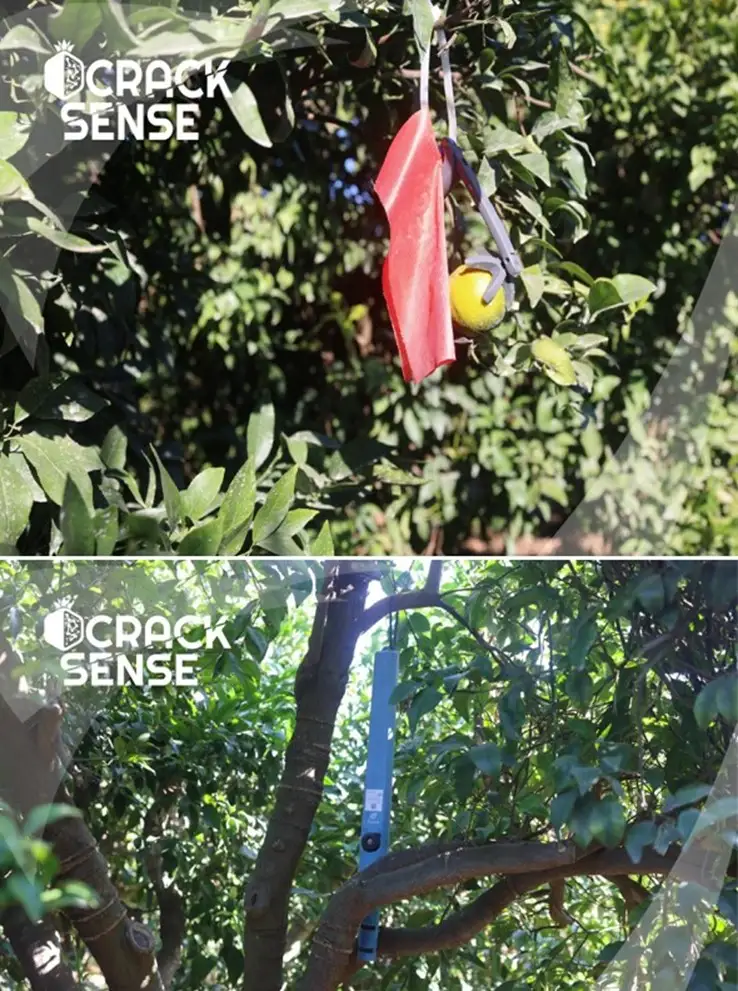 Trunk and fruit dendrometers; Author: CrackSense Project
Climate and microclimate sensors
Weather conditions, including temperature, rainfall, humidity, and solar radiation, influence tree water status and fruit development. Precision agriculture integrates fixed and portable weather stations, as well as drones, to collect daily, hourly, or even more frequent data.
These measurements can reveal how heatwaves, rainfall events, and solar exposure affect soil moisture and plant stress, supporting informed decisions to reduce fruit cracking risk.
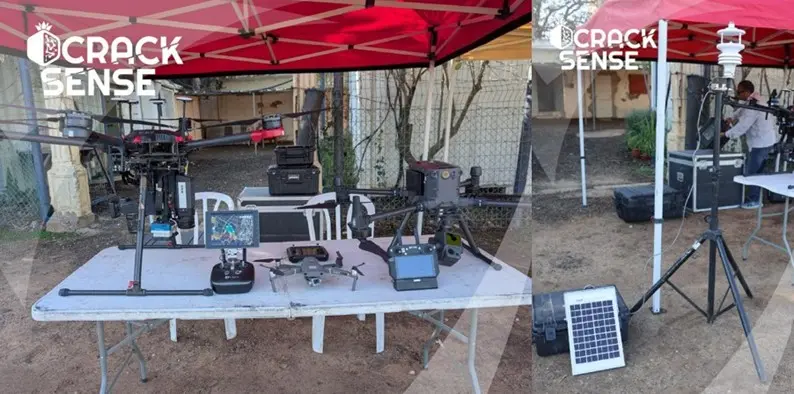 Fixed and portable weather stations and drones; Author: CrackSense Project
Plant water status sensors
Beyond soil and environmental sensors, measuring a plant’s internal water status is also essential. Tools such as stem water potential (SWP) and stomatal conductance provide direct insights into how trees manage water and respond to stress.
SWP indicates the pressure of water within the tree, while stomatal conductance measures how leaf pores regulate water loss and gas exchange. Together, these measurements can reveal periods of potential water stress before visible symptoms appear.
Advanced imaging and 3D monitoring
Modern precision agriculture also uses RGB, thermal, and multispectral imaging, often combined with LiDAR (Light Detection and Ranging) technology, to monitor tree and fruit health.
LiDAR enables the creation of a 3D point cloud, a digital three-dimensional map of the tree and its fruit. Thermography adds another layer of information by measuring surface temperatures of trees and fruit.
By combining LiDAR 3D point clouds with thermographic data, a 4D point cloud is generated. This allows the identification of potential hot spots that may stress the fruit and enables time series analysis showing changes over time.
Drones equipped with these sensors allow aerial orchard mapping, providing a comprehensive overview that integrates ground-based measurements.
Edge computing and AI modelling
All this data is only useful if it can be processed and interpreted efficiently. Edge computing and artificial intelligence models enable real-time analysis of data collected from soil, plant, and environmental sensors, as well as from satellite imagery and drones.
These systems can detect patterns, predict cracking events, and support timely interventions. By integrating edge computing and AI, growers can make data-driven decisions to reduce cracking and optimize yield and quality.
This is where the CrackSense project comes in
CrackSense is a Horizon Europe project (2023–2026) involving 14 partners from 7 countries. Its goal is to tackle fruit cracking in citrus, pomegranate, table grapes, and sweet cherries by developing sensing technologies that provide real-time data on fruit growth and environmental conditions.
By combining multiple sensing methods, CrackSense builds comprehensive datasets and integrates them through machine learning and AI to reveal relationships between soil, climate, irrigation, and fruit susceptibility to cracking.
The ultimate goal of CrackSense is to predict cracking risk in real time and at scale, helping growers make informed decisions to reduce yield losses and improve fruit quality. Through pilot experiments and upscaling activities, the project is demonstrating how smart farming technologies can transform orchards into well-monitored, data-driven systems, from individual fruits to entire regions.
Final considerations: the orchard in the era of precision agriculture
Is it possible to completely prevent fruit cracking? Perhaps not, but precision agriculture provides the tools to significantly reduce it. As these technologies are adopted, the ability to respond to stress will improve, ensuring better yields, healthier trees, and fewer cracked fruits.
For both growers and researchers, the message is clear: careful monitoring, informed decisions, and precise interventions are essential to achieve healthier, more crack-resistant fruit. Precision agriculture shifts orchard management from reactive to proactive, delivering benefits for both farmers and consumers.
If you want to learn more about precision agriculture, fruit cracking, and the innovative tools used to monitor and prevent it, you can read our articles in the CrackSense newsroom or follow us on LinkedIn for updates and insights.
Source: Crack Sense Project – Horizon Project
Opening image source: Stefano Lugli
Cherry Times – All rights reserved