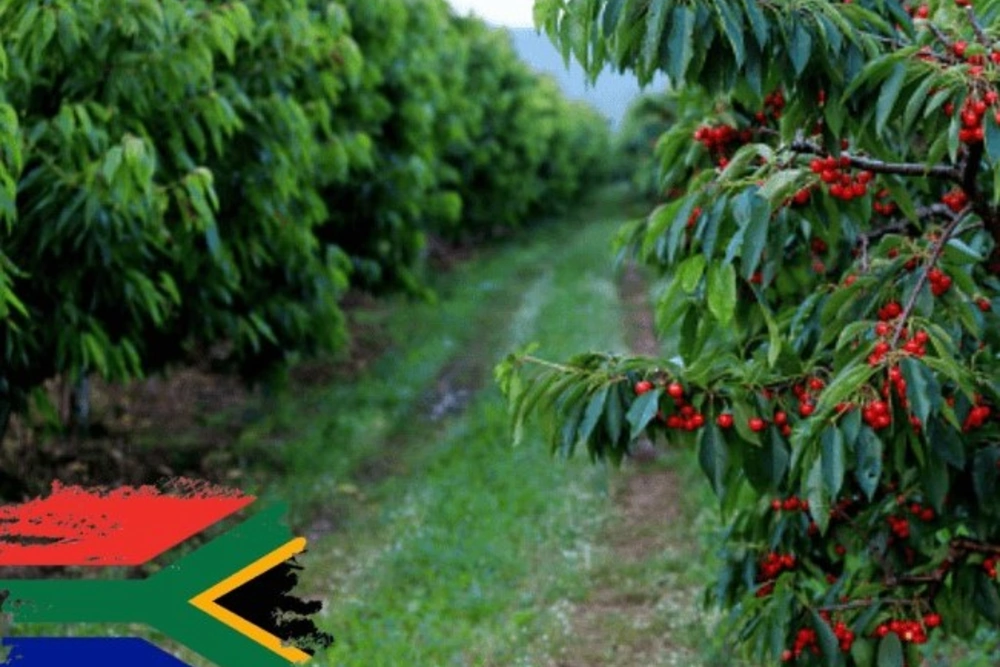
South African cherry growers are preparing to enter China’s US$3.3 billion import market for the first time, opening a potentially valuable export opportunity as the country seeks new trading partners amid uncertainty over its relationship with the United States. Growers hope that access to the world’s largest cherry market will encourage agricultural investment, create jobs and strengthen South Africa’s position in international fruit exports.
The opportunity follows a market-access agreement signed between South Africa and China on 8 September 2026. Agriculture Minister Willie Aucamp and Sun Meijun, representing China’s General Administration of Customs, signed the protocol in Beijing. The agreement establishes a framework for South African cherries to enter the Chinese market, although exporters must still satisfy outstanding regulatory requirements before their first shipments can proceed.
The opportunity in figures
586,900 tonnes
Cherries imported by China in 2025
US$3.3 billion
Value of China’s cherry imports in 2025
0.2%
South Africa’s share of global cherry production
Early-season cherries could give South Africa an advantage
China imported approximately 586,900 tonnes of cherries in 2025, valued at US$3.3 billion. That demand presents a substantial opportunity for South African producers, who currently account for just 0.2% of global cherry production. Growers see harvest timing as a way to compete despite the industry’s small production base.
South African cherries can reach maturity in September and October, ahead of the main export season in Chile, one of China’s largest suppliers. This timing could allow local farmers to enter the market before competing South American shipments arrive in significant quantities.
Karien Bezuidenhout, manager of alternative crops at fruit industry association Hortgro, believes the early-season opportunity could help South African cherries establish a position in China.
“If we can get there early, we’d say September, early October, that creates the opportunity for us to get there before the Chilean cherries,” Bezuidenhout told Reuters.
Harvest timing alone will not be enough to enter the Chinese market. Producers must meet strict plant-health requirements, maintain consistent fruit quality and develop reliable transport arrangements. Cherries are highly perishable, making temperature-controlled storage and efficient logistics essential to protecting their value during international shipment.
Producers prepare to expand
One producer preparing for the opportunity is Gert Eastes, chief executive of Ridge Cherry Farms near Rustenburg in South Africa’s North West province. Eastes has spent more than a decade developing production methods aimed at supplying the Chinese market.
His 125-hectare farm currently produces approximately 600 tonnes of cherries, with plans to increase output to around 2,000 tonnes. The expansion would depend partly on securing export markets capable of absorbing greater production.
“If we can send 1,000 tonnes in October to China, that changes our business model and the opportunities we have to grow the business,” Eastes said.
He is also preparing to expand employment if export demand develops as expected. The farm currently employs about 300 seasonal workers, with the potential to increase that workforce substantially as production grows.
The South African government estimates that access to China could support approximately 600 additional jobs across the cherry industry. However, those opportunities remain projections rather than employment already created.
| Indicator | Figure | Context |
|---|
| Ridge Cherry Farms area | 125 hectares | Farm near Rustenburg |
|---|
| Current farm production | Approximately 600 tonnes | Current output |
|---|
| Planned farm production | Around 2,000 tonnes | Expansion plan |
|---|
| Seasonal workers at the farm | About 300 | Current workforce |
|---|
| Potential additional industry jobs | Approximately 600 | Government estimate linked to access to China |
|---|
Export diversification amid trade uncertainty
The agreement forms part of a wider effort to diversify South Africa’s agricultural exports. China has introduced zero-tariff access for qualifying South African products under a bilateral trade framework, potentially improving their competitiveness in a market dominated by established suppliers.
Lower tariffs could help exporters offer more competitive prices, but they do not eliminate production, transport or compliance costs. Farmers will still need to develop buyer relationships and meet consumer expectations.
South Africa’s search for new markets has gained urgency as trade relations with the United States become increasingly uncertain.
The African Growth and Opportunity Act (AGOA), which provides eligible African countries with preferential access to the American market, has supported exports from several industries, including agriculture and manufacturing. Political tensions between Washington and Pretoria have raised concerns about South Africa’s future participation in the programme.
President Cyril Ramaphosa warned this week that the country must prepare for the possibility of losing its preferential access under AGOA. Such an outcome could affect exporters that depend on favourable trading conditions in the United States.
Aucamp has argued that expanding agricultural trade with China is not intended to undermine relations with Washington. The government wants to reduce the risks of relying too heavily on individual export destinations.
“We can’t wait and be caught with our pants around our ankles should AGOA not be renewed. We’ve got to go and open up new markets,” Aucamp said.
The government’s approach reflects a broader challenge facing African agricultural exporters. Dependence on a limited number of international markets can leave producers vulnerable to changes in trade policy, tariffs and consumer demand.
Developing relationships with additional trading partners can provide greater commercial flexibility. Successful diversification also requires investment in production, food safety systems, transport infrastructure and market development.
Potential gains across the agricultural supply chain
South Africa already exports approximately US$15 billion in agricultural products annually. The sector supports employment and earns foreign exchange, while providing markets for businesses involved in packaging, transport, storage and food processing.
China imports agricultural products worth approximately US$200 billion annually. Its scale makes it an attractive destination for exporters seeking to expand beyond traditional markets in Europe and North America.
Wandile Sihlobo, chief economist at the Agricultural Business Chamber of South Africa, believes greater access to international markets could significantly increase the country’s agricultural export earnings.
“We are already exporting 55% of what we produce. We could see our export value expanding by at least 20% over the coming years,” Sihlobo said.
The potential benefits extend beyond cherry growers. Growth in high-value agricultural exports could support investment in orchards, cold storage facilities, packaging operations and freight services. These activities can create employment across agricultural supply chains, including in rural communities where economic opportunities remain limited.
Export growth must also account for the costs and risks associated with intensive fruit production. Farmers face pressure from changing weather patterns, water availability, labour costs and international price fluctuations. Increasing production without securing reliable buyers could expose businesses to financial losses.
China’s market also presents strong competition. Chile and Argentina already supply substantial volumes of cherries, supported by established distribution networks and commercial relationships. South African growers will need to compete through quality, timing and dependable delivery.
The industry’s relatively small production base could become an advantage in specialised market segments. Producers may be able to target premium buyers seeking cherries before the main Southern Hemisphere supply season, rather than competing directly with larger exporters on volume.
Final regulatory clearance remains outstanding
The opportunity remains dependent on final regulatory clearance.
Although the two governments signed the market-access protocol in September, China must still confirm that South African exporters have satisfied the required conditions. Aucamp expects the process to conclude before the end of 2026, but the timing of the first commercial shipments remains uncertain.
South Africa is also pursuing access for blueberries, with negotiations between the two governments at an advanced stage. A successful agreement could provide another export opportunity for the country’s fruit industry and strengthen agricultural trade relations with China.
The developments carry wider significance for Africa as governments seek to increase agricultural exports and capture more value from international markets. Many countries across the continent face barriers to high-value destinations, including infrastructure constraints and regulatory requirements.
Improving trade agreements is therefore only one part of expanding agricultural exports. Farmers also need reliable logistics, recognised quality standards and access to financing to invest in competitive production.
South Africa’s cherry agreement illustrates both the opportunities and the challenges involved. Access to a large market can create new possibilities for farmers, but turning those possibilities into sustained export revenue requires practical investment and consistent delivery.
The immediate test will be whether producers secure final approval and successfully deliver their first shipments to China. Longer-term success will depend on establishing a competitive position alongside larger international suppliers.
As African economies seek stronger trading relationships beyond traditional export destinations, South Africa’s cherry industry offers an example of how agricultural diversification could support growth. Its significance will ultimately be measured by export earnings, sustainable employment and opportunities across the agricultural value chain.
Text and image: Fence Africa 24
Cherry Times - Tutti i diritti riservati