Ovule longevity is one of the key factors determining reproductive success in sweet cherry, directly influencing fruit set and the duration of the Effective Pollination Period (EPP). This is the central topic of a study by Radunić and colleagues, published in Agronomy, which investigates the physiological mechanisms underlying differences in reproductive efficiency among sweet cherry cultivars under Mediterranean climatic conditions.
What is the Effective Pollination Period?
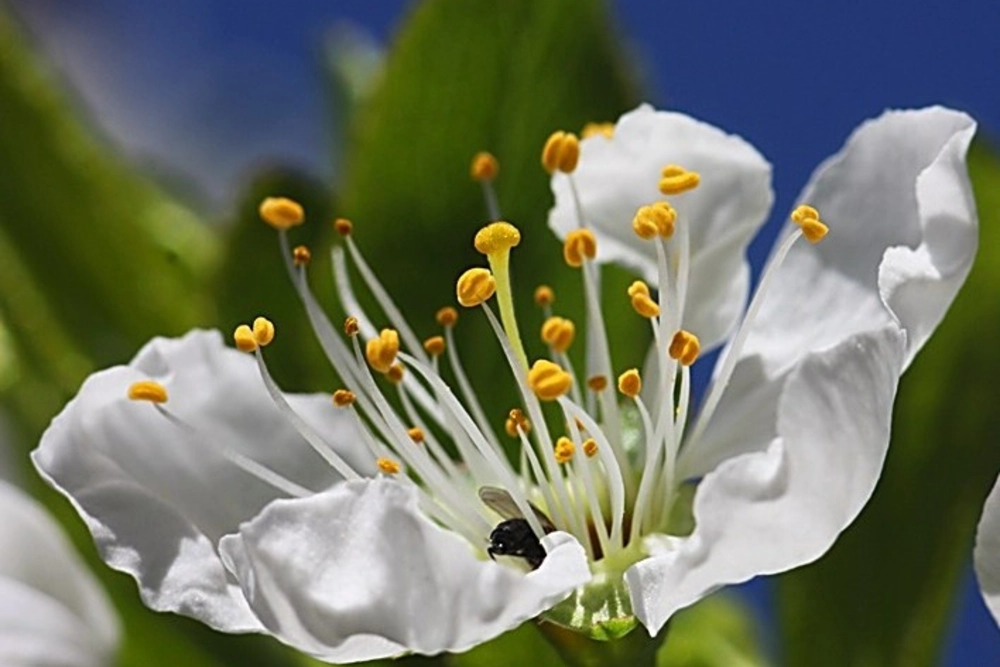
The EPP defines the time interval during which pollination can effectively lead to fertilization and fruit development. Its duration depends on the simultaneous occurrence of several physiological processes: stigma receptivity, pollen germination, pollen tube growth through the style and, most importantly, the maintenance of ovule viability.
The latter is particularly important, as even successful pollination may fail to result in fertilization if the ovules degenerate before the pollen tubes reach the embryo sac.
The study of three Croatian cultivars
The study was conducted in Croatia on three local sweet cherry cultivars, Stonska, Gomilička and Tugarka, over two consecutive flowering seasons. The authors assessed EPP duration through controlled hand pollinations performed at different stages of flowering, combining these observations with analyses of stigma receptivity, pollen tube growth and ovule viability.
Ovule viability was monitored through fluorescence microscopy, allowing the researchers to follow ovule degeneration over time.
Differences among the cultivars
The results revealed particularly interesting differences among cultivars. Stonska and Gomilička exhibited relatively long effective pollination periods, lasting approximately 9 and 11 days, respectively, and were associated with moderate to high fruit set.
In contrast, Tugarka showed a considerably shorter EPP, of approximately 4–5 days, together with consistently low fruit set, below 10%.
The most significant differences were not related to stigma receptivity or the ability of pollen tubes to grow through the style, but rather to the duration of ovule viability. In particular, Tugarka exhibited more rapid ovule degeneration, a process further accelerated by higher temperatures during flowering.
Consequently, the time available for pollen tube growth and subsequent fertilization was substantially reduced.
A trait relevant to cultivar improvement
These findings have considerable agronomic relevance, particularly in light of increasing spring temperature variability and the possibility of higher temperatures occurring earlier during flowering. The ability to maintain ovule viability for longer could represent an important physiological advantage, increasing the likelihood of successful fertilization even when pollination does not coincide precisely with the optimal period of flower receptivity.
Cultivars characterized by greater ovule longevity may therefore exhibit greater reproductive flexibility and a better ability to maintain satisfactory fruit set under less favourable environmental conditions.
Overall, the study highlights that reproductive success in sweet cherry depends not only on the availability of compatible pollen and its ability to germinate and grow, but also on the capacity of ovules to remain functional until fertilization takes place. Ovule longevity therefore emerges as a valuable physiological trait for cultivar selection and breeding programmes, particularly in the pursuit of genotypes with greater resilience to heat stress during flowering. This trait could become increasingly important in ensuring regular production and satisfactory fruit set in Mediterranean fruit-growing environments.
Source: Radunić, M.; Jazbec, A.; Goreta Ban, S. Ovule Longevity Determines the Fruit Set and Effective Pollination Period in Sweet Cherry Cultivars Under Mediterranean Climate Conditions. Agronomy 2026, 16, 1382. https://doi.org/10.3390/agronomy16141382
Image source: BAY
Melissa Venturi
Ph.D. in Agricultural, Environmental, and Food Sciences and Technologies – Fruit Tree Physiology and Cultivation - Bologna, Italy
Cherry Times - All rights reserved