Changes in climatic factors, including temperature, drought, vapor pressure deficit, and rainfall patterns, can significantly affect plant growth and development. Most of these changes have the potential to negatively impact crop productivity, particularly in arid and semi-arid regions.
In this context, the use of reflective mineral particles has emerged as a promising strategy to enhance the tolerance of fruit crops to environmental stress. A recent study conducted on sweet cherry cv. ‘Sweetheart’ investigated the physiological and nutritional effects of foliar applications of kaolinite and calcite, two minerals widely used to protect plants from heat and radiation stress.
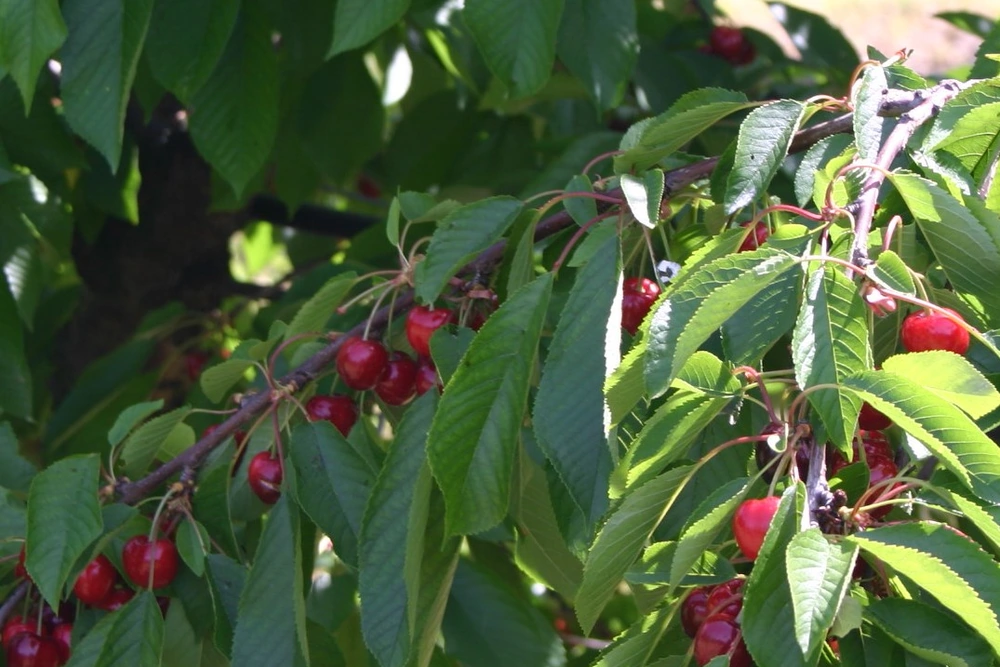
The trial was carried out under field conditions in the semi-arid region of Murcia, Spain, characterized by high summer temperatures and low relative humidity. Leaves were treated with kaolinite or calcite suspensions at concentrations of 5, 10, and 15%, both with and without the addition of a surfactant. The objective was not only to assess changes in key physiological parameters but also to evaluate the ability of these mineral particles to influence nutrient uptake and distribution within leaf tissues.
Treatments
The addition of a surfactant improved particle distribution across the leaf surface, resulting in a more uniform coating compared with suspensions lacking an adjuvant, where localized particle aggregates were observed. This enhanced coverage also appeared to promote the absorption of mineral-derived elements. From a physiological perspective, the treatments induced a temporary reduction in leaf temperature during the days immediately following application. This effect, attributed to the increased reflectance of solar radiation provided by the mineral deposits, was short-lived and gradually disappeared over the following weeks.
Similarly, stomatal conductance exhibited transient changes, suggesting an adaptive response of the leaves to the microclimatic modifications created by the surface coating. No treatment caused significant alterations in chlorophyll fluorescence or in the photosynthetic efficiency of Photosystem II. Indeed, the values of the main photosynthetic performance indicators remained within the range typical of healthy, non-stressed plants, confirming the overall compatibility of these applications with normal plant physiological functioning.
Leaf mineral analyses provided further insights into the potential mechanisms involved. Kaolinite treatments resulted in increased leaf concentrations of silicon and aluminum, particularly when a surfactant was included in the formulation. This finding suggests that a fraction of the particles, or their dissolution products, may be absorbed by leaf tissues. However, the researchers emphasized the importance of avoiding excessively high kaolinite concentrations, recommending that applications should not exceed 5% in order to limit potential aluminum accumulation.
Minerals
In the case of calcite, increases in leaf calcium concentration were more modest but still detectable, especially at the highest application rates. In addition to the elements directly supplied by the treatments, changes were also observed in the concentrations of potassium, magnesium, iron, manganese, zinc, sulfur, and strontium, indicating that mineral particle applications can influence the overall nutritional balance of the leaf.
Overall, the study demonstrates that foliar treatments based on kaolinite and calcite can induce beneficial physiological responses and contribute to mitigating the effects of summer heat stress in sweet cherry trees. Although the underlying mechanisms require further investigation, the results highlight the potential of these mineral formulations, particularly when combined with suitable adjuvants, as valuable tools for improving crop resilience to environmental stress.
Source: González-Illanes, T., Martínez-Lama, O., Bahamonde, H. A., Carrión-Antolí, A., Torres, E., & Fernández, V. (2026). Kaolinite and calcite foliar treatments induce physiological changes in cherry tree leaves. Plant Stress, 101235. https://doi.org/10.1016/j.stress.2026.101235
Image source: Stefano Lugli
Andrea Giovannini
PhD in Agricultural, Environmental and Food Science and Technology - Arboriculture and Fruitculture, University of Bologna, IT
Cherry Times - All rights reserved