From its origins in what was known as the first cherry boom in Chile during the 1990s and early 2000s, until today, production has grown exponentially due to the high demand from China.
This increase in demand and a cultivated area that has grown by 10,000 hectares per year have generated, on one hand, a flourishing and dynamic industry around this species, but also an enormous need for information for sector operators.
In this context, to help growers make informed decisions about harvesting and production of cherries, Mundoagro and agronomist and consultant Patricio Morales have launched the first "Cherry Production Manual."
The meeting, held at the Valle Escondido golf club, was moderated by Mundoagro journalist Cynthia Alfaro and attended by over 100 cherry producers and exporters.
The manual was supported by key industry sponsors such as Syngenta, FMC, Chemieagro, UPL, Stoller, Coagra, SummitAgro Tavan Chile, Biogram, Ferpac, Agrosystems, Fruteck, Greenhas, SO Agricultura, Aminochem, Innovak Global, Sumitomo Chemical, Rovensa Next, Agri Sciences, Bioamerica, Martinez & Valdivieso, Compo Expert, Agrosupport, Agro Puelma, Terrafrut, La Unión, and Provex.
Fabio Masella, founder and director of Mundoagro, welcomed us with warm words: "In 2009, when Mundoagro was founded, our mission was to accompany the best agricultural consultants in their daily work, in their journey, and then to transfer their knowledge to pursue the evolution of the national agricultural sector."
"For this, I would like to thank Patricio for allowing us to be his publishing house on the occasion of the launch of his first book, as well as I would like to thank professors Oscar Carrasco and Eduardo Alonso, mentors of Patricio, who are here with us today.”
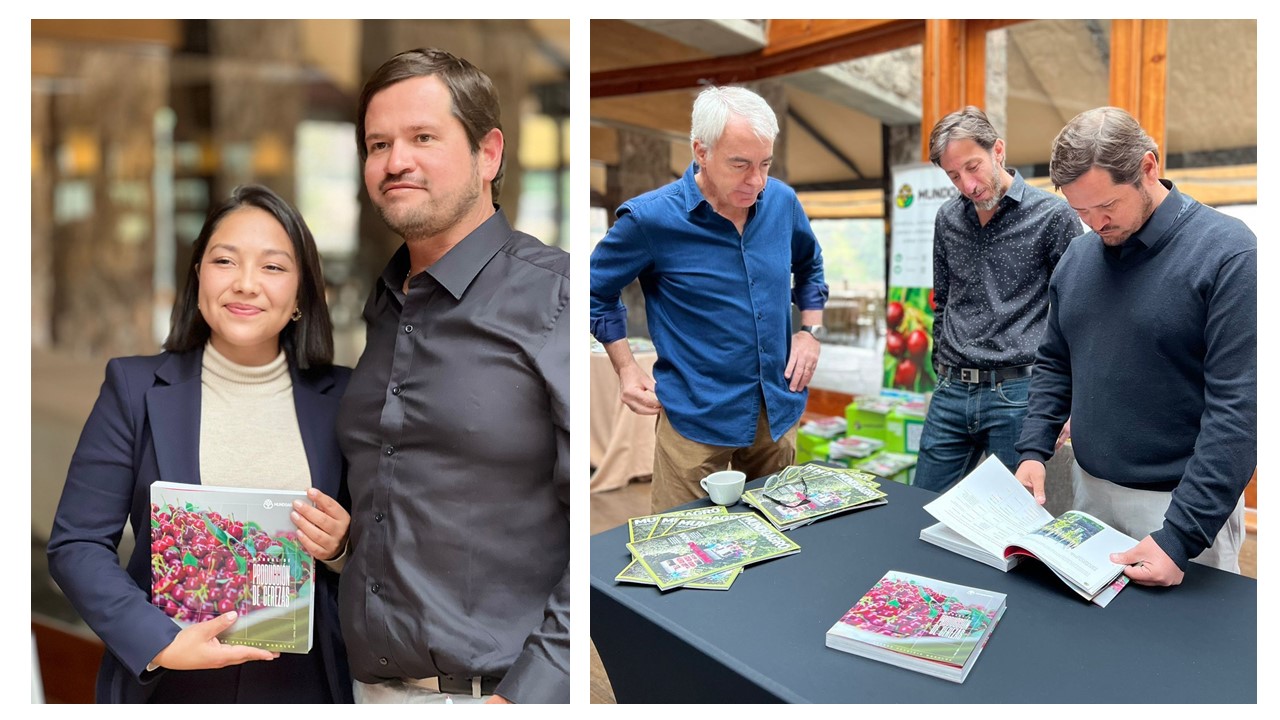 Image 1.
According to Oscar Carrasco, a professor of fruit growing at the University of Chile and professional fruit consultant, in the last 20 years, there has been a virtuous transition between the generation of academic trainers, experienced consultants, and prominent technicians related to the cherry sector, towards a new generation of professionals who have given a significant boost to the introduction of technologies and managements that allow for continuous growth in the volume and quality of the fruit.
“One of the young professionals who has stood out in this new generation is Patricio Morales, who with his inexhaustible energy is contributing with his enormous practical experience and knowledge to the success of the project he is involved in,” he added.
“The challenge of writing a book on a fruit crop is great and is possible only if you have the foundations, the will, and many hours of dedication. This manual is an example of what a good professional can offer as a contribution to the sector,” Carrasco declared.
Morales, who has provided advice to more than 100 cherry growers and stone fruit growers from Polpaico (Metropolitan Region) to Osorno (Los Lagos Region), said: “These have not been easy times for agriculture, but we will continue to be the largest exporters of cherries in the world."
"We face new challenges, there is always something different to face, and for this, we must give our best. That is why this book places the emphasis on technical work for growers, to accompany them in every phase of cultivation, from planting the orchard to post-harvest.”
The support of agronomic engineer Paula Lagos, area manager of Coagra, who wrote the content together with Patricio, was fundamental in the development of the book. “There were eight versions of the book before the final one. It took two years of work, in which my twelve years as a consultant finally bore fruit. Paula was fundamental with her accuracy.”
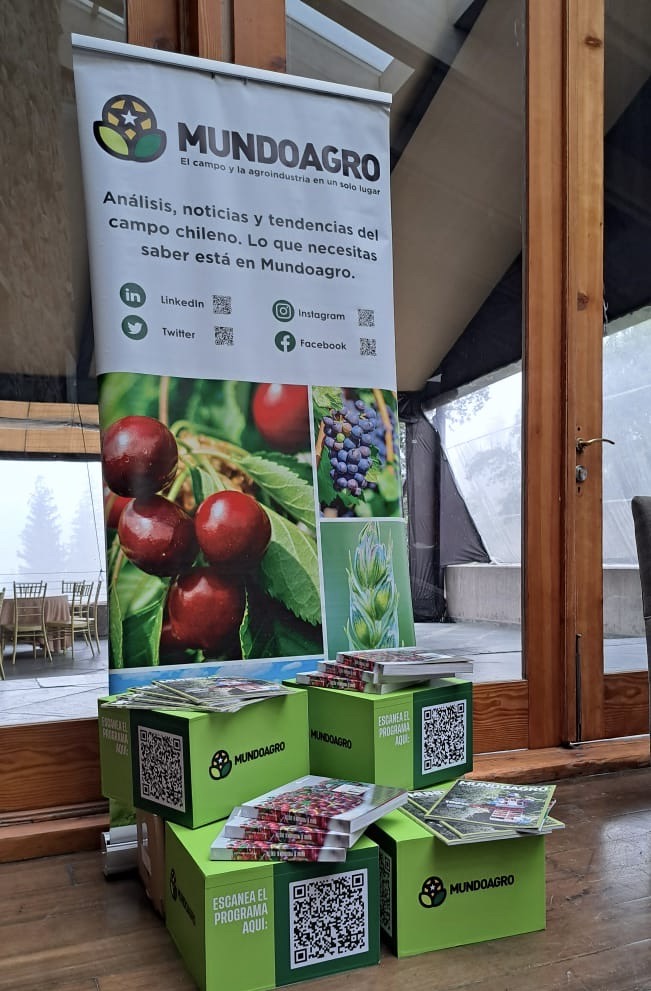 Image 2.
The Importance of the Manual
The "Cherry Production Manual" is a fundamental technical material that will facilitate the tasks of producers in the fields, in terms of varieties and rootstocks, main management systems, and plant management, among other topics.
Fernando Chulak, general director of Mundoagro, commented: "It is a great satisfaction for us at Mundoagro, not only because we are celebrating 15 years, but also because we have seen the evolution of the sector during this period, how crops like cherries have developed, increased their hectares, and improved their technical level. This book marks this development, and we are proud to have been able to accompany the sector in this growth.”
According to Paula Lagos, co-author of the book, the goal of the manual was to summarize the production of cherries even before the orchard is productive. "The content of the book is based on the choices of farmers, from why to choose a variety and what factors to consider in creating an orchard. With this manual, the cherry industry has access to comprehensive content that helps to obtain quality fruits,” she added.
Meanwhile, Carrasco stated that the presentation of this book is a significant step that Patricio is taking on a professional level and gave him his full support. “At his age, I wouldn’t have dared to write two paragraphs, but he has accumulated an enormous amount of experience in this short period, and this gives him immense value for the sector.”
"This book is important for producers and exporters because it is a precise guide that contains relevant information with many details that are often not considered in the field.”
Source: Mundoagro
Images: Mundoagro
Cherry Times - All rights reserved