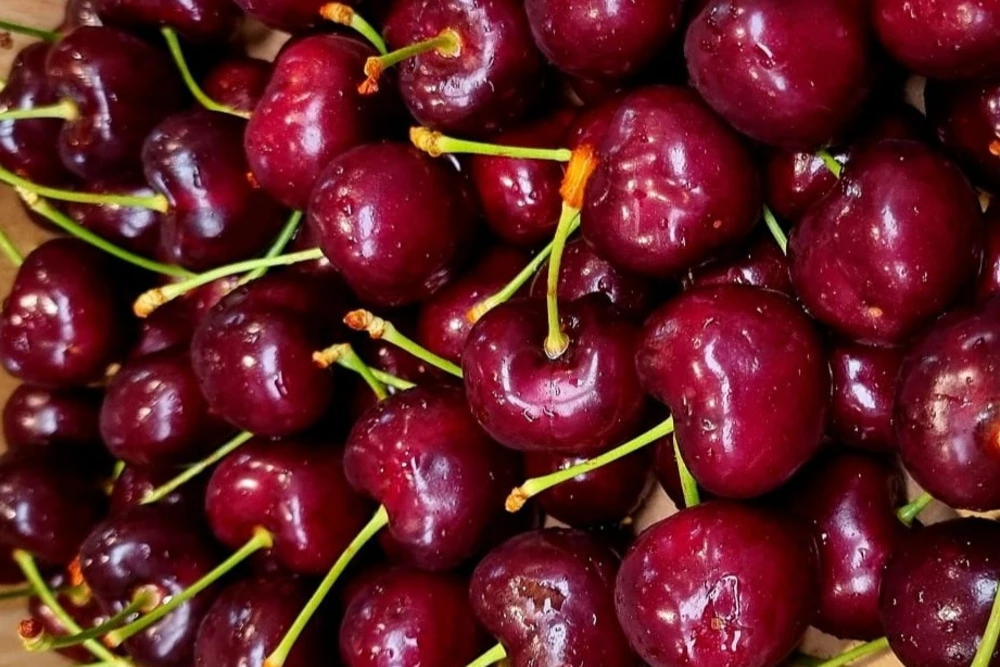
The cherry is one of the most recognizable symbols of spring: a fruit capable of immediately attracting consumers, thanks to its close link with seasonality, its emotional appeal and that natural “moreish” quality that makes it unique on the fresh produce shelf.
Before reaching the point of sale, however, every cherry passes through a complex supply chain, built on agronomic expertise, investments, commercial organization and highly precise technical choices. This is the dimension that emerges from the system developed by Agrintesa and Gruppo Alegra, today among the key players in Italian cherry production.
The historic heart remains the Vignola production area, between Bologna and Modena, where the farm of Pier Giorgio Lenzarini is also located. Lenzarini is president of Alegra, the lead company of the group of the same name, which also includes Brio and Valfrutta Fresco. Alongside this well-established territory, in recent years a new growth direction has emerged in Romagna, particularly in the Ravenna area, where Aristide Castellari, president of Agrintesa, operates in the Faenza district.
A supply chain spanning more than 400 hectares
The figures clearly illustrate the scale of the project: Agrintesa and Gruppo Alegra count more than 400 hectares planted with cherry trees, with production this year expected to approach its full potential of 3,000 tonnes.
Around three quarters of the volumes come from the Vignola area, where the group accounts for more than 50% of Vignola Cherry PGI. The remaining share comes from Romagna, a territory historically less associated with cherries than Emilia, but now at the centre of a strong specialization process.
The strategy is clear: focusing on professional orchards, protection and innovation. More than 40% of the registered cherry-growing area is covered and equipped with frost protection systems, reflecting an increasingly structured approach to managing a crop that is as valuable as it is delicate.
A crop that requires passion and expertise
For Agrintesa and Gruppo Alegra, the cherry is not merely a commercial product, but an identity-defining crop. This is also demonstrated by the fact that both presidents are producers themselves.
Pier Giorgio Lenzarini grows cherries on a family farm near Valsamoggia, in the historic Vignola production area. The family’s farming history began after the Second World War, when his grandfather left the dairy business to devote himself to fruit growing and, in particular, to cherry cultivation.
Today, together with his brother, Lenzarini manages 6 hectares of cherry trees within a farm of more than 30 hectares, which also includes pears, plums, flat peaches and apricots. Cherry harvesting, he explains, retains a special emotional dimension that is difficult to find in other crops.
Alongside this passion, however, there is considerable technical complexity. Cherry growing requires careful choices based on the pedoclimatic context, significant investments from the planting stage onwards, and leaves no room for improvisation. The season is short, mistakes have an immediate impact, and the producer’s experience remains decisive.
Varieties, orchards and production risks
Lenzarini has chosen an agronomic approach based on low-density orchards, with vigorous trees trained in vase or flag systems. The latter requires particular care during training pruning, but once established it facilitates harvesting and supports fruit quality.
The cherry season is concentrated into just over 40 days. To cover the entire production window, a well-balanced varietal range is therefore essential. The varieties grown include Bigarreaux, Lapins, Grace Star and Celeste, alongside more recent selections such as the Sweet series developed by the University of Bologna.
Each variety has specific characteristics and behaviours that the producer must understand precisely. Alongside technical management, critical issues remain: labour, especially for harvesting, is increasingly difficult to find and organize; on the phytosanitary front, Drosophila suzukii continues to be the main adversary.
In this context, belonging to a cooperative structure such as Agrintesa becomes a decisive factor: it means being able to rely on technical assistance, specialist expertise and access to the most relevant varietal innovations.
When knowledge becomes cooperation
Knowledge transfer is one of the central aspects of the Agrintesa-Alegra model. The technical know-how developed in the Emilia production area has gradually been shared with producers in Romagna, where cherry growing did not have a tradition comparable to that of Vignola.
Aristide Castellari, who manages a fruit farm of around 60 hectares in the Faenza area, sees this process as one of the most concrete expressions of cooperation: a network in which the knowledge developed across different territories is made available to the cooperative’s members.
Castellari was among the first producers in Romagna to approach cherry growing professionally, more than ten years ago. From the outset, he focused on high-density orchards and on new selections from the University of Bologna, carefully assessed by the technical department. Today he grows around 8 hectares of cherries, all protected, with a varietal mix distributed across the entire season.
Introducing a new crop in an intensive form was not an easy choice. However, the cooperative structure enabled Romagna members to undertake this path with awareness, technical support and a clear understanding of the risks and opportunities involved.
Post-harvest: a just-in-time system
The enhancement of cherries does not end in the field. Such a delicate product requires extremely rapid and coordinated post-harvest management.
According to Enrico Bucchi, general manager of Valfrutta Fresco and a key figure for Gruppo Alegra’s cherry business, this is the fruit species that most requires a “just-in-time” logic. Harvesting windows are short, shelf life is limited, and the product must reach consumers in the best possible quality condition.
For this reason, cherries are harvested and processed on the same day, avoiding prolonged storage in cold rooms. The goal is to reduce waste, preserve freshness and quality, and maximize the value of members’ production.
The investments made by Agrintesa have equipped the processing lines with advanced technologies for product selection and management. This makes it possible to ensure greater uniformity, reduce the margin of error and maintain adequate operating rhythms during a short and intense campaign.
Every day, the system must adapt to what arrives from the cherry orchards, monitored almost in real time thanks to the work of field technicians, as well as to customer requirements. In such a fast-moving supply chain, nothing can be left to chance.
Vignola PGI, Valfrutta Fresco and private label
The marketing of Agrintesa’s production by Gruppo Alegra follows several directions.
For the Emilia production area, the main reference is Vignola Cherry PGI, regarded as one of the premium expressions of the category on the Italian market. The group accounts for more than 50% of the certified product and still sees room for growth.
Romagna production, on the other hand, is enhanced through other channels: from the Valfrutta Fresco brand, which identifies the premium segment of members’ production, to the private labels of some of Italy’s leading retail chains.
The rationale is to place each production in the most suitable channel, recognizing the work carried out in the field and providing economic continuity to the investments made by producers.
Market accelerating after a slow start
The current season is unfolding in a non-linear scenario. Cold weather slowed consumption during the first part of the season, while in recent days the market has shown a very marked acceleration.
Prices are settling at positive levels, although below the peaks reached last year, when a widespread product shortage pushed prices to exceptional values.
The outlook therefore remains encouraging for the continuation of the season, in a context where product quality and the organizational capacity of the supply chain make the difference.
A supply chain that turns risk into value
The cherry concentrates an entire year’s work into just a few weeks. It is a risky, technical and demanding crop, but one capable of generating significant value when managed professionally.
The Agrintesa-Gruppo Alegra model brings together the production history of Vignola, the innovation of Romagna’s orchards, cooperative technical assistance and post-harvest management designed for a premium product.
Behind every cherry, then, there is not only a fruit awaited by consumers: there is an organized system that brings together territories, expertise and the market, transforming a complex crop into a growth driver for producer members.
Source: www.italiafruit.net
Image source: Stefano Lugli
Cherry Times - All rights reserved