Continuous monitoring of stem diameter variation (SDV) using dendrometers provides real-time insights into tree growth and plant water status, offering valuable information for precision irrigation management.
Despite the high agronomic value of these data, the adoption of dendrometers in commercial orchards remains limited, mainly due to the high cost of commercially available devices. A recent study addressed this limitation by developing and validating an open-source system based on low-cost electronic components, capable of delivering performance comparable to commercial sensors while costing approximately USD 70 (approximately EUR 60) per unit.
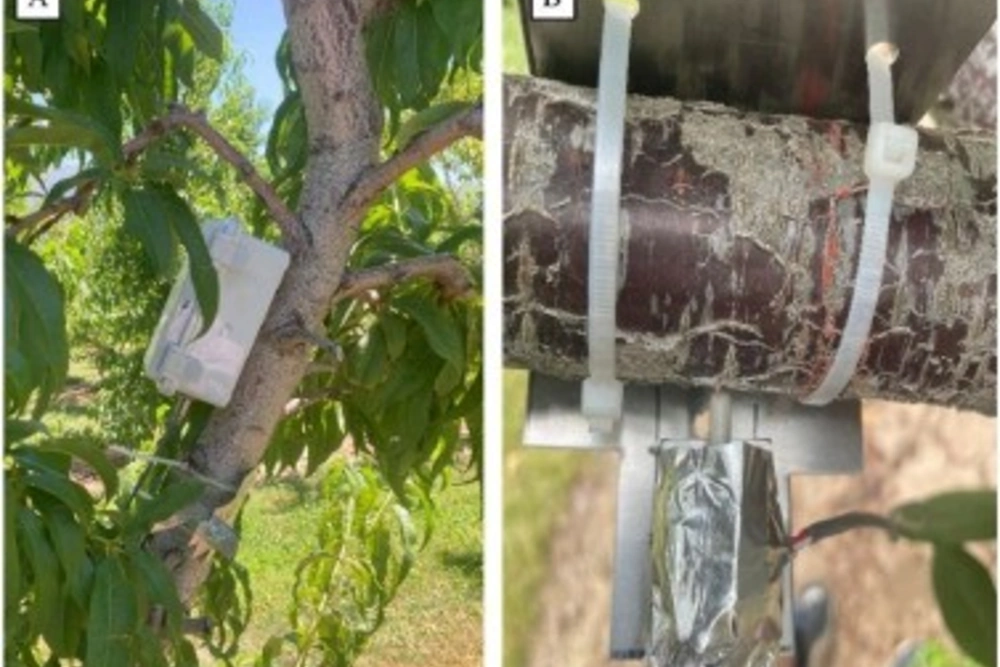
The proposed system employs a linear displacement sensor connected to an Arduino-based datalogger and powered by lithium-ion batteries, providing several months of autonomous operation without the need for solar panels.
Operational advantages
This feature represents a significant operational advantage in orchards, where installing solar panels can be challenging because of canopy shading or interference with orchard management practices. Furthermore, the system's fully open-source, modular architecture makes it easy for researchers and technicians to reproduce and customize the device.
The study also evaluated the stability of the materials used for the sensor mounting bracket. Researchers compared aluminum brackets with 3D-printed components made from PLA and ASA polymers, demonstrating that aluminum exhibited negligible thermal expansion under temperatures typical of the growing season.
In contrast, the plastic materials showed substantially greater deformation, potentially introducing measurement errors and reducing the reliability of indices used for irrigation scheduling. These findings suggest that, despite the convenience of 3D printing, aluminum remains the best compromise between accuracy, durability, and cost for field applications.
System validation
The system was validated under both controlled conditions and orchard conditions using apple, tart cherry, and peach trees. In greenhouse experiments, the dendrometers detected daily stem diameter increases of up to approximately 80 μm and accurately measured rapid stem shrinkage during induced water stress treatments.
Under field conditions, the system successfully captured daily stem contraction-expansion cycles and seasonal growth patterns, confirming physiological differences among species. Apple trees exhibited the largest daily oscillations, exceeding 500 μm, tart cherry showed intermediate fluctuations of around 200 μm, while peach displayed smaller daily oscillations but greater cumulative stem diameter growth throughout the season.
The results also revealed a strong relationship between Maximum Daily Shrinkage (MDS) – the difference between the daily maximum and minimum stem diameter – and the main atmospheric drivers of evaporative demand, particularly vapor pressure deficit (VPD) and reference evapotranspiration (ET0), especially in apple. In tart cherry, significant relationships were also observed with solar radiation.
Irrigation management
These correlations confirm that MDS is a reliable indicator of plant water status and can be used as a decision-support tool for establishing species-specific irrigation thresholds.
Overall, the study demonstrates that an inexpensive open-source system can overcome the major economic barriers that have so far limited the widespread adoption of dendrometers in commercial orchards. The ability to deploy multiple sensors at a relatively low cost makes it possible to monitor the spatial variability of plant water status, thereby improving irrigation efficiency.
Future developments include integrating the system with wireless communication networks and weather and soil moisture data, paving the way for automated decision-support systems for more sustainable orchard management.
Source: Safre, A. L., Black, B., Torres-Rua, A., Fazio, G., & Yost, K. (2026). Development and evaluation of a low-cost dendrometer system for agricultural and research applications. Smart Agricultural Technology, 14, 102073. https://doi.org/10.1016/j.atech.2026.102073
Image source: SAFRE ET AL 2026
Andrea Giovannini
PhD in Agricultural, Environmental and Food Science and Technology - Arboriculture and Fruitculture, University of Bologna, IT
Cherry Times - All rights reserved