In a context marked by unstable climate, rising logistics costs and increasingly selective export markets, Chile is focusing on varietal innovation. Among the most closely watched new entries is Cheery Glow, developed by Bloom Fresh, which has already reached around 200 hectares planted in the country.
An early cherry with a distinctive profile
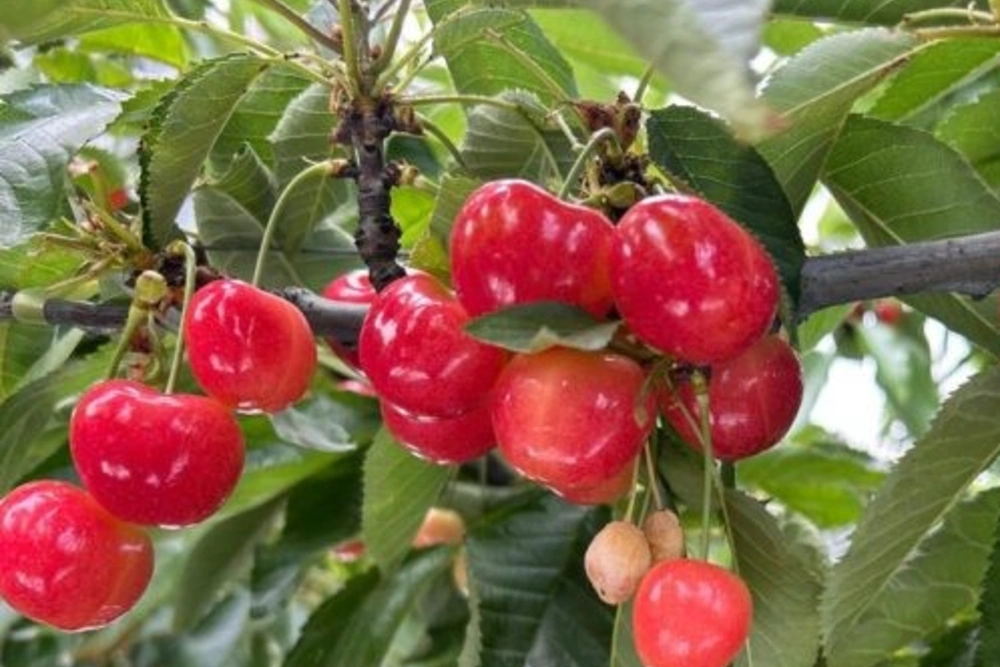
Cheery Glow (IFG Cher-Six) is an early-season variety with golden skin and a natural pink-red blush, covering 70% or more of the fruit surface. The coloration results from sun exposure, supported by an open canopy that improves light penetration.
The fruit is large, firm, and has a sugar content of 20–22 degrees Brix. Introduced to the Chinese market in mid-November last year, it received very positive feedback.
Low chill requirement: a strategic advantage
According to María José Castro, representative of Nueva Vid, Bloom Fresh’s authorized nursery in Chile, Cheery Glow adapts well to most growing areas between Coquimbo and Maule, including early zones where other varieties face greater challenges.
Its key strength is its low chill requirement: around 450 hours, compared to the 800–1,000 hours required by many traditional varieties. In a Chile where winters are becoming less predictable, this factor can help reduce production risk.
Production, harvest and export
The average yield is 15 tons per hectare, with trees that come into production early. A fruit set of 15–20% supports good productivity, while long stems facilitate harvesting without direct handling of the fruit.
Cheery Glow can be harvested 5–7 days before Santina, and up to 10 days earlier under favorable conditions. Its high firmness allows storage for up to 60 days, a key factor for shipments to China and other distant markets.
The combination of earliness, post-harvest performance and golden appearance with blush is already attracting interest from buyers in China, Europe and the United States. For Chilean growers, Cheery Glow is positioning itself as a concrete response to new climatic and commercial challenges.
Source: producereport.com
Image source: FFP
Cherry Times - All rights reserved