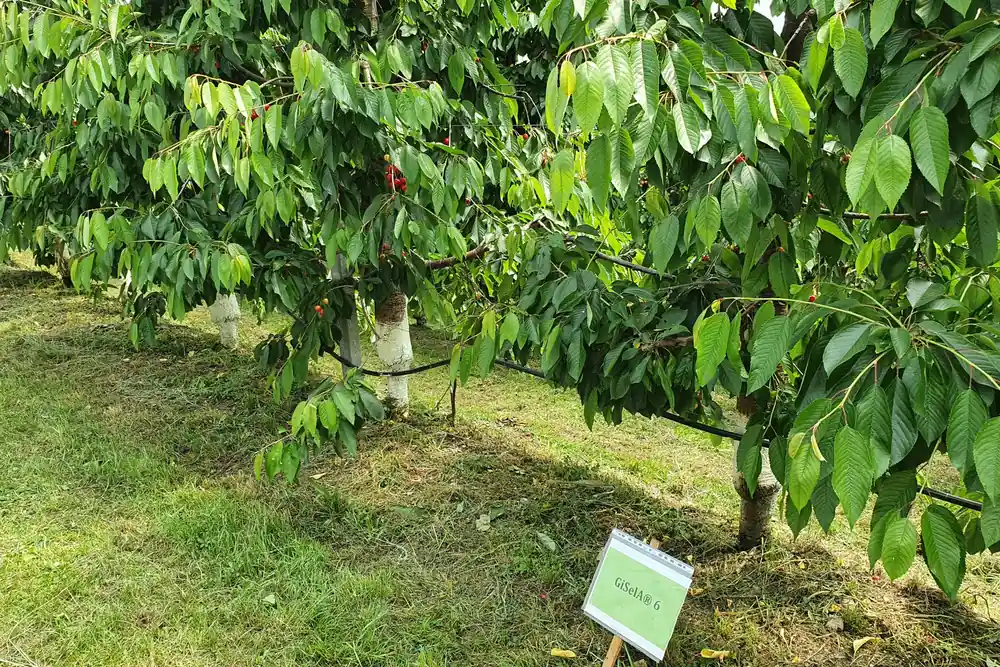
Cherry harvesting is in full swing and, for the first time, Swiss cherries are even more sustainable: starting this season, they are produced according to the standards of the national sectoral program “Nachhaltigkeit Früchte” (Fruit Sustainability), with an expected harvest of 2,400 tonnes, according to the Swiss Fruit Association.
Since 2022, the national sectoral solution “Nachhaltigkeit Früchte” has existed for pome fruits. Starting this season, the program has been extended to include cherries and plums as well. Producers can choose from a range of measures and must reach a certain score, known as the “level of ambition.” This makes the stone fruit production even more sustainable.
The Role of Politics
National Councillor Priska Wismer-Felder, speaking at Jakob Wildisen’s farm in Hitzkirch (LU), praised the industry’s commitment and highlighted the responsibility of politics: “Politics plays a decisive role. Through targeted framework conditions, incentive programs, and legislative provisions, it creates the foundations for fruit growers to operate in an ecological, economically stable, and socially responsible manner.”
The national sectoral solution “Nachhaltigkeit Früchte” includes nine sustainability goals, with measures across the three dimensions of sustainability – environmental, economic, and social. Thanks to the wide catalog of measures, each company can choose those that best suit its needs to produce even more sustainably. Support for the program is high: already in the first year, about 75% of the cherry-growing area complies with the new requirements.
Production and Support
The main retailers and Swisscofel members support the initiative: for the additional effort, producers are compensated with 25 centimes per kilogram of cherries (around €0.26/kg).
Currently, cherry harvesting is in full swing. Swiss producers harvest between 400 and 500 tonnes per week during the peak season weeks, following the criteria of the new sectoral solution “Nachhaltigkeit Früchte.” The many hours of sunshine in May and June are ensuring crisp and sweet cherries, as explained by Bruno Eschmann, president of the Swiss Center for Cherry and Plum Production.
Text and image source: fruitnet.com
Cherry Times – All rights reserved