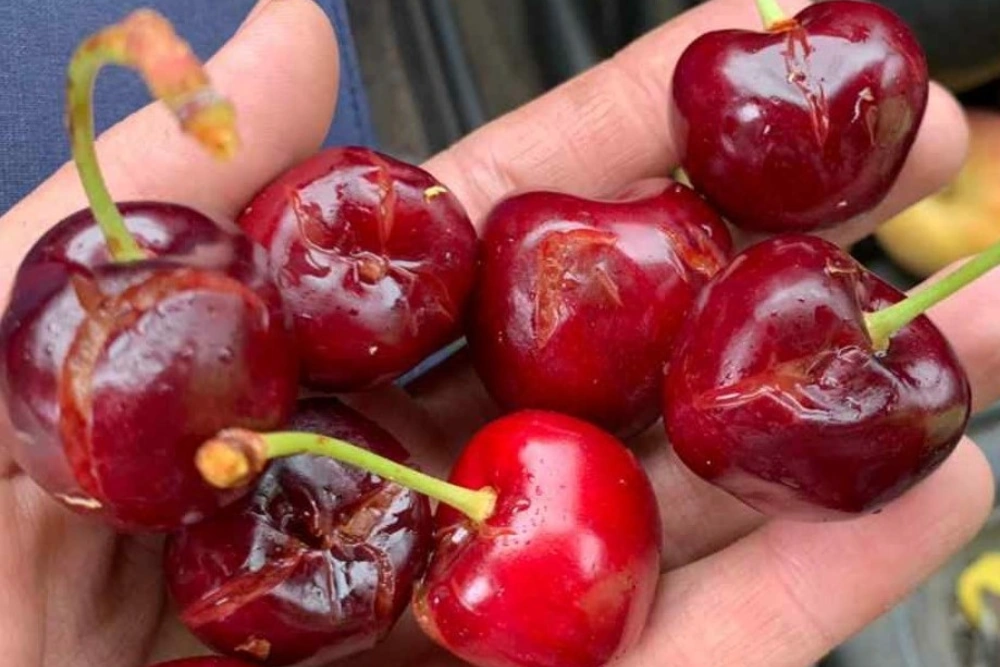
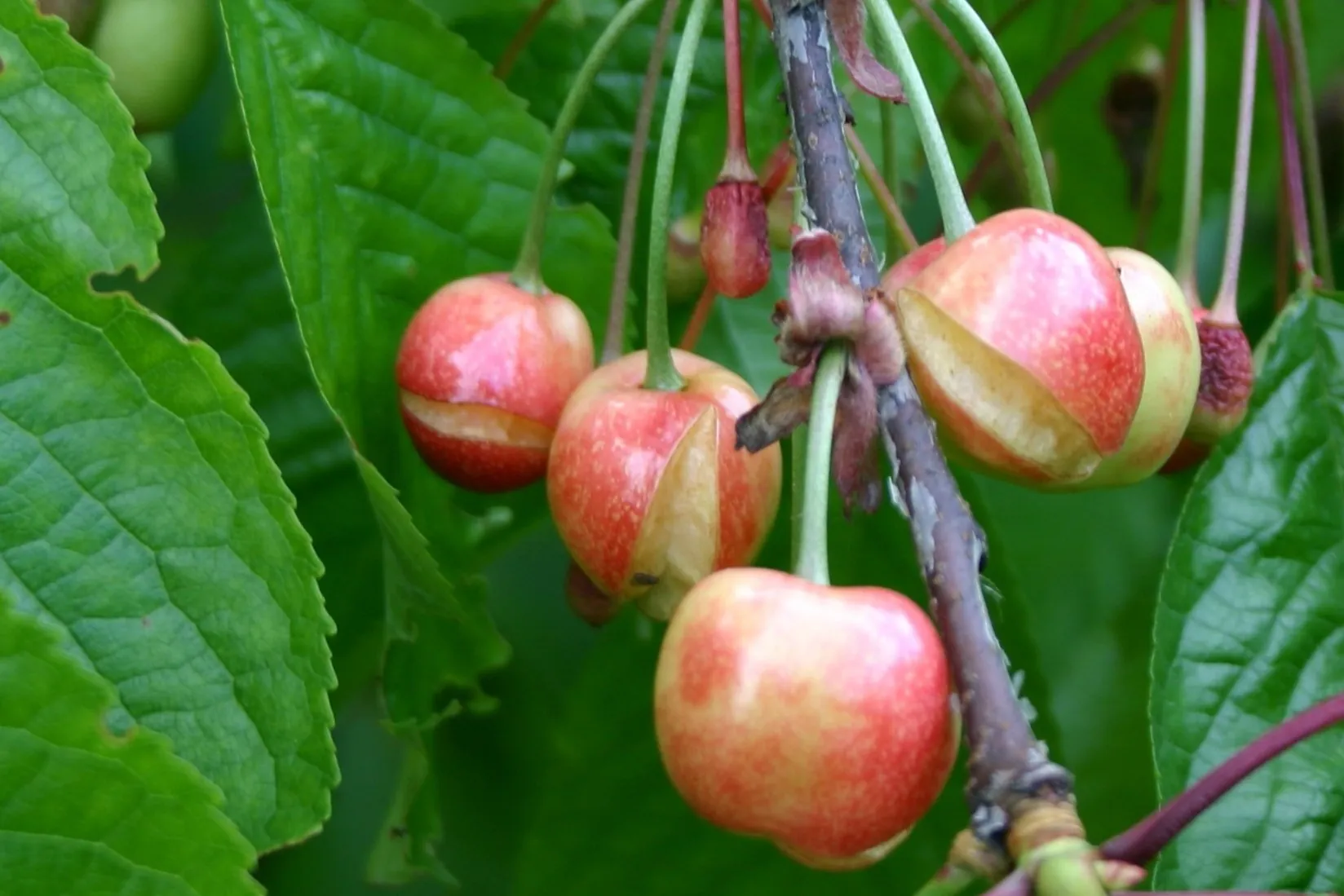
One of the main technical challenges in cherry production is preventing fruit cracking, which has direct negative e9ects on commercial quality and causes significant yield losses.
Susceptibility to cracking is influenced by environmental factors such as rainfall, humidity, and high temperatures, but it also has a strong genetic component that determines marked varietal di9erences.
A recent study proposed an innovative approach for the molecular characterization of cracking susceptibility based on a comparison between two gene expression quantification techniques: qPCR and digital PCR (dPCR), and on the definition of a “bitmap” of genes capable of discriminating between highly susceptible and more tolerant fruits.
Cracking susceptibility and gene expression
The study compared two cultivars with well-known contrasting behavior: the highly susceptible “Burlat” and the more tolerant “Sweetheart”.
Researchers analyzed the expression of 16 genes associated with cuticle metabolism, cell wall remodeling, water and calcium transport, and epicuticular wax biosynthesis, key processes known to play a role in fruit cracking.
Although qPCR and dPCR rely on di9erent detection principles, they showed a high correlation (R = – 0.90), allowing Ct values to be converted into absolute copy numbers through a specific equation.
This linear relationship made it possible to harmonize datasets produced with di9erent technologies and represents a potential tool to improve experimental comparability, one of the biggest limitations in expression studies.
Key genes and metabolic pathways
The researchers identified a restricted set of eight genes: PaCER1, PaXTH, PaEXP1, PaEXP2, PaKCS6, PaWINA, PaWINB, and PaCER3; which together define an “expression bitmap” e9ective in distinguishing fruits with high vs. low susceptibility.
These genes belong to two major pathways: epicuticular wax biosynthesis (CER, KCS) and cell wall metabolism (XTH, EXP).
Their modulation aligns with established knowledge of cracking mechanisms: a thinner, less waxy, or structurally fragile cuticle facilitates water absorption, increases tissue tension, and predisposes fruits to splitting; similarly, less elastic or more degraded cell walls may lose their ability to redistribute mechanical stress.
Integrated analyses (PCA and heatmaps) showed a clear separation of samples based on their cracking index, confirming the robustness of the selected gene group.
Implications for breeding and diagnosis
The conclusions highlight that although dPCR shows greater technical variability compared to qPCR, its output in absolute copy numbers facilitates biological interpretation and improves comparability across experiments.
dPCR therefore appears particularly promising for applications where environmental variability in field conditions complicates transcriptomic analysis.
The study goes beyond methodological comparison, showing how the definition of a core set of key genes can become an operational tool for breeding programs, early diagnosis of susceptibility, and evaluation of the e9ectiveness of agronomic treatments aimed at reducing cracking (such as calcium, abscisic acid, or biostimulant applications).
Future applications and integration
The researchers acknowledge that the proposed bitmap represents only a first step toward fully validated functional markers, but its consistency with known metabolic pathways and its classification accuracy make these genes excellent candidates for further investigation, including possible applications in marker-assisted selection.
Finally, thanks to the strong correlation between the two techniques, integrating qPCR, dPCR, and transcriptomic data may become more feasible, supporting more flexible and advanced strategies to mitigate fruit cracking, a problem that severely limits profitability in commercial cherry production.
Source: Santos, M., Gila-Navarro, A., Weiss, J., Gonçalves, B., Matos, M., & Egea-Cortines, M. (2025). Validation of a bitmap of genes involved in cherry fruit cracking by digital PCR and qPCR, suitable for plant breeding. Scientific Reports, 15(1), 26619. https://doi.org/10.1038/s41598-025-11006-w
Image source: SL Fruit Service
Andrea Giovannini
University of Bologna (IT)
Cherry Times - All rights reserved