India ranks second in global fruit production after China and is often referred to as the "fruit basket of the world" thanks to its diverse climate, which supports the cultivation of numerous fruit varieties. However, significant losses occur due to physiological disorders, among which fruit cracking represents a major issue.
Fruit cracking is a pre-harvest physiological disorder characterized by the rupture or splitting of the fruit skin or cuticle, which can sometimes extend deep into the flesh. The average loss caused by this disorder ranges from 50% to 85%, significantly reducing fruit quality and rendering the product unmarketable, leading to substantial economic losses for growers.
Fruit cracking commonly occurs in various horticultural crops such as cherries, plums, apricots, apples, litchi, pomegranates, citrus fruits, bananas, avocados, grapes, persimmons, peaches, tomatoes, and pistachios. Therefore, understanding the causes of fruit cracking and adopting appropriate management strategies is essential to minimize losses and improve fruit quality.
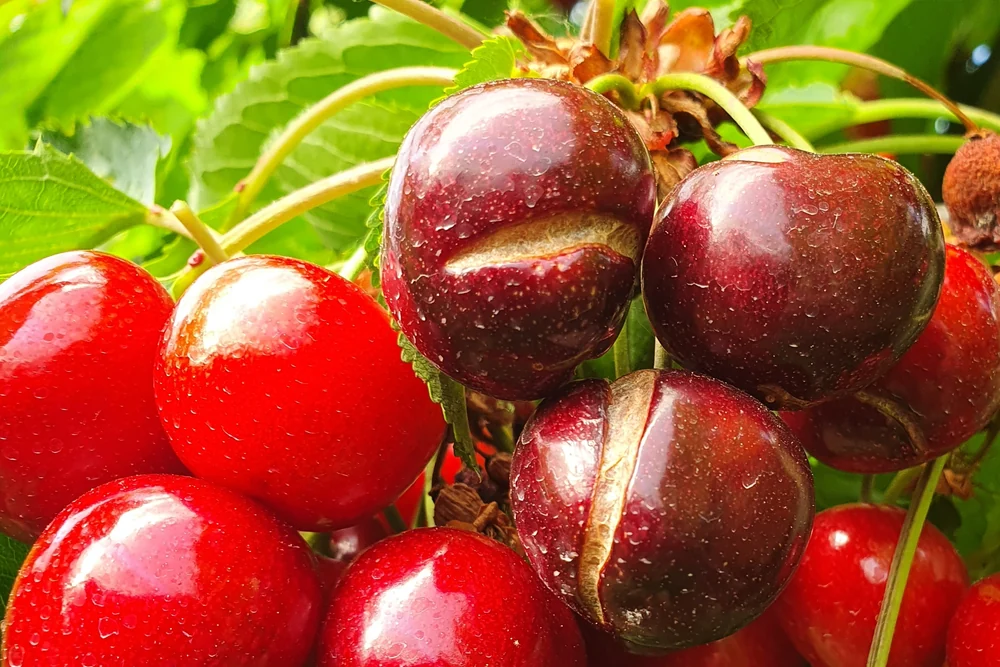
The two main causes of fruit cracking in cherry trees are as follows:
- Water balance within the tree: trees growing in saturated soils due to rainfall or excessive irrigation absorb excess water. As the fruit matures, sugar concentration increases, creating a high osmotic potential that leads to cracking.
- Stagnant rainwater on the ripening fruit: the increase in sugar concentration in ripening fruit creates an osmotic gradient on the surface. Prolonged contact between the cuticle and water causes water to penetrate into the fruit.
Physiological mechanism of fruit cracking
Cracking due to water imbalance Fruit cracking often occurs when, after a long period of drought, water becomes suddenly abundant again. During drought periods, xylem and phloem tissues harden and lose their ability to expand. When water supply suddenly increases, internal tissues resume rapid growth, while rigid vascular tissues fail to expand accordingly. This difference in growth rate causes the fruit skin to rupture.
Cracking due to environmental stress Environmental conditions such as high temperatures and low humidity during summer cause hardening and loss of elasticity of the fruit skin. When heavy rains occur during the rainy season, internal tissues expand rapidly due to increased water uptake. Since the skin cannot expand at the same rate, the fruit surface breaks, resulting in cracking.
Mitigation strategies
- Irrigation management
Water stress followed by a sudden increase in water availability can raise the risk of fruit cracking. Light but frequent irrigation, which maintains a favorable microclimate within and around the plant, has been found to minimize cracking. To prevent cracking, maintaining a consistent water supply through drip irrigation is recommended. - Nutrient management
Deficiencies in calcium, boron, and phosphorus are strongly associated with increased cracking. Calcium strengthens cell walls by stabilizing pectin in the middle lamella, reducing the likelihood of cracking. Boron enhances cell elasticity and prevents the breakdown of vegetative tissues. - Plant growth regulators
Plant growth regulators (PGRs) play a crucial role in controlling fruit cracking by influencing fruit development. The application of NAA improves fruit set and skin elasticity, thereby reducing cracking. Similarly, the application of GA₃ delays skin senescence and decreases the incidence of cracking in Eureka lemon. Ethylene, which accelerates ripening and softening, is also associated with increased susceptibility to cracking. - Bagging and mulching
Bagging is a physical protection technique that reduces fruit cracking by modifying the microenvironment in which the fruit develops. Mulching, whether with plastic or organic materials, combined with proper irrigation, has proven effective in controlling fruit cracking by reducing water stress. - Antitranspirants
Antitranspirants are chemical compounds that reduce the rate of transpiration from plant leaves and help plants tolerate stress. They decrease stomatal opening and increase leaf resistance to water vapor diffusion without significantly affecting carbon dioxide absorption. This helps reduce transpiration, maintain fruit skin elasticity, and minimize cracking.
Conclusion
Fruit cracking is a serious pre-harvest physiological disorder caused by the combined effects of environmental stress, irregular water availability, nutritional imbalance, hormonal disorders, and the genetic susceptibility of cultivars. Sudden fluctuations in soil moisture, high temperatures with low atmospheric humidity, and poor skin elasticity increase internal fruit pressure, ultimately leading to surface rupture. Additionally, physiological factors such as water imbalance and environmental stress further increase susceptibility to cracking.
Effective control of this disorder requires an integrated management approach rather than a single practice. Proper irrigation scheduling, balanced nutrient management, foliar application of calcium and boron, mulching, and the adoption of crack-resistant cultivars can significantly reduce fruit cracking and improve both quality and market value.
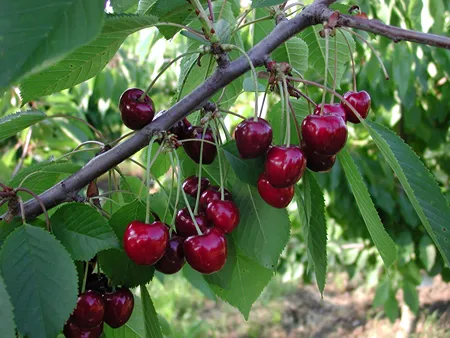
Image source: Stefano Lugli
Anjali Sejal Nivedita
Department of Fruit Science, Himachal Pradesh, India
Cherry Times - All rights reserved