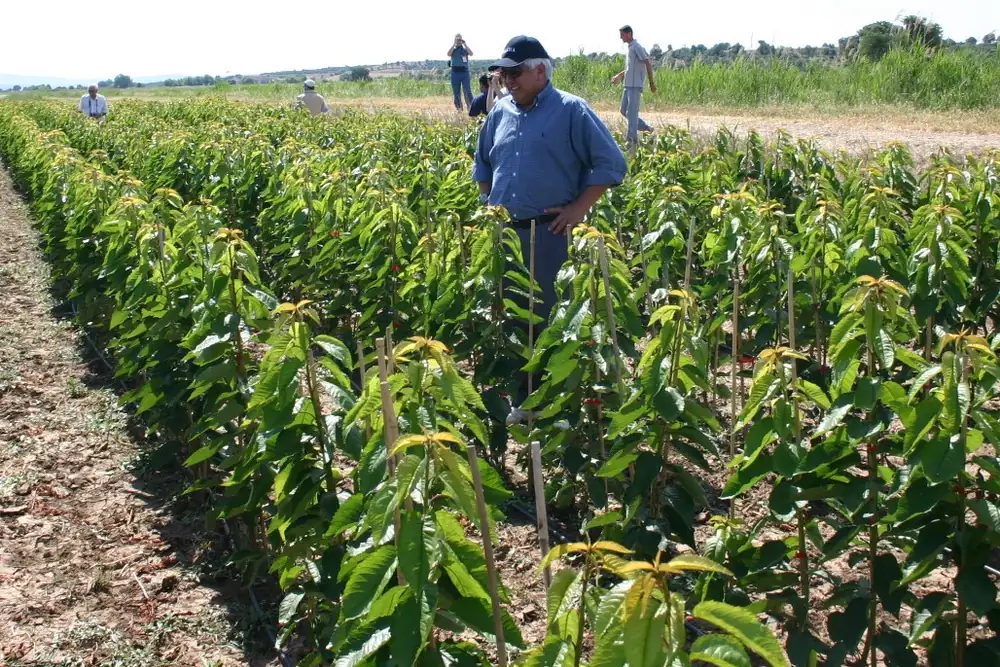
At the University of Craiova (Romania), the effect of growth regulators on improving the branching of nursery-grown trees was evaluated. The study was conducted on three sweet cherry cultivars—Sunburst, Kordia, and Regina—and grafting was carried out using the “knip” system.
The rootstock used was Prunus mahaleb, which is widely employed in sweet cherry cultivation because of its adaptability and moderate vigor. The main objective of the research was to test different plant growth regulators in order to identify the best combination for increasing the number and quality of lateral branches.
Good branching of nursery trees is an important trait for obtaining well-formed young trees that are ready for production within the first years after planting. It allows for a more balanced canopy development, better light distribution, and earlier fruit production.
Hormonal treatments
To stimulate the formation of lateral branches, two hormonal treatments were used: the cytokinin 6-BA and a mixture of 6-BA with gibberellin GA4+7. These growth regulators are known for their ability to promote cell division and the growth of lateral buds.
Treatments were applied three times during June to the nursery trees. Four different concentrations were tested: untreated control, 500 mg/L, 1,000 mg/L, and 1,500 mg/L. Each plant received 5 mL of solution per treatment.
At the end of the growing season, several parameters were measured: trunk diameter, expressed as trunk cross-sectional area (TCSA), tree height, total number of lateral branches, their total length, and the number of branches longer than 30 cm.
Cultivar results
The results showed interesting differences among the cultivars. In Kordia and Regina, growth regulator treatments did not significantly affect trunk diameter, tree height, or average lateral branch length. However, some of the higher concentrations markedly improved branching.
In particular, treatment with 6-BA at 1,500 mg/L and with 6-BA + GA4+7 at 1,000 and 1,500 mg/L significantly increased the total number of branches, their total length, and the number of branches longer than 30 cm compared with untreated plants.
The Sunburst cultivar showed an even stronger response to the treatments. All growth regulator applications increased the total number of lateral branches and the number of branches longer than 30 cm compared with the control.
Sunburst response
The best results were obtained with 6-BA at concentrations of 1,000 and 1,500 mg/L. These treatments also significantly increased the total branch length.
The study therefore demonstrates that the use of growth regulators can improve the quality of nursery-produced sweet cherry trees, especially by increasing lateral branching. However, treatment effectiveness depends on the cultivar and the concentration used.
In general, the higher doses of 6-BA proved to be the most effective for obtaining better-branched trees.
Source: https://intam.institut-tamis.rs/handle/123456789/415
Image source: Stefano Lugli
Melissa Venturi
Ph.D. in Agricultural, Environmental, and Food Sciences and Technologies – Fruit Tree Physiology and Cultivation - Bologna, Italy
Cherry Times - All rights reserved