One of the most important operations from a production standpoint, and one with the greatest impact on the tree, is the removal of various vegetative structures from the plant during the winter dormancy period.
Pruning consists of cutting or removing excess and unwanted plant material, pursuing several objectives: reinvigorating structures through wood renewal, regulating the crop load at an early stage, improving fruit set, providing support and rigidity to the fruit, and restoring plant architecture.
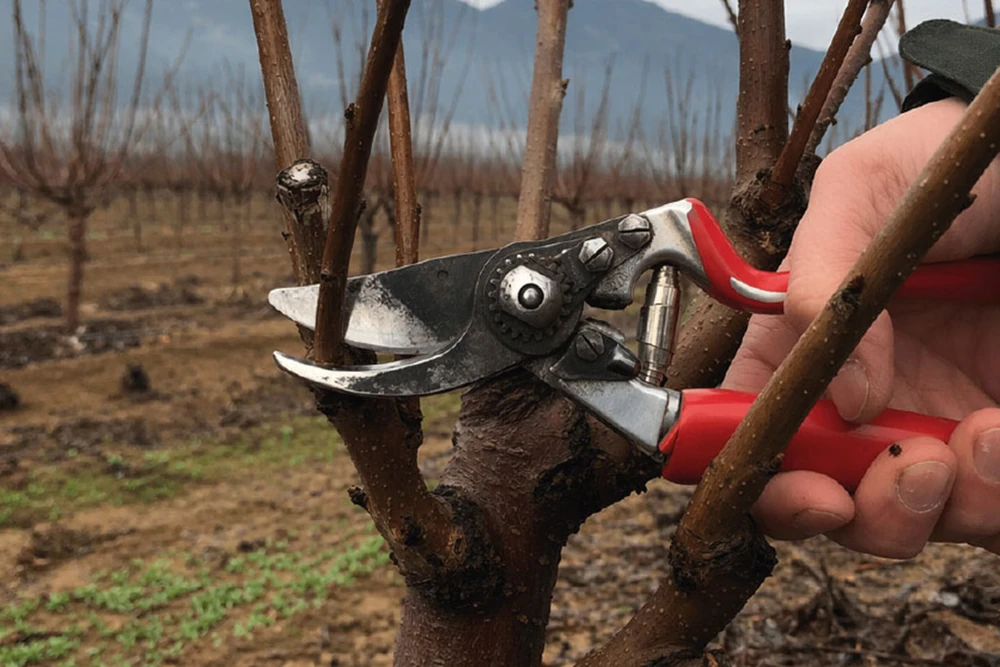
This process must begin from the first year of the orchard.
To define a winter pruning strategy, it is necessary to carry out an analysis of bud fertility in order to determine the number of fruiting sites to leave after pruning to achieve the expected yield and quality. The fertility of the cultivar/rootstock combination and the planting density of each orchard must also be taken into account.
Winter pruning
With winter pruning, it is possible to maintain the shape and size of the trees and control the direction and extent of growth. These aspects are important for preserving plant architecture and facilitating operations such as harvesting and phytosanitary treatments.
Pruning largely depends on the productive potential of the orchard.
Winter pruning must be adjusted as precisely as possible and correctly carried out according to the recommendations for each situation, thereby avoiding costly and inefficient operations such as flower and fruit thinning. This makes it possible to reduce labor costs while at the same time improving fruit size and fruit quality.
1. Crop load regulation
To regulate the crop load during winter, factors such as the production target, the orchard's history, the geographical area, the potential of the cultivar and its combination with the rootstock must be considered.

There is a direct relationship between pruning and crop load regulation, since in cherry trees pruning is a tool for controlling production and stimulating shoot growth. Pruning intensity must increase as the vigor of the cultivar/rootstock combination decreases, because less vigorous combinations respond more strongly to crop load regulation.
Pruning intensity must also be adjusted according to the increase in expected yields.
2. General approach to winter pruning of cherry trees
- 1. Before pruning, it is mandatory to carry out an analysis of bud fertility to determine the number of flowers and viable flower primordia.
- A particularly important, and potentially limiting, factor to consider when defining the pruning strategy is the tree's rootstock/cultivar combination, since this drastically alters vigor and fruiting habit. For example, Lapins/Colt does not have the same characteristics as Lapins/MaxMa 14.
- When cutting lateral branches, it is always necessary to leave a wood stub with at least 3-4 buds or spurs to prevent the death of productive wood. Leaving this portion of wood makes it possible to generate new, more balanced growth points.
- Shortening branches bearing spurs and at least two years old has a reinvigorating effect and, above all, allows early crop load regulation. This operation is particularly important in productive cultivars such as Lapins, Sweetheart and Santina. It is necessary to shorten them while leaving a portion of wood of at least 7-10 mm. Fruit must be produced on self-supporting wood capable of supporting it and promoting good fruit size. Shortening branches with an excessive number of spurs can also avoid the need for subsequent flower or fruit thinning.
- Timely regulation of the fruit load has positive effects on fruit size and fruit quality. This cut must be made behind the transition point between one-year-old wood and older wood.
- Renew structures such as aged branches and spurs and/or those with few fruiting sites. The useful life of a spur for producing quality fruit is 4-5 years. It is therefore necessary to keep the tree supplied with constantly renewed wood and spurs in order to ensure quality production.
- Remove the water sprouts present on secondary and tertiary branches, always leaving a stub with 3-4 buds.
- Define the height of the trees, which must not exceed 60% of the distance between rows, in order to promote canopy light penetration. For example, with a planting layout of 2 × 4 meters, tree height must not exceed 2.4 meters.
- Remove large and excessively vigorous branches that weaken the leaders and obstruct light penetration. Shorten them while leaving 3-4 spurs or buds to encourage the development of new replacement branches with balanced vigor.

10. Improve the ratio between leaves and fruit, maintaining 6-8 leaves per fruit in order to achieve better fruit size and quality.
11. In winters characterized by a greater accumulation of chill hours, the trees must be subjected to more intensive pruning.
12. Maintain the tree shape in the different training systems: central leader, multi-leader, V-trellis, KGB, Spanish bush, etc.
3. Protection of pruning cuts
Protection of pruning wounds is essential, because they represent an entry point for various wood-decay fungi, such as those responsible for silver leaf disease, Calosphaeria and Cytospora, and for bacteria, mainly belonging to the genus Pseudomonas, which damage tissues and put plant health at risk.
3.1 Treatments for protecting pruning cuts
Once winter pruning or summer pruning operations have begun, it is important to apply the treatment immediately to the parts pruned during the day or, at the latest, within 48 hours after pruning. This makes it possible to seal the cuts and protect the wounds from colonization by fungi and bacteria.

Apply a volume of between 1,000 and 1,500 liters of water per hectare, depending on the size of the tree canopy, in order to obtain uniform coverage of all pruning cuts.
3.2 Protecting cuts with pruning sealant or wound paint
It is important to create a protective barrier over the cuts made during pruning, especially those made on wood older than two years.
To ensure the health of our orchards, I suggest combining both recommendations: protecting individual cuts with pruning sealant or wound paint and carrying out whole-tree treatments.

Correct method for protecting pruning cuts

INCORRECT method for protecting pruning cuts

Bing/Gisela 6 cultivar before and after winter pruning: central leader system and low-vigor combination

Santina/Colt cultivar before and after winter pruning: central leader system and high-vigor combination

Lapins/Colt cultivar before and after winter pruning: KGB system

Lapins/Colt cultivar before and after winter pruning: central leader system and vigorous combination

Regina/MaxMa 14 cultivar before and after winter pruning: central leader system and medium-vigor combination

Image source: Patricio Morales
Patricio Morales
Agro Asesoria
Cherry Times - All rights reserved