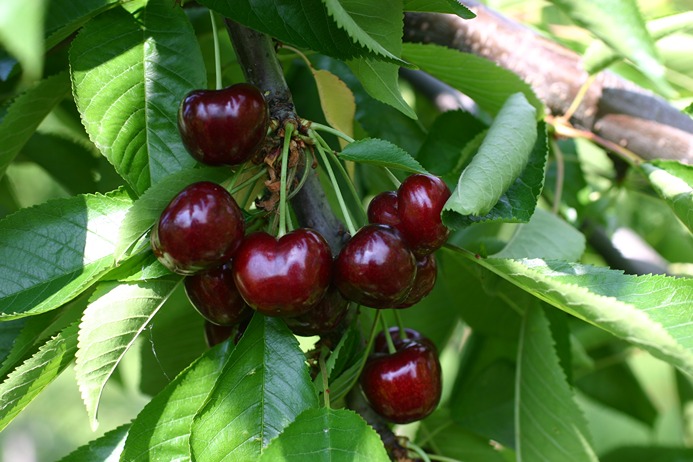
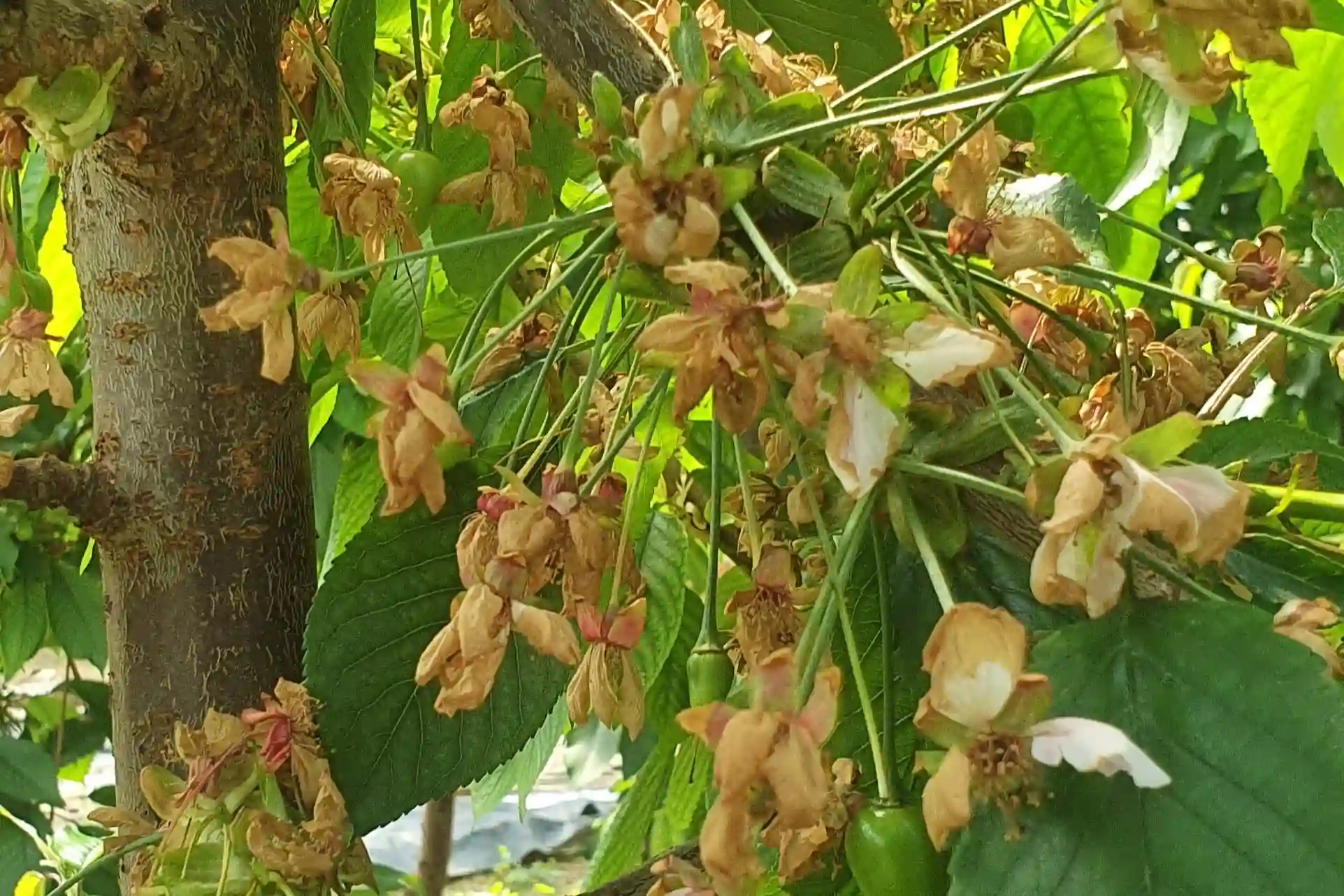
At the end of 2025, the global cherry market is facing one of the most significant crises of recent years. Plummeting prices, weak demand and an increasingly abundant supply paint a picture that raises serious concern for the start of 2026.
With the end of the year approaching, the situation in the main destination markets for cherries – China, Europe, the United States and Latin America – shows a common trend: a surplus of product that the market is struggling to absorb. According to several reports from analysts and specialized firms, this imbalance between supply and demand could intensify further in the first months of 2026.
At the root of this downward pressure on prices is an increase in supply, driven mainly by an expansion strategy from Chile, the world’s leading producer and exporter of cherries. The country has increased export volumes and brought forward its commercial window, flooding the market with large quantities of fruit over a shorter period of time.
This anticipation has led to an accumulation of early-season fruit, generating a domino effect on prices. The result? An average year-on-year drop of 25%, with peaks of 50% in the Chinese market.
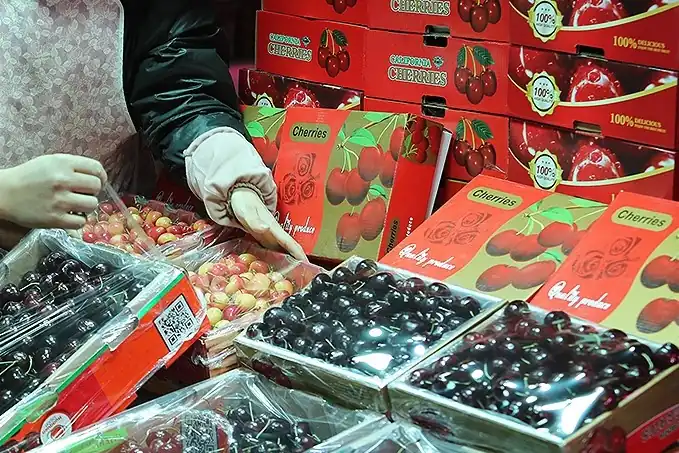
China: mirror and engine
As the leading destination market for Chilean cherries, China acts as the barometer for the entire sector. Data collected in week 51 of 2025 leave little doubt: average prices, particularly for the Santina variety, were 40% lower than in the same period of 2024 and about 60% below 2023 levels.
This unprecedented drop reflects a profound shift in product positioning: from a rare and sought-after item, cherries have become a mainstream product, marked by strong quality segmentation.
Europe and the Americas
The downward trend is also evident in other key markets. In Hamburg, Germany, the average FOT price (Free On Truck) for cherries recorded a 15% decline. In the Netherlands, prices fell by 9%, while in São Paulo, Brazil, wholesale quotations dropped by 15%, despite a promising start to the season. In the United States as well, Shipping Point prices (equivalent to FOB at origin) show a similar pattern.
Although these are averages, the figures reveal a clear trend: the entire global market is under pressure, with few exceptions.
Market X-ray
A recent Smartcherry report, presented by Agustín Cornejo of QC Fruits, provides a detailed snapshot of the situation in China. In week 51 alone, the country imported about 1,500 containers of cherries at an average price of USD 8.1 per kilo (around €7.40), with generally good quality. But the peak came in week 52, with 4,300 containers, a 180% increase compared to the previous week.
And the flow is far from stopping: the first weeks of January are expected to bring another 7,500 containers in total, at a time when demand begins to slow after the peaks of Christmas and the Chinese New Year.
With festive demand fading, January is shaping up to be the most critical month of the entire 2025–2026 season.
Quality and differentiation
The report highlights further crucial details. According to Luna Yao, executive at Chinese importing company Fujian Sanvirtue, the quality of fruit arriving in recent weeks has been highly uneven. While premium cherries have managed to maintain stable prices and good turnover, medium- and lower-grade lots, often affected by pitting, softness or mold, have struggled to find buyers, with sharp price cuts.
The Santina variety, dominant in the early part of the season, appears particularly vulnerable in the final phase, with declining quality limiting its storage potential. By contrast, Lapins is emerging as the key variety in determining how the market will evolve for the rest of the season.
Outlook for 2026
2025 ends with unmistakable signals: week 52 set a new all-time high in weekly volume and highlighted a highly selective market, where only top-quality fruit is able to secure adequate returns.
For the cherry export industry, a strategic rethink is now unavoidable. More accurate planning, market segmentation and strict quality management will be essential to avoid further setbacks in the first months of 2026.
Source: masp-lmneuquen-com.cdn.ampproject.org
Image source: Yicai Media Group
Cherry Times – All rights reserved