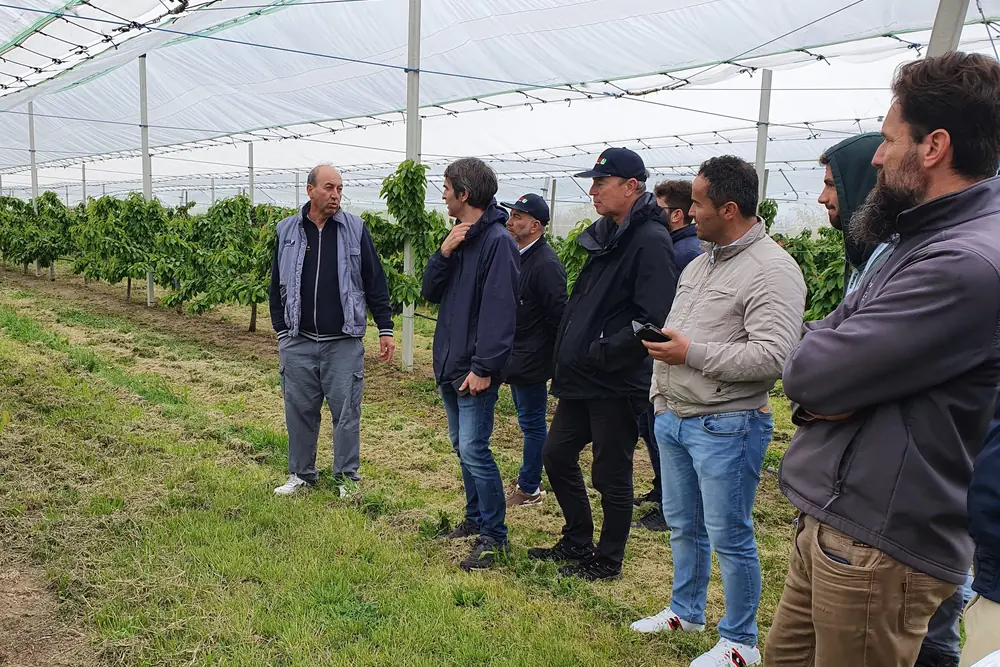
The technical consultant specializing in cherries maintains that covers in cherry orchards are no longer used solely for defensive purposes, but have now become a key tool for stabilizing quality, exportable condition, and economic returns in modern orchards.
For years, covers in cherry orchards were mainly associated with protection against rainfall and fruit cracking. However, the current production and commercial scenario has profoundly changed this view.
According to Ricardo Miño, today they represent a strategic tool capable of directly influencing production stability, exportable quality, and long-term profitability. As he explains, in addition to reducing the risk of cracking, a well-designed system makes it possible to regulate the orchard microclimate, mitigate temperature extremes, reduce the impact of wind, and improve skin condition and harvest uniformity.
What are the main reasons today for installing covers in cherry orchards: rain, cracking, temperature regulation, etc.?
Covers are no longer exclusively a protection tool against rain. In the current production context, they represent a strategic decision for commercial and production stabilization.
Protection against cracking remains the main reason, but the range of functions performed by a good system goes far beyond this.
From a physiological standpoint, a well-designed cover regulates the temperature of the fruit microclimate, mitigates peaks of direct radiation, reduces the mechanical impact of wind, improves skin condition, and can have a positive effect on harvest uniformity.
In increasingly frequent climatically unstable seasons, this set of functions is critical to supporting exportable quality. There is also a financial dimension that we cannot ignore.
With production costs exceeding 15,000-20,000 dollars per hectare, approximately 13,800-18,400 euros per hectare, in modern training systems, the cover is a tool for protecting invested capital. In markets that severely penalize fruit with condition deficits, its impact on return per box is significant.
In which areas or agroclimatic conditions is the investment most justified?
The climatic justification is most evident in areas with a high probability of rainfall during the ripening and harvest period, especially between November and January.
The regions of Ñuble, Biobío, and La Araucanía concentrate the highest-risk conditions: average rainfall above 600 mm per year, high relative humidity in spring, and frequent episodes of morning fog that saturate the fruit epidermis and increase the risk of cracking even in the absence of visible rain.
However, the decision is not only climatic.
It must be assessed together with the cultivated variety, with late varieties such as Regina or Kordia being more vulnerable, the destination market, and the buyer’s level of requirement in terms of fruit condition.
In areas of Maule or Colchagua, with early varieties and harvest before December, the economic equation may be less favorable if considered only from this perspective.
However, in the last two seasons, the use of more perimeter-based covers or cultivation under macro-tunnels has allowed us to bring harvests forward by up to 14 days and, given current conditions, this represents a major advantage.
Which types of systems currently predominate, and in which cases do you recommend them?
The three main systems are the tunnel, the V-shaped structure, and the complete structural cover. Each responds to a different level of investment, risk, and operational complexity. The tunnel system is the quickest to install.
It is suitable for orchards with moderate climatic risk. Its main limitation is ventilation: on days with high temperature and humidity, it can generate unfavorable microclimates inside the canopy. Today, its high cost represents the main limitation.
The V-shaped system ensures excellent water evacuation and natural lateral ventilation. It probably represents the best balance between cost and performance for most situations in south-central Chile.
Complete structures are the most versatile and offer greater microclimate control, but they require a significant initial investment and very precise agronomic management.
They are recommended for high-risk areas, high-production-potential orchards, and modern training systems such as DESH or I-Trellis, where the cover must be integrated from the design stage with the tree architecture.
Which variables should be considered when choosing a system: variety, rootstock, planting layout, etc.?
The first variable is the variety and the rootstock, because they determine vigor, the final architecture of the tree, and the period of greatest vulnerability to rain. A Regina on Gisela 6 does not require the same design criteria as a Lapins on Colt.
The expected final height of the tree, the training system, the orientation of the rows in relation to prevailing winds, the soil type and its ability to support anchors, as well as machinery access within the orchard, must also be considered.
Two often underestimated variables are the cost of skilled labor for management under cover, which can increase operating costs by 15-25%, and the impact on the phytosanitary program, which must be fully adapted in terms of products, water volumes, and application windows.
Finally, economic sustainability must be assessed. It is not just a matter of understanding whether the cover “can pay for itself,” but whether it improves the risk-adjusted return of the production system over an 8-10 season horizon.
How should installation be planned according to the cherry production calendar?
Planning should begin at least 12-18 months before the first season under cover. One of the most frequent mistakes I see in the field is starting the installation process when the orchard is already in full production, which forces growers to improvise structural solutions without enough time for adjustments.
Before installation, the following must be defined: the soil structure in order to correctly size the anchors, the distance between posts according to the chosen system, the orientation that maximizes ventilation, machinery entry and exit points, and any modifications to the irrigation system that may be necessary.
A critical and often overlooked point: the cover completely changes the orchard microclimate, which requires agronomic management to be reconsidered in advance.
The pruning program, nutritional plan, crop load management, and phytosanitary program must be redesigned for the conditions of the covered orchard before the system comes into operation.
What are the most common mistakes during installation?
The most frequent and costly mistake is undersizing the structure. Many growers try to reduce the investment cost by decreasing the diameter of the posts, the number of anchors, or the cable tension.
The result is systems that collapse in the presence of wind or water accumulation on the plastic, causing damage that far exceeds the initial savings. The second mistake is poor ventilation. A poorly ventilated cover creates microclimates with high temperature and relative humidity, which favor fungal diseases, particularly Botrytis, and can delay ripening or negatively affect firmness.
Poor orientation in relation to the direction of the prevailing wind, excessive plastic tension, which accelerates UV fatigue wear, and the absence of active water evacuation systems in the low points of the cover are also common.
The summary of all these mistakes is the same: a poor orchard under plastic remains a poor orchard. The cover does not correct management deficiencies, it amplifies them.
What impact do covers have on tree physiology: flowering, fruit set, ripening?
The physiological impact is profound and multidimensional. A cover simultaneously modifies four key variables for the tree: temperature, relative humidity, intercepted radiation, and air movement.
None of these variables acts in isolation, and their interactions determine physiological responses that the grower must anticipate.
In practice, greater vegetative vigor is often observed under cover, with longer shoots and denser foliage, which can compete with the allocation of photoassimilates to the fruit.
Differences in firmness are also recorded, which may increase or decrease depending on thermal management, along with changes in the rate of soluble solids accumulation and, in some systems, lower color development in bicolor varieties.
For all these reasons, the cover must be accompanied by a precise technical strategy, including opening pruning to improve internal light, crop load regulation, hormonal management when working with ripening regulators, and adjustment of the nutritional program according to the higher water demand and the different transpiration pattern of the covered tree.
How often should covers be checked and adjusted?
The system must be inspected continuously and in a structured manner throughout the year.
The minimum recommended protocol includes four formal technical inspections: before the start of the season, to prepare the system for rain and wind events; before flowering, to check the condition of tie rods, plastics, and anchors; before harvest, to ensure that the system is in optimal condition during the period of greatest risk; and after major weather events, such as strong winds, hail, or snow, regardless of the planned calendar.
At each inspection, the following must be checked: the condition of anchors and posts, the tension of cables and wires, the integrity of the plastic with particular attention to micro-tears and UV fatigue areas, the operation of water evacuation systems, and the condition of joints and metal connectors.
Ignored minor damage is the main cause of major structural failures. The rule is simple: repair quickly, repair properly.
What are the most frequent types of damage: wind, UV radiation, mechanical wear, and how can they be prevented?
The most frequent types of damage are: UV wear of the plastic with loss of transparency and mechanical properties; micro-tears at tension points, which spread quickly with the wind; mechanical fatigue of connectors and tie rods; and water accumulation in low-slope areas, which overloads the structure.
In areas with frequent or intense wind, anchors are the critical element of the system. An undersized anchor can cause the collapse of a structure that is in excellent condition in all other components.
Prevention starts with design: using certified materials with UV specifications appropriate to the area, sizing the structure to withstand a wind load of at least 120 km/h in foothill or exposed areas, and including active water evacuation systems in flat or low-slope covers.
What is the average service life of the materials, and how can it be optimized?
Service life varies significantly depending on material quality and maintenance level. For plastics, a medium-thickness film with anti-UV additives suitable for the area can last between 5 and 6 seasons under normal conditions. Hot-dip galvanized metal structures have a service life of 25-30 years under normal maintenance conditions.
The highest-risk points are joints and connectors, where electrolysis between different metals can accelerate corrosion. In structures with wooden posts, the quality of the elements is essential to ensuring a prolonged service life.
To optimize durability: maintain the correct plastic tension throughout the season, repair any breakage within 48 hours of detection, avoid water or wind overloads through active evacuation systems, and carry out a recorded technical inspection at the end of each season.
How do covers affect the quality and condition of exported fruit?
A well-managed cover can significantly improve fruit quality, skin condition, lot uniformity, and, above all, drastically reduce the incidence of cracking.
This translates directly into a higher percentage of exportable-category fruit and better condition at destination.
However, poor management under cover can produce exactly the opposite effect: soft fruit due to excessive accumulated temperature, reduced color development due to lower intercepted radiation, or internal condition problems associated with nutritional imbalances in the covered tree.
The technical conclusion is that the cover is a management amplifier. An orchard with good agronomic management under a well-designed system can achieve outstanding levels of quality and production stability. An orchard with poor management under cover can further worsen its performance.
What key advice would you give to a grower considering installing covers for the first time?
The most common mistake is evaluating the investment by looking exclusively at the installation cost. The correct analysis must consider the risk-adjusted return over a horizon of at least 8-10 seasons.
The components of the analysis are: installation cost and annual depreciation; estimated impact on the percentage of exportable fruit, because moving from 60% to 80% export fruit can completely change the equation; price differential for better condition; additional cost of management under cover; and the historical probability of damaging rainfall events in that specific orchard.
As a general reference framework: in high-climatic-risk areas with late varieties, a 40-65% reduction in cracking can justify investments of up to 35,000 dollars per hectare, approximately 32,200 euros per hectare, over 3-6 seasons.
In low-risk areas with early varieties, the payback period can extend to 10 or more seasons. The most important advice: do not cut costs on structure and ventilation.
The cost difference between a well-sized and an undersized structure is often less than 20% of the total, but the difference in terms of performance and service life can exceed 100%.
Beatriz Parra
Smartcherry
Source: Smartcherry
Image source: Stefano Lugli
Cherry Times - All rights reserved