Written by Tobin Northfield, Entomology, Washington State University. Edited by Scott Harper, Plant Pathology, Washington State University. May 4, 2026.
Preharvest risk
The warm weather this spring may have led to increased phytoplasma movement and growth, allowing Colladonus reductus to transmit in their first generation, typically in late May and June. However, we observed C. reductus adults on May 6 in the Yakima region, so adult emergence is early this year. In blocks with X-disease prevalence we recommend applying herbicides to target broadleaf weeds, and this year coordinating preharvest fruit fly sprays to also target X-disease vectors if they are present.
As a reminder, X-disease vectors must acquire X-disease phytoplasma each year, and typically do not transmit phytoplasma until July or August when C. reductus has its second adult generation. However, in 2024 we observed transmission in the first generation after a particularly warm pre-bloom period, as well as more consistent phytoplasma titers in the leaves earlier in the season than previously documented. Thus, the particularly warm spring in 2026 may also drive early transmission this year.
Effective leafhopper insecticides
Recent lab bioassays conducted at WSU Wenatchee suggest several insecticides caused high leafhopper mortality, including pyrethroids (e.g., Asana XL, Mustang Maxx), sulfoxamine (e.g., Transform), neonicitinoids (e.g., Actara 25 WG, Admire Pro), pyrethrins (e.g., Pyganic), and flonicamid (e.g., Beleaf) (Marshall et al. 2025). For additional efficacy information see the Tree Fruit Crop Protection Guide.
Key vectors
The most abundant vector in orchards with high X-disease prevalence is C. reductus. However, C. geminatus is also an important vector, and in 2025 we observed higher abundance of Scaphytopius acutus (Figures 1, 2), which prefers shrub and tree hosts more than the broadleaf weed-feeding Colladonus species.
This other X-disease vector, S. acutus, appears to have two generations, with the first round of adults emerging in late May/early June, and a second in August through September. These species and other vectors in the area can be found at the WSU X-disease vector gallery, and further management information can be found at the WSU X-disease page.
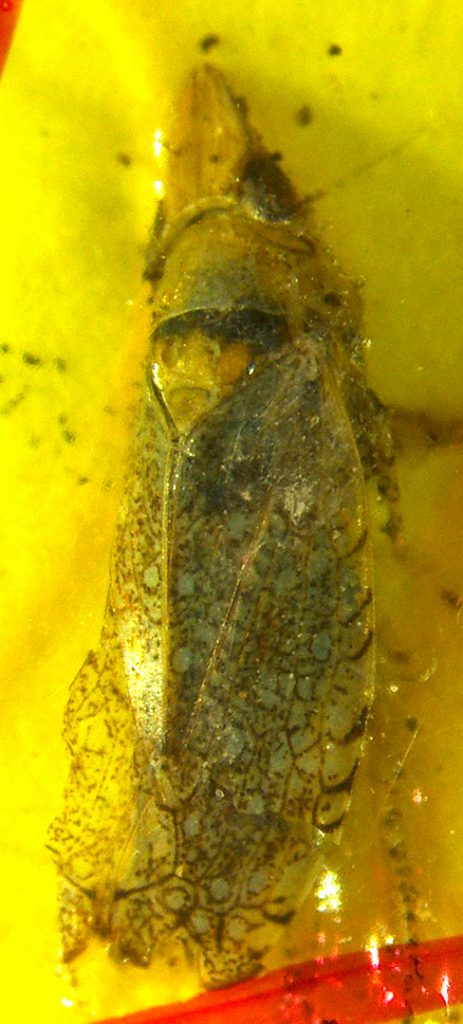 Figure 1. Scaphytopius acutus (dorsal side) caught on a yellow sticky trap to aid in identification on traps. Note the acute angle at the top of the head, giving it the name “acutus.” For more detailed images see the WSU X-disease vector gallery.
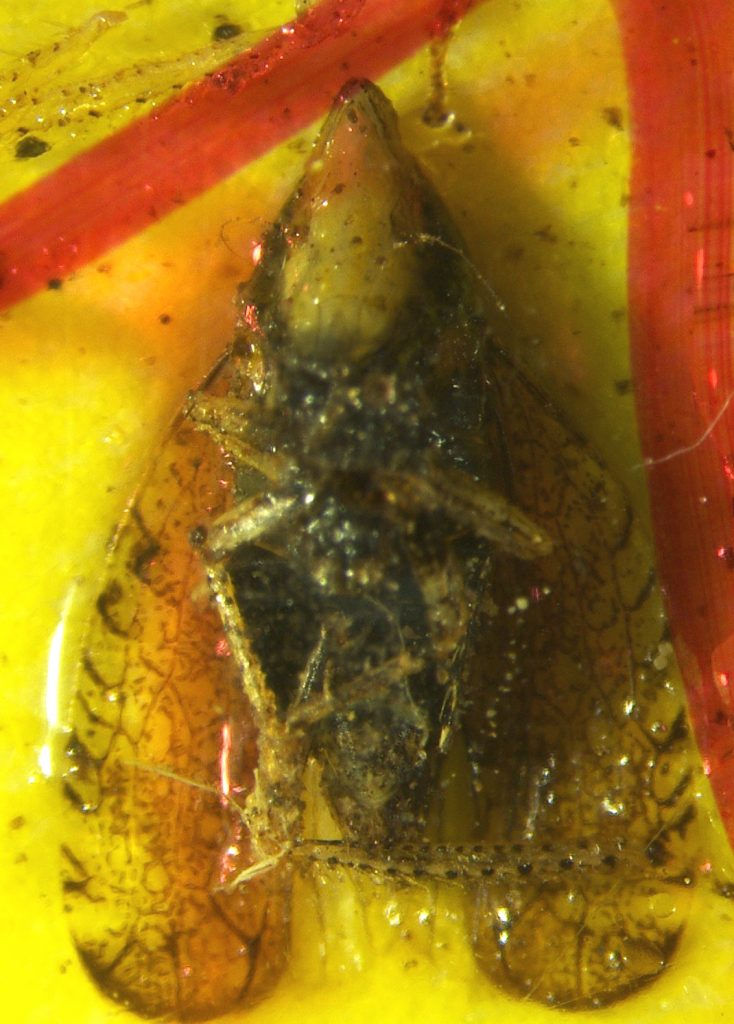 Figure 2. Scaphytopius acutus (ventral side) caught on a yellow sticky trap to aid in identification on traps. Note the acute angle at the top of the head, giving it the name “acutus.” For more detailed images see the WSU X-disease vector gallery.
Tobin Northfield
Entomology, Washington State University. Edited by Scott Harper, Plant Pathology, Washington State University. May 4, 2026
Source: Fruit Matter, maggio 2026 - WSU
Opening image source: DuPont, WSU
Cherry Times - All rights reserved