British Columbia cherries can be purchased in the Big Apple, New York. True or false?
A big cheer, if you answered yes, because they can be found gleaming as brightly as the day they were picked from the tree.
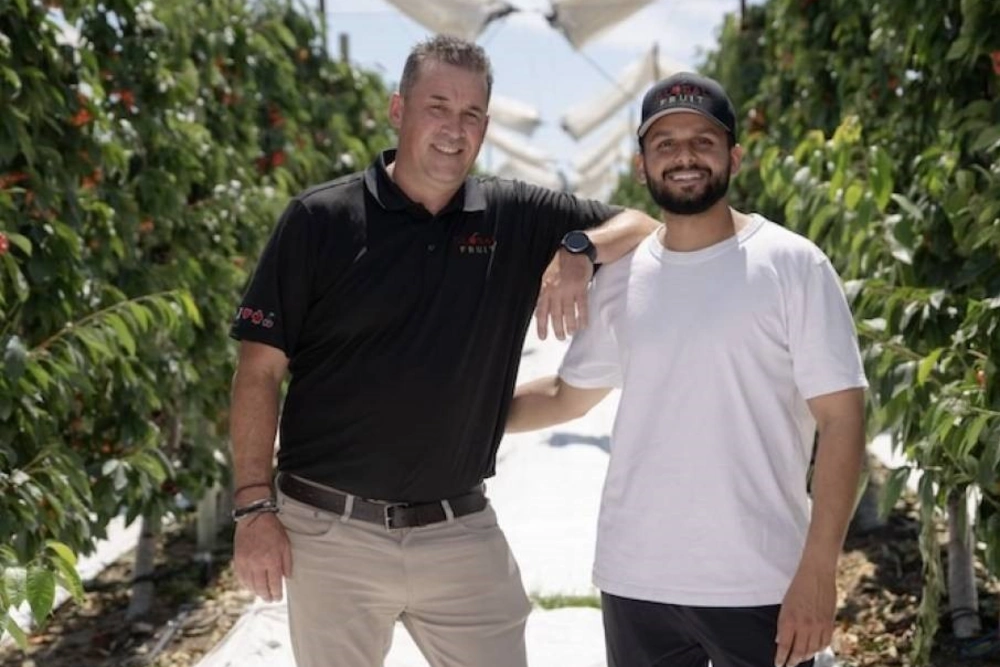
Trade is alive and well with the United States according to Andre Bailey, owner of Global Fruit, headquartered in Creston, British Columbia.
He started the marketing company in 2002, and now serves growers who produce on just under 2,000 acres in the (809 hectares) Okanagan Valley. The entire British Columbia cherry sector has topped a new record at 15,000 acres (6,070 hectares).
Trade with the United States
In the case of Global Fruit’s production, half is exported to the United States, so hungry are Americans for the luscious fruit. That’s a surprising statistic, given that growers in Washington, California and Oregon have 51,500 acres (20,842 hectares) in production.
In 2025, the Northwest Horticultural Council reported that the crop was valued at $287 million (USD) and (approximately €251.8 million) 31 per cent of the crop was exported. The top destination? Canada!
It’s an interesting fact that the U.S. and Canada are each other’s top export market for sweet cherries.
“We’re now into a 10-year period under CUSMA rules, but it’s still business as usual for cherries,” says Bailey. He salutes the goliath, knowing that British Columbia is the last geography in North America to ripen sweet cherries. Canada has what America needs.
Export-style cherries around the world
BC’s reputation for “export-style” high-brix, firm, flavourful cherries is one that’s recognized by 22 countries around the world. Depending on consumer demand, either Korea or China are the next biggest buyers of BC cherries.
And other Asian countries, from Thailand to Taiwan, clamour for the delicacy. This year’s mid-autumn festival falls on September 25, presenting a late-season target for premium sales at the end of BC’s growing season.
That’s where higher elevations and late-maturing varieties come into play. Thanks to breeding efforts at the Summerland Research and Development Centre (SuRDC), those late-maturing, long-stemmed varieties include Staccato, Sovereign and Sentennial, ripening a month after Bing cherries.
Path to success
Export growth is in no small part due to Summerland’s breeders who have focused on extending the growing season so that when the Pacific Northwest is finished picking in early August, British Columbia is still picking for another month or more.
In fact, the SuRDC Summerland Cherry Breeding Program turned 90 this year.
“Its genetics are found in every major cherry growing region of the planet and if you don't find our direct genetics, you'll see it in the parentage of many of the other cultivars developed by others,” says Nick Ibuki, business development manager, Summerland Varieties Corporation.
“This year we are excited to see Sansia and Safirah cherries on the market as growers expand into the new, leading genetics. Future goals of the program include the replacement of current cultivars with improved genetics of size, firmness, taste, texture and productivity, and expanded window of earlier to later harvesting cherries.”
Future varieties and weather
By 2029, BC cherry growers are anticipating a variety which matures mid-June. The cherry sector has also adapted to weather challenges, most notably a heat dome in 2021 and crop failure due to early frosts in 2024.
“We’ve made some proactive changes to mitigate weather extremes with retractable roofs, reflective covers and misting in the orchards to bring temperatures down by 8°C.,” says Bailey. “This year, we’re facing water restrictions in parts of the Okanagan.”
Diversity in geography is also a plus. Harvest starts in the southern reaches of the Okanagan Valley -- Osoyoos and Oliver – and goes as far north as Armstong. Test plantings are in Salmon Arm.
In addition, there’s 400 to 500 acres (162 to 202 hectares) in Creston – the Kootenays -- where cherries mature 10 days later than the Okanagan Valley. Bailey’s home base is here, where he stewards 54 acres (21.9 hectares).
Sorting and export quality
For Global Fruit, state-of-the-art optical sorting and grading at Northern Cherries and Royal Fruit optimize the value of every tree’s bounty. Different sizes can be channelled to different customers, depending on the need.
“We have one-half of one per cent rejection claims on our deliveries,” says Bailey. That’s quite an achievement given the scope of exports as far away as the Middle East.
Changes in the marketplace
Now in Canada’s sights for more trade, the Middle East presents its own complexities. Turkey is a strong competitor in fruits and vegetables, ranked among the top 10 fruit and vegetable exporters globally. Cherries are one of its signature specialties.
Still, BC’s Global Fruit air freights refrigerated cherries to Dubai, the capital of the United Arab Emirates, a niche market.
Since BC gained access to the Chinese market in 2014, experience has been gained in a culture that prizes cherries. However, that market is evolving quickly from wholesalers directly to retailers, spurred by the COVID pandemic.
Consumers want the convenience of buying groceries in one place. Global Fruit has an Asian sales director who navigates these changes in retailing, splitting his time between Kelowna and China.
Diversification in global markets
“The Chinese economy is struggling and volumes are down,” says Bailey. “That’s why diversification is so important.”
Currently, Global Fruit sends 50 per cent of its harvest to the United States, 30 per cent to offshore markets and 15 to 20 per cent to Canadians. In eastern Canada, the question is why more BC cherries don’t appear on grocery shelves.
The answer, it would seem, is that retailers buy Washington state cherries on lower costs and higher volumes. It’s a shame that more of those “export-style” BC cherries don’t land in Toronto, Montreal and Halifax.
“We need diversification to be sustainable,” says Bailey, who wisely spots the vulnerabilities of being too exposed in any one market. “The future goal would be to sell 30 per cent of the crop in Canada, 30 per cent in the U.S. and 35 per cent to other countries with a buffer for internal switches.”
Canadian cherry month
The BC Cherry Association, helmed by Sukhpaul Bal, has been aiming to do just that for four years now. Canadian Cherry Month has been proclaimed from July 15 – August 15.
This year’s slogan -- Flip for Canadian cherries -- is a gentle reminder to switch from Washington-state cherries, ubiquitous in eastern Canada. Hello retailers! If only consumers could taste these domestically grown gems.
“Geopolitics is out of our control,” Bailey concludes. “Diversification is the best way to offset that.”
Go abroad
Simultaneously, BC blueberry growers are finding that they are also heavily reliant on the U.S. market. Statistics Canada reports that 2025 production was 162.1 million pounds of (73.5 million kilograms) which 87 per cent found American buyers.
BC Blueberry Council executive director Sudeshna Nambiar is pointing out a need to diversify in the next five years. The challenge? Competitors are implementing the same strategy.
The U.S. Highbush Blueberry Association will be taking part in a USDA Agribusiness Trade Mission to Vietnam from November 9-12.
Text and image source: thegrower.org
Karen Davidson
The Grower
Cherry Times - All rghts reserved